




At eTail West in Palm Springs, amid conversations about volatility, tariffs, AI acceleration, and omnichannel complexity, our Chief Revenue Officer Richard Jones opened with a reframing that cut through the noise:
AI is not your main bottleneck. Visibility is.
It’s a provocative statement at a time when AI dominates every board agenda and marketing roadmap. But it lands because it exposes a blind spot most brands haven’t fully confronted.
Retailers don’t have an AI shortage. They have a recognition shortage.
And until that gap is closed, no model — no matter how sophisticated — can deliver on its promise.
Watch the Keynote Now
The Consumer Has Already Raised the Bar
Before diving into technology, Richard grounded the conversation where it belongs: with the customer. 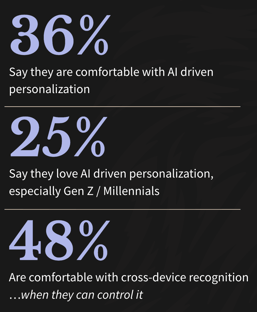
Wunderkind’s newly released 2026 Consumer Insights Report reveals something both simple and challenging. Consumers don’t want more marketing. They want better marketing. Across generations, the strongest signal is clear: fewer messages, more relevance.
This isn’t a rejection of personalization. In fact, it’s the opposite. Most consumers are comfortable with AI-driven experiences — many even welcome it — provided they maintain control over frequency, timing, and topics. Only a small minority are outright resistant.
What customers reject isn’t intelligence. It’s irrelevance. It’s excess. It’s the feeling of being chased instead of understood.
They’re telling brands, in effect: remember me, respect my time, and show up when it matters.
That’s a higher standard than “use AI.” It’s a mandate to use AI responsibly — and that requires something most stacks still lack.
Visibility.
The Illusion of AI Maturity
Marketing organizations are not standing still. More than 90% have integrated AI into strategy and operations. Budgets continue to expand. New copilots, predictive engines, autonomous journey builders — the tools are everywhere.
And yet, many teams are overwhelmed. Gartner has found that companies use only about a third of the capabilities within the technology they already own — a sharp drop from just a few years ago.
The industry is caught in a paradox. On one side, an AI arms race. On the other, bloated and fragmented stacks where capabilities outpace clarity.
But the deeper issue isn’t tool adoption. It’s audience visibility.
Across retail and DTC, 80–85% of site visitors are effectively anonymous. During peak periods, that number can rise to 90–95%. Only 2–3% convert on a first visit.
That means the vast majority of traffic brands pay to acquire — through search, social, affiliates, CTV, influencers — enters their ecosystem unseen.
AI is optimizing for the minority: logged-in users, loyalty members, existing CRM profiles.
The majority browse, consider, and leave.
Inside the stack, it’s as if they never existed.
Richard put it simply: AI is the brain of modern marketing. Identity is the eyes. A brilliant brain with poor eyesight still makes bad decisions.
The Revenue Hiding in Plain Sight
This isn’t just a data problem. It’s a revenue problem.
When brands close the identity gap — in a privacy-safe, first-party way — the impact is measurable. Identity-powered one-to-one email and SMS programs frequently drive between 6% and 15% of total digital revenue. In many cases, they rank among the top one to three revenue channels, outperforming even Google and Meta in scale and ROAS.
Consider ICONIC London. Despite massive influencer and social traffic, the brand struggled to convert anonymous visitors. By recognizing more of that traffic and activating behavioral triggers, ICONIC London achieved a fourfold increase in marketable opt-ins. Email submit rates rose from 2.4% to 9.9%, and revenue targets were exceeded by 152% in the U.S. and 105% in the U.K.
No replatforming. No wholesale rip-and-replace.
Just more visibility into the traffic they were already paying for — and smarter activation through the systems they already trusted.
That’s the multiplier effect identity creates. It doesn’t compete with the stack. It makes the stack work harder.
Identity as Strategic Infrastructure
The temptation in 2026 will be to keep chasing incremental AI gains — a more refined model here, a more autonomous workflow there.
But the brands that outperform over the next three years won’t necessarily be the ones with the flashiest AI. They’ll be the ones feeding their AI the most complete, permissioned, first-party view of their customers.
That means auditing how much of site traffic is actually recognized in the ESP or CDP. It means prioritizing high-intent journeys — cart abandonment, browse, price-drop alerts, replenishment — where consumers actively want assistance. And it means treating identity not as a feature, but as foundational infrastructure.
Because resilience in volatile markets doesn’t start with acquiring more traffic. It starts with monetizing the traffic you already have.
The five-, six-, and seven-figure gains many brands are chasing aren’t hidden in new channels. They’re already on your site.
The only question is whether your systems can see them.
Watch the Full Keynote
Richard’s full eTail West keynote is less than 15 minutes long — and it’s packed with data, sharp perspective, and practical guidance for leaders navigating AI saturation and performance pressure.
If you’re investing heavily in AI…
If your team is being asked to do more with less…
If resilience and profitable growth are top priorities for 2026…
Take 15 minutes and watch the full session.
Because before you buy another tool, it may be time to ask a simpler question:
What percentage of your revenue is hiding in the traffic you can’t see?
Watch the full keynote below.