




Turning Identity and Autonomous Marketing into Revenue
A New Kind of Acquisition Problem
For years, the dominant philosophy in marketing was straightforward: growth comes from doing more. More campaigns. More journeys. More segmentation.
As marketing technology expanded, companies invested in tools for email marketing, SMS messaging, onsite personalization, analytics, advertising platforms, and marketing automation. The expectation was that a larger stack would unlock better performance. Instead, many teams found themselves managing increasingly complex systems.

Customer journeys multiplied. Segments became more granular. Campaign calendars grew crowded. Yet despite this growing sophistication, performance often plateaued. The problem wasn’t effort. It was the structure of the systems themselves. Most marketing platforms were designed for a simpler digital environment—one where a cookie could follow a visitor across sessions and a predefined journey could guide someone from first visit to purchase.
Today’s customers behave very differently. They browse on their phones during a commute. They research products later on a laptop. They compare options across multiple tabs and often return days later from an entirely different device. A single purchase decision may involve dozens of touchpoints, many of which occur anonymously. Traditional marketing systems struggle in this environment because they rely on static rules and linear funnels. They expect predictable behavior from customers who increasingly behave unpredictably. Modern acquisition requires something more adaptive: systems capable of interpreting signals in real time and responding dynamically.
Acquisition in an Autonomous Marketing World
In many organizations, acquisition is still treated primarily as a list-building exercise. Success is measured by the number of email addresses or phone numbers collected. But modern acquisition has evolved into something far more strategic. At its core, acquisition today is about establishing consented, high-intent relationships that power an intelligent marketing ecosystem. Three capabilities make this possible.
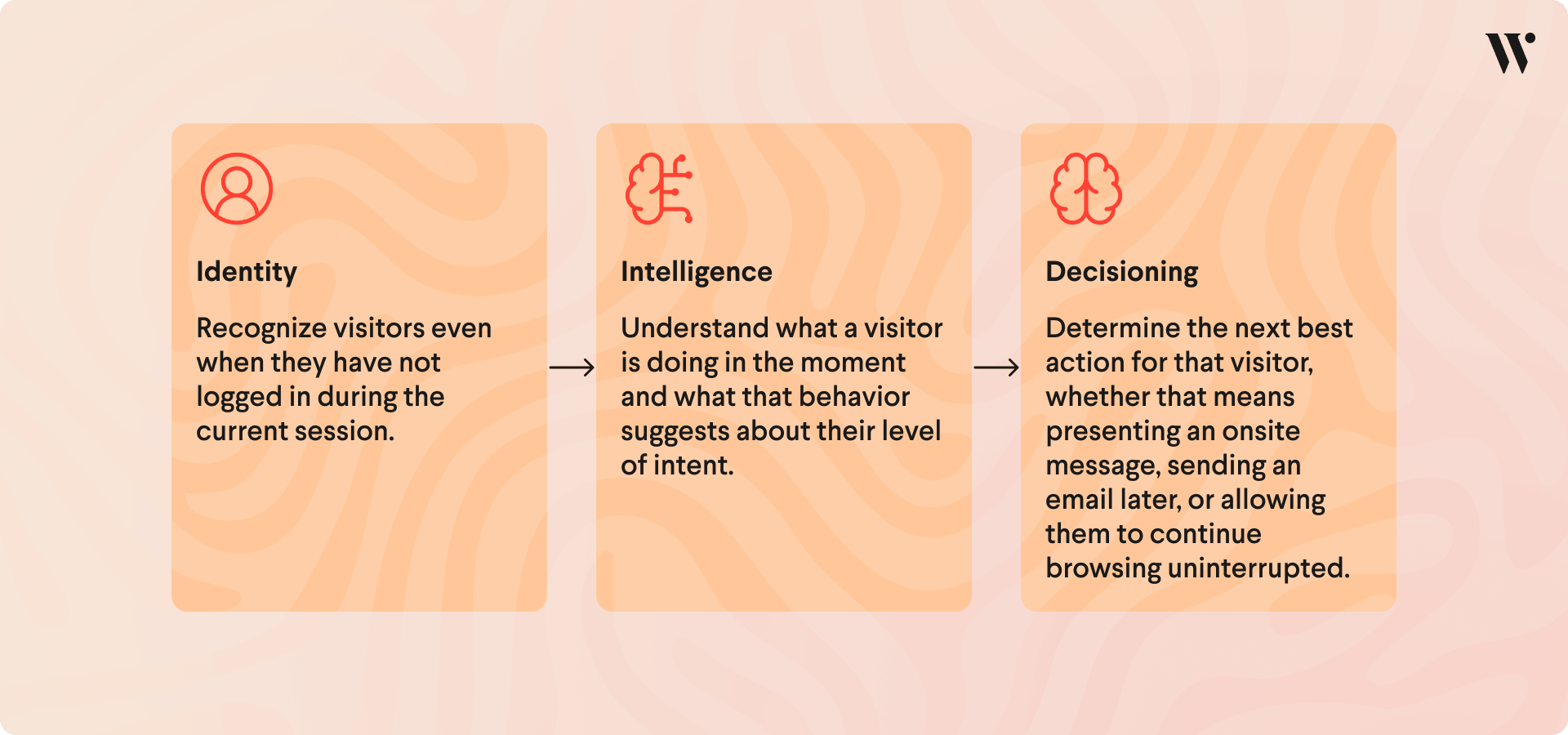
The first is identity—the ability to recognize visitors even when they have not logged in during the current session.
The second is behavioral intelligence—the ability to understand what a visitor is doing in the moment and what that behavior suggests about their level of intent.
The third is decisioning—the ability to determine the best next action for that visitor, whether that means presenting an onsite message, sending an email later, or allowing them to continue browsing uninterrupted.
When these capabilities operate together, they form the foundation of an Autonomous Marketing Platform.
Rather than manually designing every possible customer journey, marketers define the strategic guardrails of the system. The platform evaluates signals continuously and determines which interaction will produce the best experience and the strongest business outcome. In this environment, acquisition becomes less about pushing visitors through a predetermined funnel and more about meeting them where they are in real time.
Identity: The Foundation of Modern Acquisition
Before deciding which incentive to test or which capture experience to deploy, marketing teams should begin with a simple question:
How many of your visitors can you actually recognize?
If your acquisition strategy relies solely on the data captured during a single session, you are seeing only a small portion of your true audience. Returning visitors often appear as new users. Activity across devices remains disconnected. High-value customers may browse anonymously until the moment they choose to purchase.
An effective identity layer changes this dynamic.
By connecting behavioral signals across sessions, devices, and touchpoints, identity resolution allows brands to recognize far more of their website visitors. A browsing session becomes part of a broader behavioral history that provides context about the customer.

Wunderkind’s Identity Graph was built to support this level of recognition. By analyzing behavioral signals across billions of devices and digital interactions, it enables brands to understand who is visiting their site and how those visitors have engaged previously.
This expanded visibility dramatically increases the opportunities for engagement. More visitors can be recognized. More behavior can be understood.
From Static Journeys to Agentic AI

Traditional marketing journeys rely on predefined rules. A visitor lands on a product page. If they meet certa
in conditions, a message appears. If they abandon their cart, a series of reminders follows. At first, these systems appear manageable. But as marketing programs grow, rule-based journeys tend to become increasingly complex. New campaigns are layered onto existing ones.
Conditions multiply. Over time, teams find themselves maintaining a maze of overlapping logic.
The problem is not that these journeys were poorly designed. The problem is that consumer behavior evolves faster than static rules can adapt. Agentic AI introduces a different model.nstead of executing fixed workflows, the system evaluates each interaction dynamically. It asks a set of questions continuously: Who is this visitor? What have they done before? What are they doing right now? Which response is most likely to create value? The answer may be an onsite experience, an email reminder, or no message at all.
In many cases, the most intelligent decision is restraint—allowing the visitor to continue browsing without interruption. This approach allows marketing systems to adapt as customer behavior changes. Rather than managing endless rule trees, marketers design the strategy and the guardrails while AI handles the moment-to-moment decisioning within that framework.
Designing Intelligent Acquisition Experiences
Once identity and decisioning are in place, acquisition strategies can focus on the experiences that convert attention into relationships. The most effective acquisition programs are built around context. Instead of presenting the same request to every visitor, they consider signals such as where the visitor is in their journey, what they have browsed, and how engaged they appear to be. Behavioral triggers play a central role in this process. A visitor who scrolls deeply through a product page, interacts with product details, or returns to the site multiple times may be demonstrating meaningful interest. These moments provide natural opportunities to invite a deeper connection.

Other signals reveal moments of hesitation or disengagement. When visitors begin navigating away from a page or switching browser tabs, a timely message can remind them of the value a brand offers. The goal is not to interrupt the browsing experience, but to participate in it—presenting opportunities for connection at moments when they feel helpful rather than intrusive.
Measuring What Truly Drives Growth
Acquisition strategies must ultimately be judged by their impact on business performance. For many years, marketing teams measured acquisition success through surface-level metrics such as form submissions or click-through rates. While useful, these indicators rarely tell the full story. More meaningful insights come from understanding how acquisition experiences influence revenue outcomes. Metrics such as incremental conversion lift, revenue per visitor, and average order value provide a clearer view of the true impact of marketing efforts.
Control groups are particularly valuable in this process. By comparing the behavior of visitors who saw a particular experience with those who did not, marketers can determine whether an acquisition strategy is generating genuine incremental value. Over time, these insights allow autonomous systems to refine their decisioning. Experiences that consistently produce positive outcomes are prioritized, while those that create friction are adjusted or removed. In this way, acquisition programs become self-improving systems rather than static campaign calendars.