





How modern marketing teams use identity, real-time signals, and AI decisioning to deliver more relevant experiences — and capture more revenue in Salesforce Marketing Cloud
Salesforce Marketing Cloud is one of the most powerful platforms available for orchestrating lifecycle marketing.
Salesforce Marketing Cloud is one of the most powerful platforms available for orchestrating lifecycle marketing. It enables marketing teams to design sophisticated journeys, automate messaging across channels, and deliver personalized communications at scale.
But the way customers behave online has changed dramatically. Today’s shoppers move between devices, browse anonymously, and expect brands to respond to their interests in real time. As a result, even well-built lifecycle programs can struggle to keep pace with how people actually interact with brands.
This guide explores how identity, behavioral signals, and autonomous marketing are helping Salesforce Marketing Cloud teams adapt to this new reality. By recognizing more visitors, understanding customer behavior more clearly, and responding to that behavior in the moment, marketing teams can transform their lifecycle programs into a more responsive and revenue-generating system.
Marketing Automation Was Built for a Different Online World
Marketing automation was designed for a simpler digital environment. In its early days, most campaigns followed a predictable structure: customers entered a predefined journey, messages were scheduled in advance, and campaigns ran according to a fixed sequence.
That approach worked well when digital behavior was relatively straightforward. But today’s customers move fluidly between devices, channels, and sessions. A shopper might discover a product on their phone during lunch, revisit the same site later on a laptop, and finally make a purchase days later from a tablet. Throughout this process, they may remain anonymous until the very moment they decide to buy.
For marketing teams using Salesforce Marketing Cloud, this shift creates a growing disconnect between how campaigns are designed and how customers actually behave. Traditional static journeys assume predictable patterns, but real customer behavior rarely follows a predetermined path.
Closing this gap requires a different approach to lifecycle marketing—one that helps marketing teams recognize more customers, respond to real behavior as it happens, and capture revenue opportunities that would otherwise go unnoticed.
Most website traffic remains anonymous during a browsing session.
Why Many Lifecycle Programs Plateau
Salesforce Marketing Cloud gives marketers powerful tools to orchestrate customer journeys, build audiences, and deliver targeted messaging. However, even well-executed programs can reach a performance plateau if the underlying customer data and signals driving those campaigns are incomplete.
Identification gaps
If a visitor cannot be connected to a customer profile, they never enter your campaigns. That means shoppers can browse products, compare options, or abandon a cart without triggering a single message. Over time, those missed moments translate into lost revenue opportunities from customers who were already showing intent.
This is why identification has become such an important part of modern lifecycle marketing. Wunderkind’s identity technology helps brands recognize more of their website visitors and connect them to permissioned customer profiles—turning anonymous traffic into addressable audiences for email and SMS programs.
Static campaign logic
Many lifecycle programs still rely on first, identifying the “who” and then fixed rules determine how and when messages are sent. Marketers often set predetermined send times, define rigid audience segments, and choose channels in advance based on assumptions about customer behavior. While this structure once worked well for traditional marketing automation, it doesn’t always reflect how people actually shop today. Customer behavior is fluid and unpredictable, and it rarely follows the same schedule that campaigns are built around.
Behavioral signals stay unused
Every interaction on your website provides valuable insight into customer intent. When shoppers browse product pages, explore categories, add items to their cart, or complete purchases, they generate signals that reveal what they are interested in and how close they may be to buying. Yet much of this behavioral information never reaches the campaigns designed to act on it, because it’s locked away and not in a format to act on. Without access to these signals, marketing programs miss opportunities to respond to real customer activity at the moment it matters most.
The Role of the Autonomous Marketing Platform
For many Salesforce Marketing Cloud teams, the challenge isn’t creating campaigns. It’s having the intelligence needed to power them.
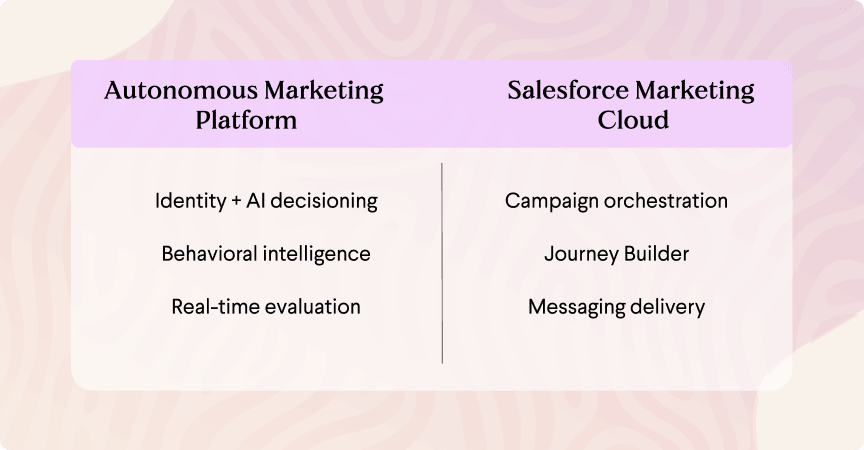
The Wunderkind Autonomous Marketing Platform (AMP) provides that intelligence layer. By combining identity resolution, behavioral signals, and AI decisioning, AMP helps marketing teams recognize more customers and respond to their behavior with timely, personalized experiences.
Those experiences help convert more shoppers, recover otherwise lost opportunities, and ultimately drive incremental revenue from the marketing programs you already run. AMP uses artificial intelligence and behavioral data to help marketing teams deliver personalized customer experiences while reducing the manual work required to build and optimize campaigns.
When used alongside Salesforce Marketing Cloud, AMP helps marketing teams:
• recognize more visitors across devices
• interpret customer behavior in real time
• determine the most relevant next interaction
Salesforce continues to serve as the messaging hub, while AMP provides the intelligence that helps campaigns respond to customer behavior.
Where Wunderkind Signals Fit
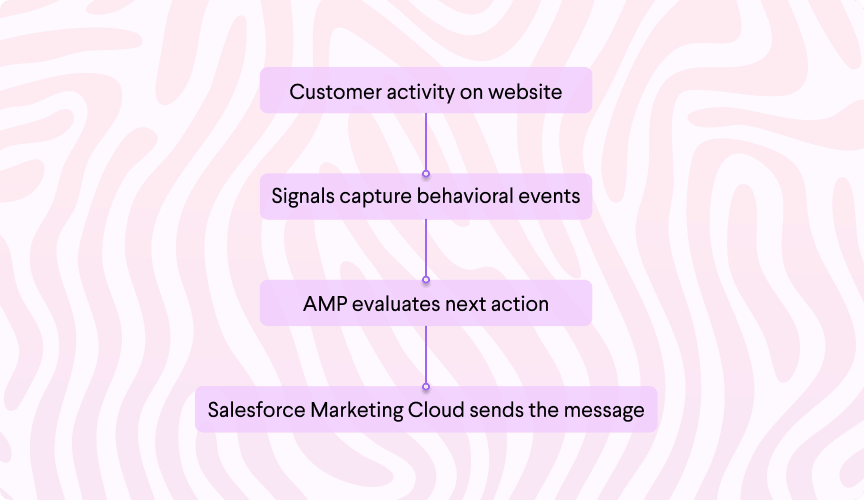
Within the Autonomous Marketing Platform, Signals serves as the real-time behavioral data layer. Signals captures meaningful moments of customer activity—such as product views, cart abandonment, and purchase events—and sends that intelligence into Salesforce Marketing Cloud.
Examples of signals include:
• product views
• cart abandonment
• inventory changes
• purchase activity
• browsing patterns
With richer behavioral data flowing into your campaigns, marketing teams can engage shoppers while intent is still high, helping turn more browsing sessions into completed purchases.
Rather than waiting for scheduled campaign triggers, marketing programs can respond to what customers are doing in the moment.
What This Makes Possible
When identity, behavioral signals, and autonomous decisioning work together, marketing teams can create experiences that feel far more responsive to customer behavior. Examples include:
Smarter abandonment recovery
Messages are triggered based on actual customer behavior rather than fixed schedules.
Inventory-driven engagement
Customers can be notified when products return to stock or when inventory is running low.
Post-purchase follow-ups
Recommendations can arrive shortly after a purchase, while customer interest remains high.
Catalog and product discovery
Messages can highlight relevant products based on browsing behavior.
These experiences move lifecycle marketing away from static campaigns and toward systems that respond dynamically to customer behavior.
Where Lifecycle Marketing Is Headed
Salesforce Marketing Cloud provides the orchestration layer for modern lifecycle marketing. Platforms like the Autonomous Marketing Platform add the intelligence that helps those campaigns respond to real customer behavior. Together, they help marketing teams recognize more customers, deliver more relevant experiences, and capture more revenue from the marketing programs they already run.
See How Autonomous Marketing Works with Salesforce Marketing Cloud
Learn how the Autonomous Marketing Platform and Signals help Salesforce Marketing Cloud teams create more responsive lifecycle marketing.

Knowledge is Power
Want to share this data with your team?
Our AI Assistant can help you apply these insights to your business.
Knowledge is Power
Want to share this data with your team?
Our AI Assistant can help you apply these insights to your business.