



Skip to content
2026-LP-BG-BFCM-1920x1080-01-1

The Battle for the BFCM Shopper

Exclusive original research into how price, promotions, channels and AI are reshaping the path from discovery to conversion

Executive Summary

BFCM Demand Is Strong, but Winning the Shopper Will Take More Than a Discount

Black Friday and Cyber Monday (BFCM) have evolved from a promotional weekend into a major cultural and commercial moment in the U.S. shopping calendar. Participation remains enormous: 202.9 million consumers shopped over Thanksgiving weekend in 2025, according to the National Retail Federation. Against that backdrop, Wunderkind’s research suggests consumers are entering BFCM 2026 ready to spend, but increasingly deliberate about where, when and why they buy.

Nearly half (46%) expect to spend more than last year, while 60% anticipate spending at least $250 and 35% $500 or more. Yet higher spending intent should not be mistaken for unconstrained confidence. Inflation and rising prices influence 41% of consumers, while expectations of better deals (29%) and the desire to save money (27%) reinforce how central value will be to purchase decisions.

Consumers are also becoming more active participants in the promotional ecosystem. Four in ten deliberately leave products in carts hoping to receive an offer, 36% exchange their email or phone number for discounts and 31% revisit products or sites hoping to trigger remarketing. Price-drop notifications are the single strongest trigger for bringing non-purchasers back (34%).

Meanwhile, competition for that demand is intensifying. Discovery stretches across retailer sites, social, search, advertising and emerging AI tools, while 48% expect marketplaces to account for most of their purchases versus just 14% for brand websites. More than half (51%) have already used AI to assist with shopping.

For retailers, BFCM 2026 is therefore not simply a race to offer the biggest discount. The opportunity is to recognize intent earlier, understand what individual shoppers value and use timely, relevant experiences to convert demand before it moves elsewhere.

TL;DR

10 Quick Insights from Our BFCM Consumer Data

1. BFCM Shoppers Are Planning to Spend More

Nearly half (46%) expect to spend more than last year, while 60% plan to spend at least $250 and 35% expect to spend $500+. Millennials show particularly strong upside, with 38% anticipating spending significantly more.

2. Spending Intent Is Colliding With Economic Pressure Inflation and rising prices influence 41% of shoppers, rising to 61% of Boomers. Yet 29% expect better deals this year and 27% are motivated by saving money, putting value at the center of BFCM decisions.
3. BFCM Baskets Extend Well Beyond Gifting

Gifts lead purchase intentions at 45%, but apparel and footwear (43%) and electronics (40%) follow closely. Category demand varies sharply by generation: beauty reaches 41% of Gen Z but just 5% of Boomers.

4. Discounts Convert, but They Aren’t Everything

Discounts are the strongest purchase driver, ranked first by 33% and in the top two by 47%. But two-thirds rank something else first, with limited-time offers, free shipping, loyalty rewards and reviews competing for influence.

5. BFCM Discovery Is Fragmented and Generational

Retailer websites and apps lead discovery at 42%, while social reaches 41% of Gen Z and 39% of Millennials. Boomers look very different: 49% discover deals through television or streaming ads, compared with 26% of Gen Z.

6. Price Drops Are More Powerful Than Retargeting

Price-drop notifications are the top return trigger at 34%, versus just 5% for retargeted ads. Email reminders and loyalty rewards each reach 23%, while text reaches 20%, highlighting the opportunity for timely, behavior-triggered messaging.

7. Shoppers Are Actively Trying to Trigger Better Offers Four in ten shoppers deliberately leave products in their carts hoping for a follow-up offer, while 36% subscribe to email or text for discounts and 31% repeatedly visit products or sites hoping to trigger remarketing.
8. Marketplaces Threaten to Capture BFCM Conversion

Nearly half (48%) expect to make most purchases through online marketplaces and 42% through major online retailers. Just 14% expect brand websites to account for most purchases, creating a significant challenge for direct conversion.

9. BFCM Creates an Opening for Customer Acquisition

While 34% plan to stick with brands they know and trust, 32% expect to shop equally between familiar and new brands and another 21% will try new brands because of promotions or discounts. BFCM loyalty is far from locked in

10. AI Is Becoming a BFCM Shopping Copilot

More than half (51%) have already used AI for shopping, with another 21% interested. Consumers are most comfortable using it to find deals (37%) and compare products (36%), while Gen X adoption for these tasks rises to 52% and 49%, respectively.

Methodology

In partnership with MX8 Labs, Wunderkind surveyed 300 U.S. consumers about their spending intentions and shopping behaviors for Black Friday and Cyber Monday 2026.

The research covers expected spend, purchase categories, economic influences, deal discovery, shopping tactics, preferred channels, brand and marketplace preferences, and AI-assisted shopping. It also examines which marketing channels, messages and incentives may encourage consumers to return and purchase.

Findings were analyzed by gender and generation—Gen Z, Millennials, Gen X and Boomers, to identify differences in intended BFCM behavior.

Data collection was completed in September 2026.

How Do You Expect Your BFCM Spending to Change From Last Year, and How Much Do You Plan to Spend?
BFCM Shoppers Are Ready to Spend Big

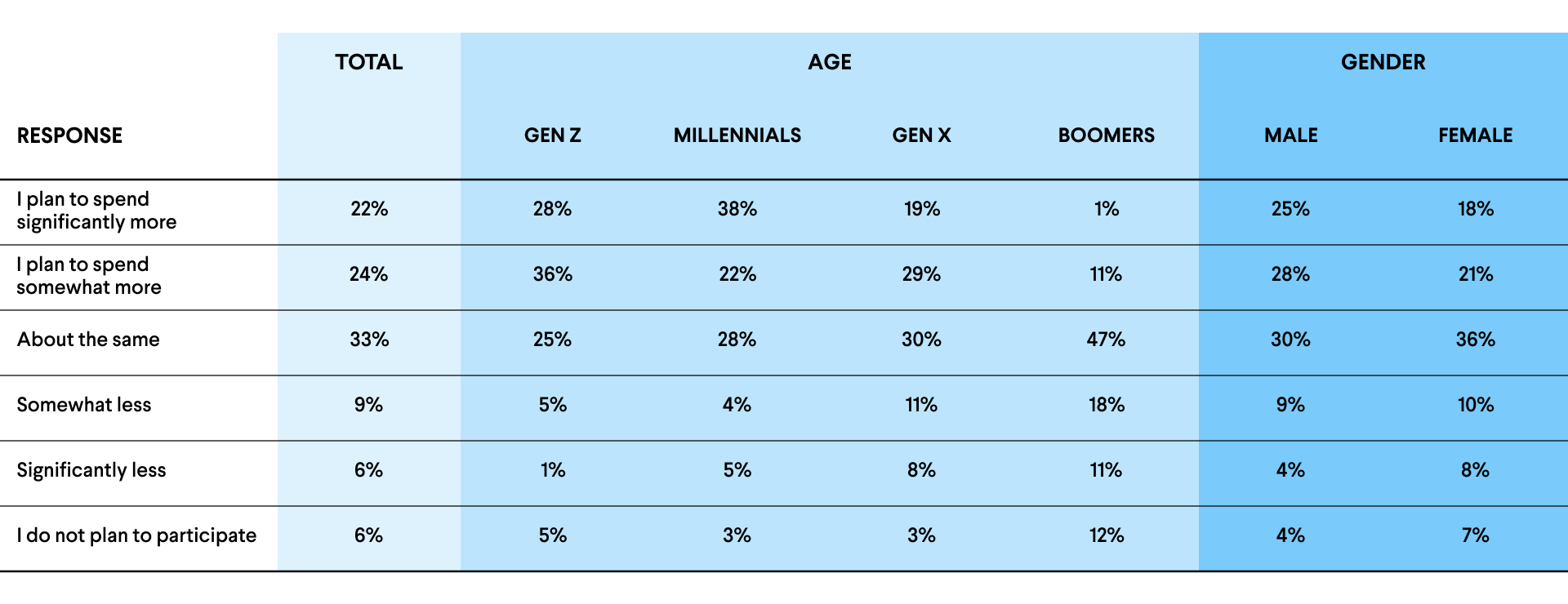
Consumers enter BFCM 2026 with strong spending intent. Nearly half (46%) expect to spend more than last year, including 22% who anticipate spending significantly more. By comparison, merely 15% plan to spend less, while one-third (33%) expect spending to remain about the same.

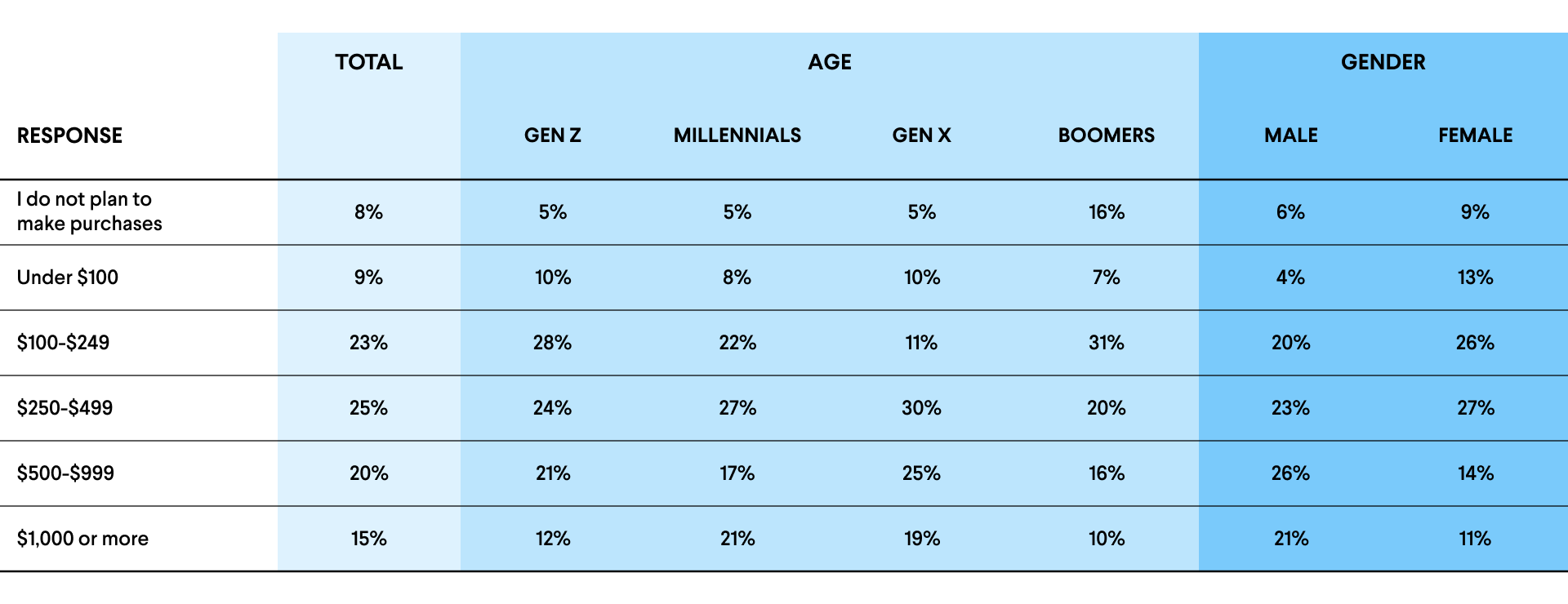
Planned budgets point to meaningful purchasing power: 60% expect to spend at least $250, including 35% who anticipate spending $500 or more, but that opportunity varies considerably by generation.

Millennials show the strongest high-end potential, with 38% planning to spend significantly more and 21% expecting to spend $1,000+. Gen X has the greatest concentration of $500+ shoppers at 44%. Gen Z signals broader spending growth, almost two-thirds (64%) expect to spend more than last year, but just (12%) plan to cross the $1,000 threshold. Boomers are notably more cautious: 29% expect to spend less or not participate, while only 26% anticipate spending $500+. BFCM growth potential therefore appears concentrated among younger and middle-aged shoppers rather than evenly distributed across generations.

Key Findings

SPENDING INTENT REMAINS STRONG

46%

plan to spend more than last year

15%

plan to spend less

MILLENNIALS SIGNAL THE BIGGEST UPSIDE

38%

plan to spend significantly more

21%

plan to spend $1,000+

BFCM BUDGETS ARE SUBSTANTIAL

60%

plan to spend $250+

35%

plan to spend $500+

GEN X EMERGES AS A HIGH-VALUE AUDIENCE

48%

plan to spend more than last year

44%

plan to spend $500+
What It Means for Marketers

Turn Spending Intent Into Revenue

Strong spending intentions create opportunity, but retailers still need to earn their share of consumers’ planned BFCM budgets. The priority is identifying which shoppers are showing the strongest intent and responding before that demand shifts elsewhere.

Recognizing returning shoppers and understanding behaviors such as repeat product views, cart activity and price sensitivity can help retailers distinguish casual browsers from higher-intent prospects. Rather than defaulting to blanket BFCM promotions, brands can use these signals to trigger more relevant email and text experiences, personalize offers and prioritize high-value audiences, turning planned spending into a stronger opportunity for conversion and revenue.


How Do You Expect Your BFCM Spending to Change From Last Year, and How Much Do You Plan to Spend?

BFCM_Question_01-png

BFCM_Question_04


Which factors are influencing your BFCM spending plans this year?

Economic Pressure Is Making BFCM Value More Important

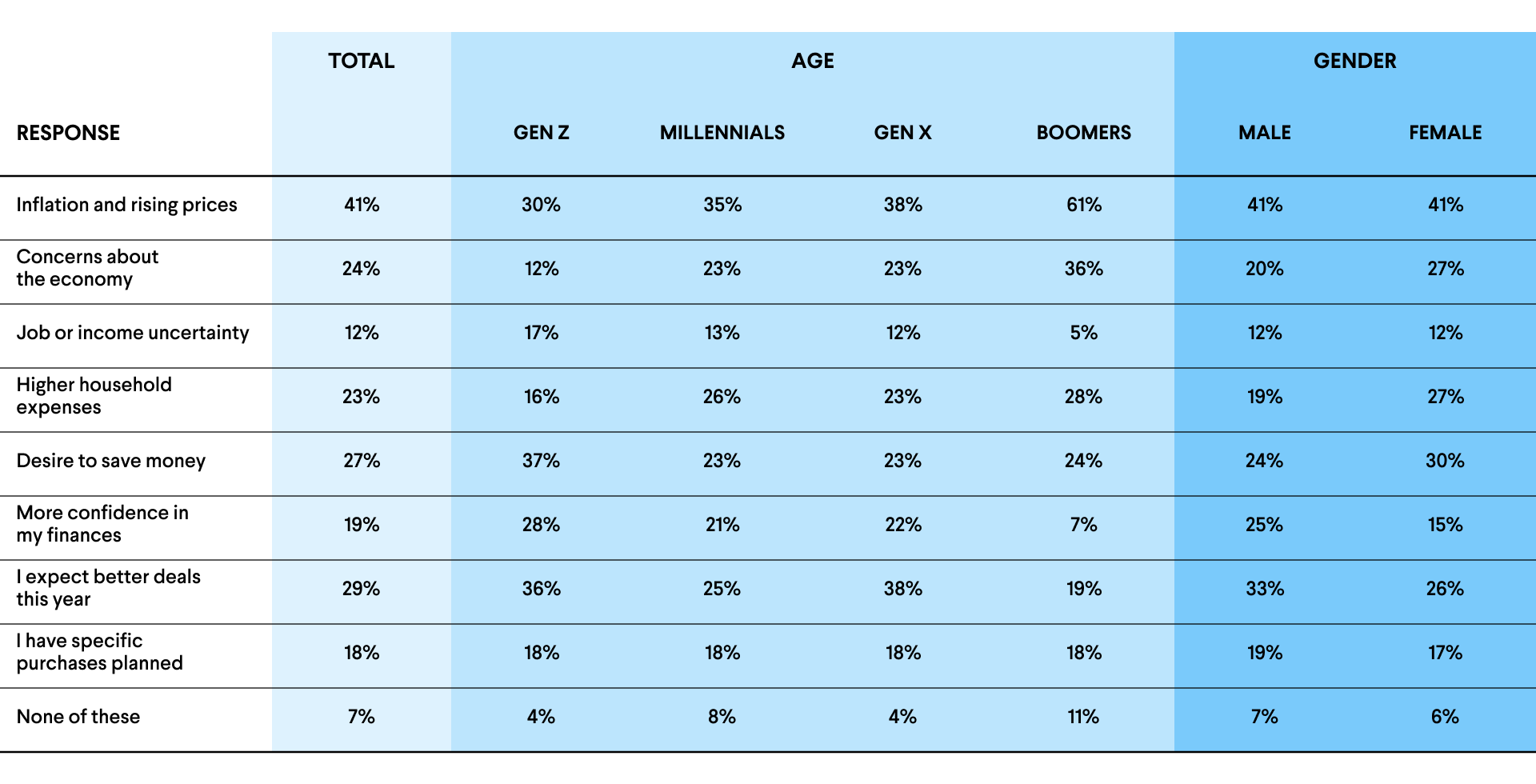
Consumers may be planning to spend this BFCM, but financial pressure and expectations of value are shaping decisions. Inflation and rising prices lead at 41%, ahead of expectations for better deals (29%) and the desire to save money (27%). Economic concerns (24%) and higher household expenses (23%) add further pressure.

Generational differences reveal contrasting mindsets. Boomers are the most economically cautious, with 61% citing inflation and 36% economic concerns. Gen Z is more savings- and deal-oriented: 37% want to save money and 36% expect better deals, while 28% cite greater financial confidence.

Gen X has the highest expectations for better deals (38%), while inflation leads among Millennials (35%). Specific planned purchases remain consistent at 18% across every generation, suggesting BFCM demand extends beyond predetermined shopping lists.

Key Findings

INFLATION LEADS SPENDING CONSIDERATIONS

41%

cite inflation and rising prices

61%

of Boomers cite inflation

GEN Z IS LOOKING TO SAVE

37%

cite a desire to save money

36%

expect better deals this year/div>

GEN X HAS THE HIGHEST DEAL EXPECTATIONS

38%

expect better deals this year

19%

vs. 19% of Boomers

FINANCIAL CONFIDENCE DIVIDES GENERATIONS

28%

of Gen Z cite greater financial confidence

7%

Just 7% of Boomers say the same
What It Means for Marketers

Make Value Relevant, Not Just Cheaper

BFCM shoppers are willing to spend but remain sensitive to price and value, making relevance as important as promotion. Deeper discounts should not be the default route to conversion.

Product views, repeat visits, cart activity and engagement with discounted items can reveal where intent and price sensitivity intersect. Retailers can use these behavioral signals to trigger relevant email and text experiences, including price-drop and product-specific messaging, helping capture demand while protecting margin where possible.


Which factors are influencing your BFCM spending plans this year?
BFCM_Question_02

Which categories are you most likely to purchase during Black Friday or Cyber Monday?

BFCM Category Demand Looks Different by Generation

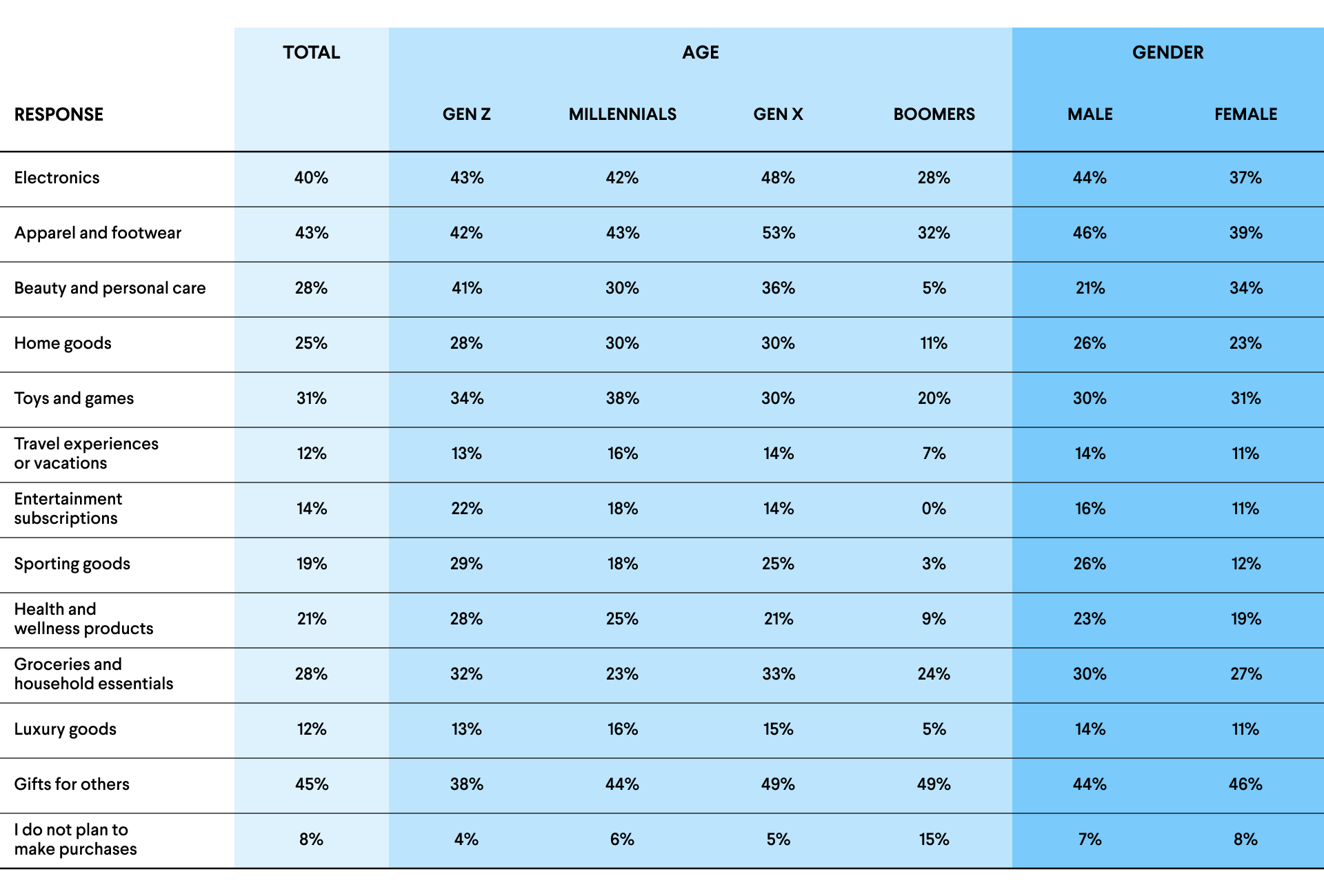
Gifting leads BFCM purchase intentions, with 45% planning to buy gifts, followed by apparel and footwear (43%) and electronics (40%). However, category demand varies considerably by generation. Gen X shows broad purchase intent, leading on apparel (53%) and electronics (48%), while 49% plan to buy gifts. Gen Z stands out for beauty and personal care (41%), compared with just 5% of Boomers, alongside stronger interest in sporting goods (29%) and health and wellness (28%).

Boomers are more concentrated around gifting (49%), with lower interest in electronics (28%) and apparel (32%). Millennials show a broader mix across gifts (44%), apparel (43%), electronics (42%) and toys and games (38%). BFCM baskets are therefore likely to span gifting and other purchases, with category opportunities differing markedly by generation.

Key Findings

GIFTING TOPS THE BFCM SHOPPING LIST

45%

plan to purchase gifts for others

43%

plan apparel and footwear

ELECTRONICS REMAINS A BFCM STAPLE

40%

overall plan to purchase electronics

48%

of Gen X

GEN X SHOWS BROAD CATEGORY DEMAND

53%

plan apparel and footwear

49%

plan gifts for others

BEAUTY SKEWS DRAMATICALLY YOUNGER

41%

of Gen Z plan beauty purchases

5%

of Boomers
What It Means for Marketers

Turn Category Interest Into Relevant Journeys

BFCM demand spans multiple categories, making one-size-fits-all promotions less effective. What shoppers browse, cart and revisit can reveal the products and categories they are actively considering.

By recognizing shoppers and connecting behavior across sessions, retailers can trigger more relevant email and text experiences based on demonstrated interest. These signals can also support cross-sell opportunities, helping brands convert immediate BFCM demand while building richer customer profiles to inform personalization beyond the peak shopping period.


Which categories are you most likely to purchase during Black Friday or Cyber Monday?
BFCM_Question_03

What is most likely to convince you to make a purchase during BFCM?

Discounts Dominate the BFCM Purchase Decision

When consumers rank the types of BFCM deals they find most appealing, discounts lead overall, with 27% ranking them first. Buy one, get one offers follow at 16%, while free shipping ranks third at 14%. Free gifts with purchase (12%) also outperform cashback and early access deals (9% each).

Looking beyond first choice reinforces the strength of straightforward value. 44% place discounts in their top two, while 33% put buy one, get one offers in their top two and 29% do the same for free shipping. Free gifts with purchase also perform relatively strongly, reaching 26% across the top two positions.

By contrast, loyalty member-exclusive deals are ranked first by only 6%, while bundles or packages reach 7%. The pattern suggests shoppers favor immediate, easily understood economic value during BFCM, but that value does not have to come exclusively from deeper percentage discounts.

Key Findings

DISCOUNTS DOMINATE CONVERSION

33%

rank discounts #1

47%

rank them in the top two

URGENCY IS THE NEXT STRONGEST LEVER

13%

rank limited-time offers #1

29%

rank them in the top two

FREE SHIPPING ADDS TO THE VALUE EQUATION

9%

rank free shipping #1

25%

rank it in the top two

OTHER CONVERSION DRIVERS FRAGMENT

8%

rank loyalty rewards #1

8%

rank positive reviews #1
What It Means for Marketers

Don’t Treat Every Shopper as Equally Price-Sensitive

Discounts have the greatest overall influence, but two-thirds of consumers rank something else as their top purchase driver. Retailers therefore need more than blanket markdowns to convert demand.

Identity and behavioral intelligence can help brands understand when individual shoppers are demonstrating intent and respond accordingly. Repeat product views, cart activity and engagement with offers can inform timely email and text journeys, allowing retailers to deploy discounts and urgency where they are most likely to influence action rather than automatically sacrificing margin across every BFCM interaction.

Which shopping tactics do you typically use to find the best deals?

BFCM Shoppers Are Actively Engineering Better Deals

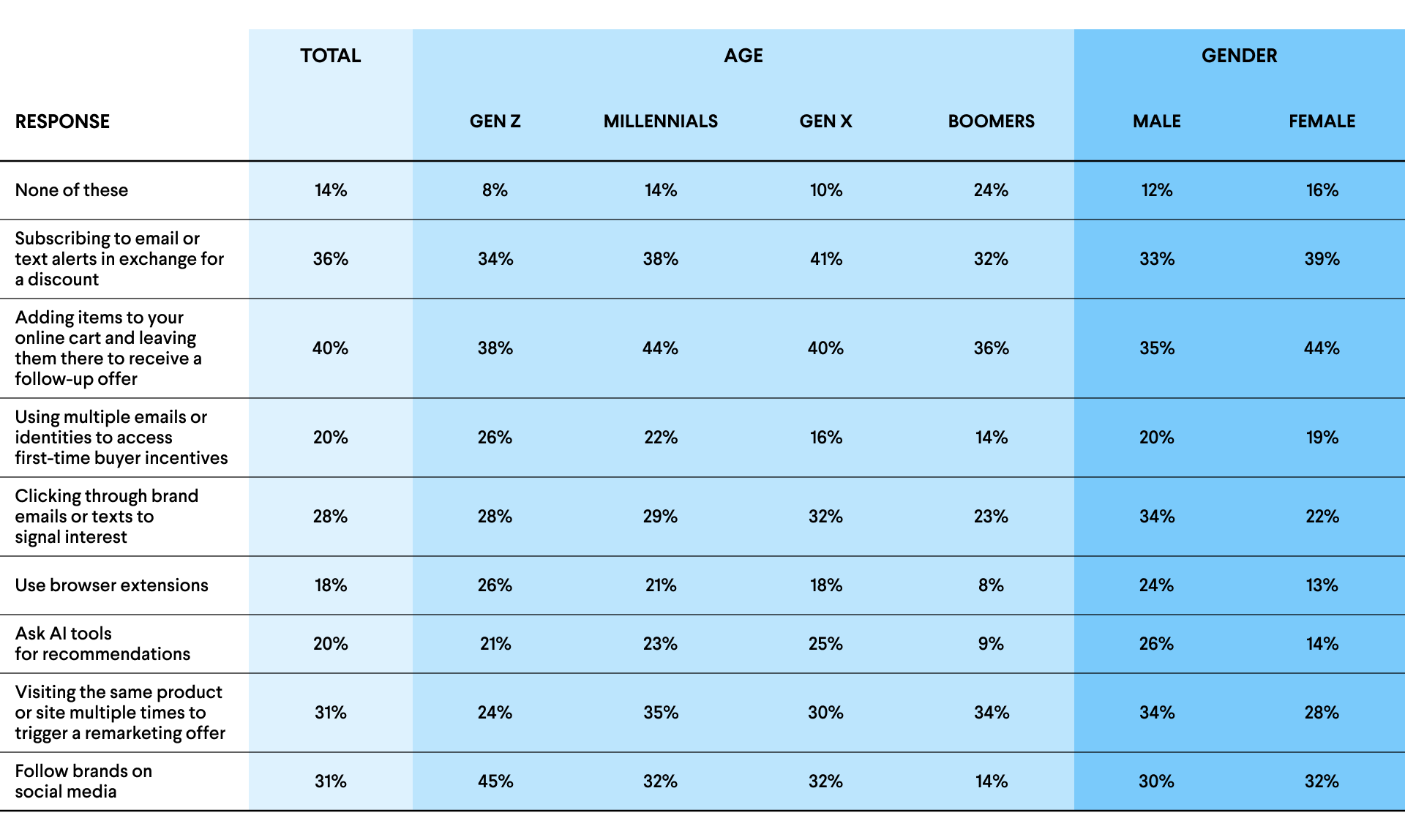
Consumers are not passively waiting for BFCM offers, they are savvily using their own behavior to try to unlock better value. The most common tactic is adding products to a cart and leaving them there in anticipation of a follow-up offer (40%), while 36% subscribe to email or text alerts in exchange for a discount. Nearly one-third (31%) repeatedly visit products or sites hoping to trigger a remarketing offer.

This behavior is particularly pronounced among Millennials: 44% deliberately abandon carts and 35% make repeat visits seeking an offer. Gen X leads subscription-for-discount behavior at 41%, while 32% click through brand emails or texts to signal interest. Gen Z takes a more socially oriented route, with 45% following brands on social media, but 38% also intentionally leave products in their carts.

Notably, one in five consumers use multiple emails or identities to access first-time buyer incentives, rising to 26% of Gen Z. The findings suggest consumers increasingly understand how digital marketing works, and are intentionally generating signals they expect brands to recognize and reward.

Key Findings

SHOPPERS EXPECT ABANDONMENT TO PAY

40%

leave carts hoping for a follow-up offer

44%

of Millennials do this

DISCOUNTS DRIVE IDENTITY CAPTURE

36%

subscribe to email or text for a discount

41%

of Gen X do this

REPEAT VISITS ARE INTENTIONAL

31%

revisit products or sites seeking an offer

35%

of Millennials do this

SHOPPERS USE MULTIPLE IDENTITIES

20%

use multiple emails or identities for incentives

26%

of Gen Z do this
What It Means for Marketers

Recognize the Intent Behind the Behavior

BFCM shoppers generate valuable intent signals through email capture, repeat product views, clicks and cart abandonment. The challenge is connecting those behaviors to the same shopper across sessions.

Wunderkind’s identity resolution and behavioral intelligence can help retailers build richer customer profiles and activate timely email and text journeys through existing platforms. Brands can respond to demonstrated intent with relevant products and offers, rather than automatically escalating discounts whenever shoppers abandon carts or return.


Which shopping tactics do you typically use to find the best deals?
BFCM_Question_10

What type of deals are most appealing to you?

The Best BFCM Deal Isn’t Always the Biggest Discount

When consumers rank the types of BFCM deals they find most appealing, discounts lead overall, with 27% ranking them first. Buy one, get one offers follow at 16%, while free shipping ranks third at 14%. Free gifts with purchase (12%) also outperform cashback and early access deals (9% each).

Looking beyond first choice reinforces the strength of straightforward value. 44% place discounts in their top two, while 33% put buy one, get one offers in their top two and 29% do the same for free shipping. Free gifts with purchase also perform relatively strongly, reaching 26% across the top two positions.

By contrast, loyalty member-exclusive deals are ranked first by only 6%, while bundles or packages reach 7%. The pattern suggests shoppers favor immediate, easily understood economic value during BFCM, but that value does not have to come exclusively from deeper percentage discounts.

Key Findings

DISCOUNTS ARE THE MOST APPEALING DEAL

27%

rank discounts #1

44%

rank them in the top two

TWO FOR ONE OFFERS PROVIDE AN ALTERNATIVE

16%

rank two for one #1

33%

rank it in the top two

FREE SHIPPING REMAINS VALUABLE

14%

rank free shipping #1

29%

rank it in the top two

FREE GIFTS CAN ADD PERCEIVED VALUE

12%

rank free gifts #1

26%

rank them in the top two
What It Means for Marketers

Personalize Value, Not Just Products

BFCM value does not have to mean applying the deepest discount to every shopper. Consumers respond to different deal mechanics, creating an opportunity to use behavioral intent to determine which incentive may be most relevant.

Recognizing shoppers and connecting product views, repeat visits and cart activity can help retailers trigger more targeted email and text experiences. Instead of relying solely on blanket markdowns, brands can tailor messaging around discounts, shipping or other value propositions, using relevance to support conversion while helping protect margin where possible.

How do you usually discover Black Friday or Cyber Monday deals?

BFCM Deal Discovery Is Fragmented, but Retailer-Owned Destinations Lead

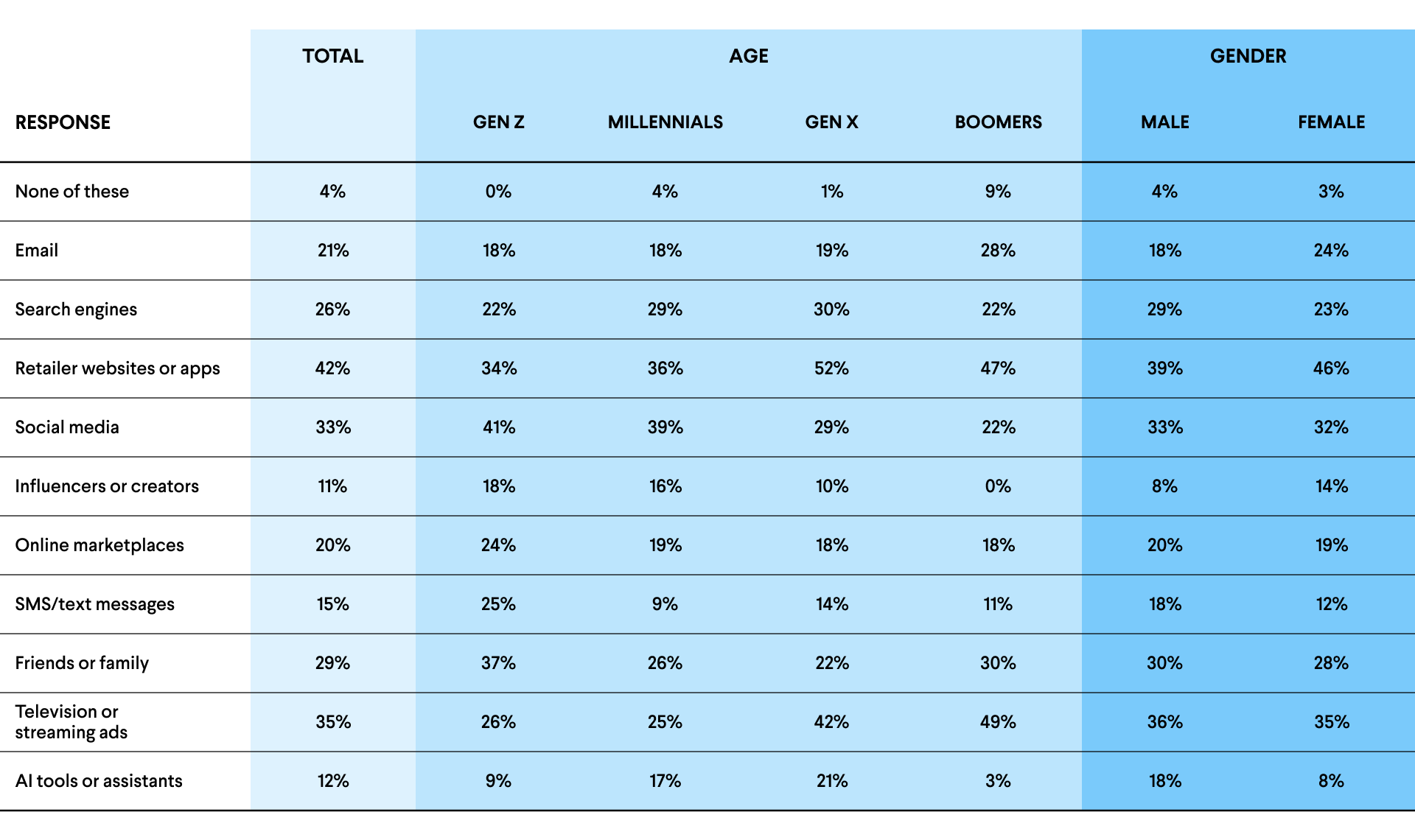
Consumers discover BFCM deals across multiple channels, with retailer websites and apps leading at 42%, followed by television or streaming ads (35%) and social media (33%). Friends and family (29%) and search engines (26%) further fragment the discovery journey.

Channel preferences vary sharply by generation. Gen Z is the most social-led, with 41% discovering deals through social media and 25% through SMS. Millennials also favor social (39%), while Gen X leads in retailer websites and apps (52%).

Boomers follow a different path, led by television and streaming ads (49%) and retailer websites or apps (47%). AI remains an emerging discovery channel at 12% overall, but rises to 21% among Gen X versus just 3% of Boomers, highlighting an increasingly multi-channel and generation-dependent discovery journey.

Key Findings

RETAILER-OWNED DESTINATIONS LEAD

42%

discover deals on retailer websites or apps

52%

of Gen X

SOCIAL DOMINATES WITH YOUNGER SHOPPERS

41%

of Gen Z discover deals on social

39%

of Millennials

TRADITIONAL MEDIA STILL REACHES OLDER SHOPPERS

49%

of Boomers discover via TV or streaming ads

26%

vs. 26% of Gen Z

AI IS ENTERING THE DISCOVERY MIX

12%

discover BFCM deals through AI

21%

of Gen X vs. 3% of Boomers
What It Means for Marketers

Connect Fragmented Discovery to Recognizable Intent

Retailers cannot control where BFCM discovery begins as shoppers move across social, search, advertising and AI. The opportunity is to connect what happens next.

Recognizing returning visitors and behaviors such as product views, repeat visits and cart activity can reveal intent beyond acquisition source. Retailers can use these signals to trigger relevant email and text experiences, building continuity across visits and turning fragmented discovery into identifiable demand that brands can nurture toward conversion.


How do you usually discover Black Friday or Cyber Monday deals?
BFCM_Question_07

Which channel is most likely to get your attention when brands promote Black Friday or Cyber Monday offers?
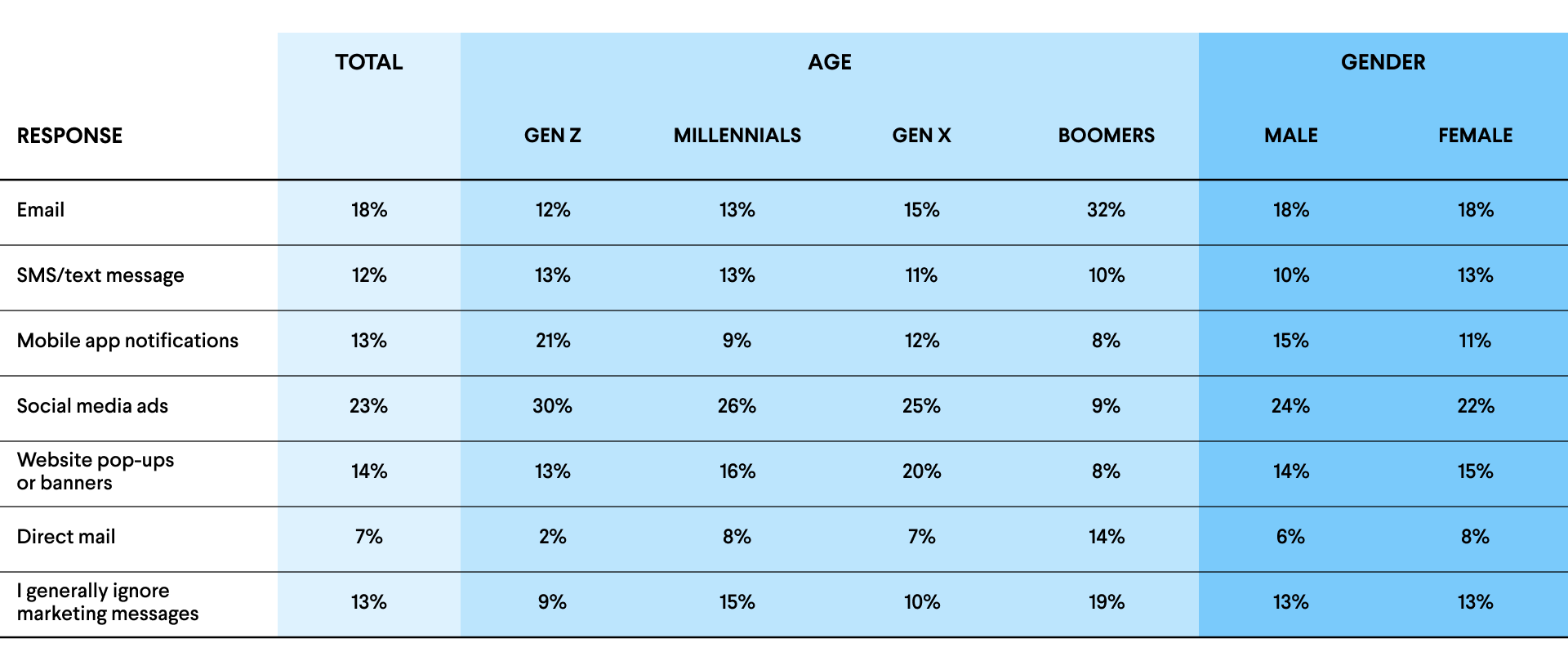
Social Edges Attention, but BFCM Messaging Is Generational

Getting noticed during BFCM depends heavily on reaching consumers through the right channel. Social media ads are most likely to capture attention overall (23%), followed by email (18%), while website pop-ups or banners (14%), mobile app notifications (13%) and SMS (12%) compete within a relatively fragmented messaging landscape.

Age creates much sharper distinctions. Gen Z is the most responsive to social media ads (30%), with mobile app notifications a notable second at 21%. Millennials and Gen X also favor social, at 26% and 25% respectively, although Gen X shows comparatively stronger receptiveness to website messaging (20%).

Boomers reverse the pattern. Email is their standout channel at 32%, more than three times social media ads (9%), while direct mail also performs relatively strongly at 14%. They are also the most likely to ignore marketing messages altogether (19%). The findings suggest that BFCM attention is not won through a universal channel strategy: different generations respond to distinctly different touchpoint

Key Findings

SOCIAL EDGES BFCM ATTENTION

23%

choose social media ads

30%

of Gen Z

EMAIL HAS AN OLDER STRONGHOLD

32%

of Boomers choose email

12%

vs. 12% of Gen Z

APP NOTIFICATIONS STAND OUT FOR GEN Z

21%

choose mobile app notifications

8%

vs. 8% of Boomers/div>

ONE IN EIGHT TUNE MARKETING OUT

13%

generally ignore marketing messages

19%

Rising to 19% of Boomers
What It Means for Marketers

Optimize for Relevance, Not Message Volume

During BFCM, winning attention is not about sending more messages or undercutting competitors at the expense of margin. Retailers need to understand how individual shoppers engage and use those signals to determine when and where to communicate.

Wunderkind’s identity and behavioral intelligence helps brands recognize shoppers and use real-time intent to trigger timely email and text through their existing stack, creating fewer, more relevant touches rather than adding to peak-season promotional noise.


Which channel is most likely to get your attention when brands promote Black Friday or Cyber Monday offers?

BFCM_Question_08

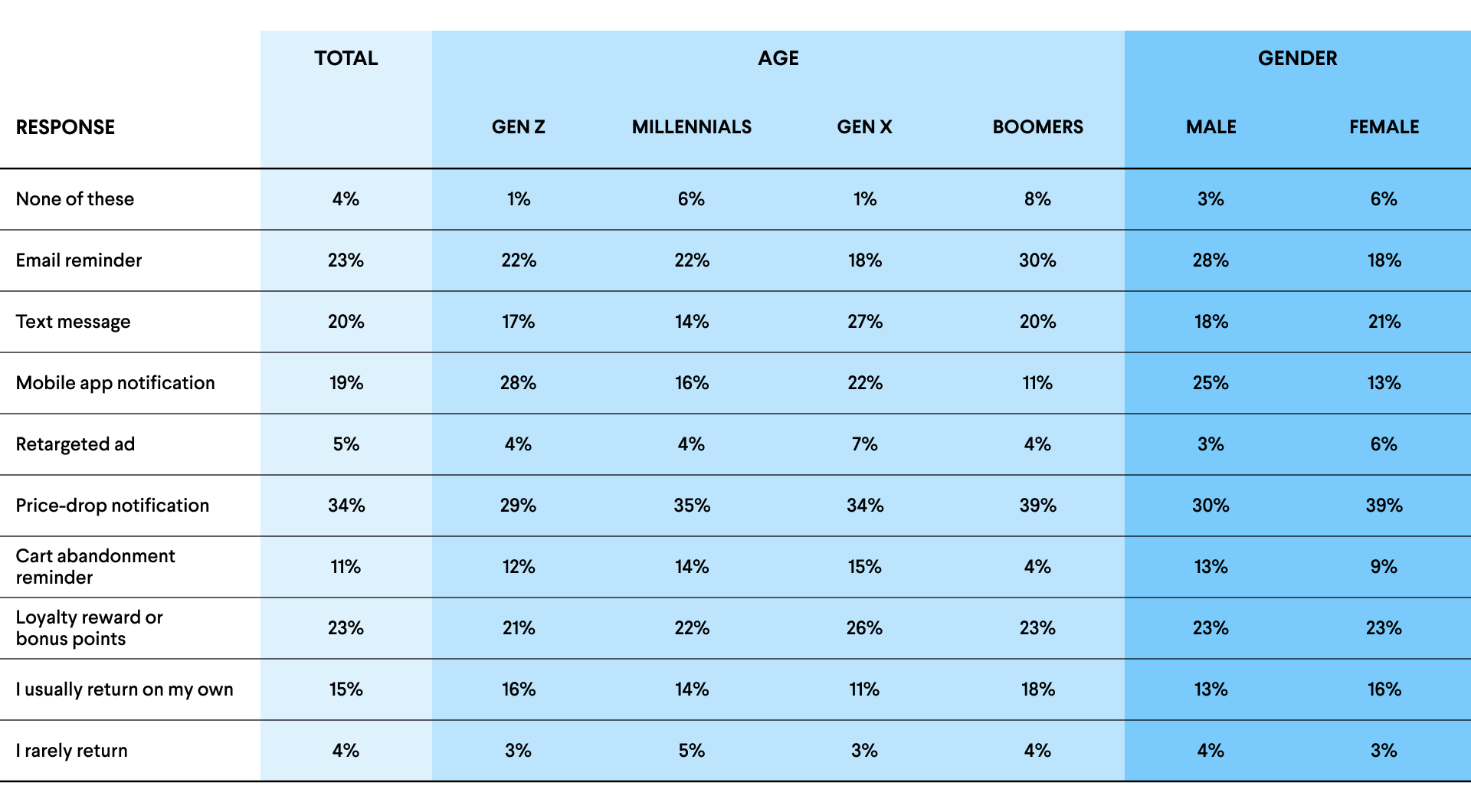
If you do not purchase immediately, which type of reminder is most likely to bring you back?

Price Drops, Email and Text Are the Strongest Trigger to Bring BFCM Shoppers Back

Getting attention is only part of the BFCM challenge. When shoppers leave without purchasing, price-drop notifications are the strongest return trigger (34%), ahead of email reminders and loyalty rewards (23% each), text messages (20%) and app notifications (19%). Retargeted ads trail at just 5%.

Price drops appeal across generations, from 29% of Gen Z to 39% of Boomers, but preferred channels differ. Boomers favor email reminders (30%), Gen X is most receptive to text (27%), while Gen Z favors app notifications (28%).

This highlights the value of behavior-triggered communication over generic promotion. Delivering a relevant price-drop notification requires knowing which shopper viewed which product and being able to reach them when its price changes, turning product-level intent and identity into a timely BFCM conversion opportunity.

Key Findings

PRICE DROPS ARE THE #1 RETURN TRIGGER

34%

choose a price-drop notification

5%

vs. just 5% for retargeted ads

EMAIL REMAINS A STRONG RETURN CHANNEL

23%

choose an email reminder

30%

of Boomers

TEXT STANDS OUT FOR GEN X

27%

choose a text reminder

14%

vs. 14% of Millennials

SPENDING INTENT REMAINS STRONG

34%

choose price-drop notifications

11%

choose cart reminders
What It Means for Marketers

Identity Turns Price Changes Into Conversion Moments

A price drop is only valuable as a trigger if retailers can connect it to the shoppers who previously demonstrated interest. That requires recognizing consumers across visits, understanding product-level behaviors and activating against those signals when something meaningful changes.

Wunderkind can help retailers connect identity with behaviors such as product views and cart activity, then power triggered email and text campaigns when relevant products drop in price. Rather than broadcasting a sitewide BFCM promotion, retailers can reach shoppers with a message tied directly to demonstrated intent, creating a more relevant reason to return while potentially reducing reliance on indiscriminate discounting and paid retargeting.


If you do not purchase immediately, which type of reminder is most likely to bring you back?
BFCM_Question_09

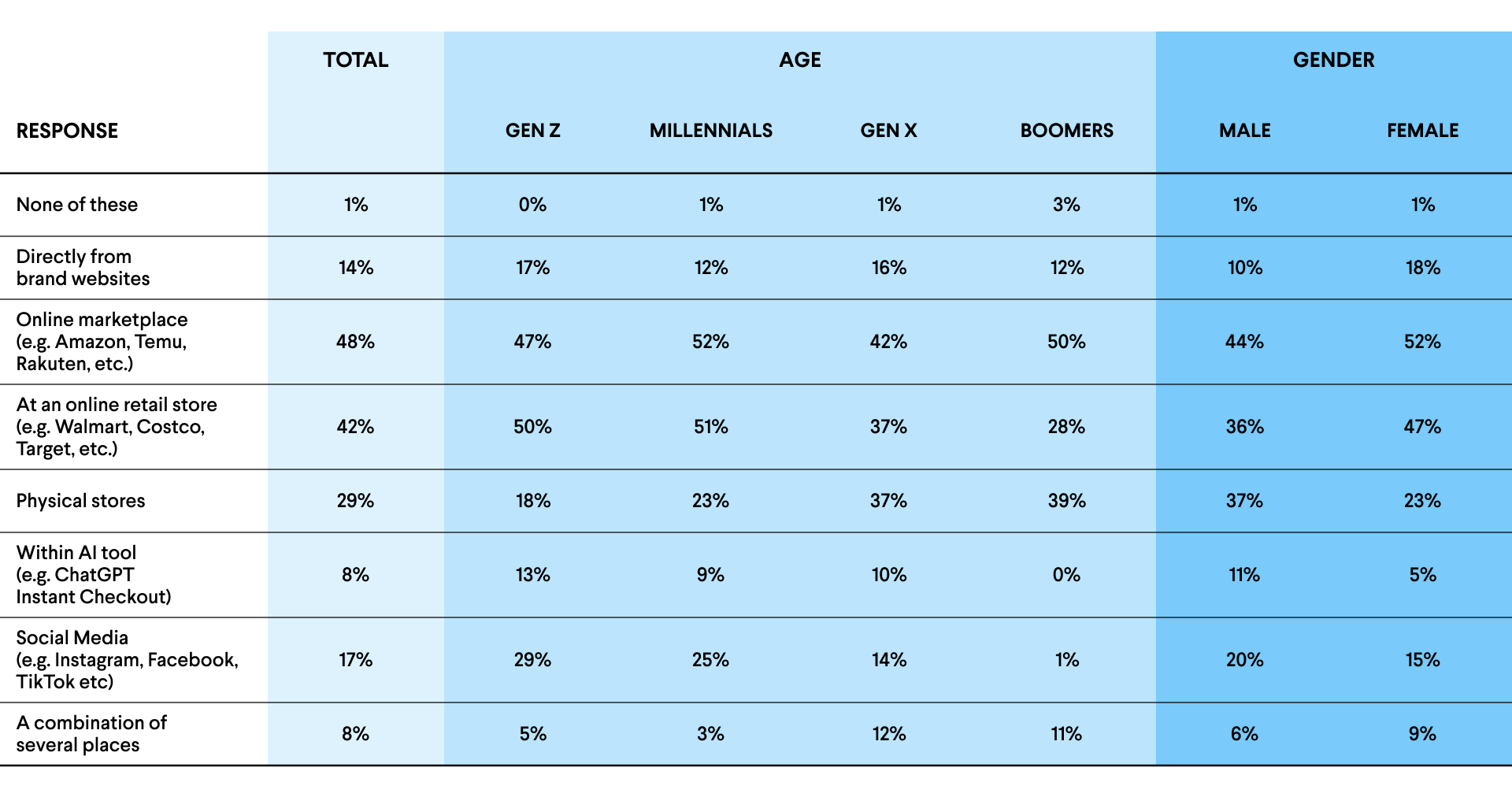
Where do you expect to make most of your purchases?

BFCM Conversion Is Concentrating on Marketplaces and Major Retailers

concentrated. Online marketplaces lead at 48%, followed by online retailers such as Walmart, Costco and Target (42%). Just 14% expect to make most purchases directly from brand websites, while 29% expect to shop in physical stores.

Channel preferences vary considerably by generation. Millennials are the most marketplace-oriented (52%), while 51% expect to purchase through online retailers. Gen Z similarly favors online retailers (50%) and marketplaces (47%), but stands out for social commerce at 29%.

Older shoppers retain a stronger offline preference: physical stores reach 37% of Gen X and 39% of Boomers, versus 18% of Gen Z. AI checkout remains nascent at 8% overall, rising to 13% among Gen Z. For brands, the challenge is clear: BFCM interest can easily convert elsewhere.

Key Findings

MARKETPLACES LEAD EXPECTED PURCHASES

48%

expect to buy through marketplaces

52%

of Millennials

ONLINE RETAILERS ARE CLOSE BEHIND

42%

expect to purchase through online retailers

50%

of Gen Z

DIRECT BRAND SITES FACE A CONVERSION GAP

14%

expect to make most purchases directly

48%

vs. 48% through marketplaces

PURCHASE CHANNELS SPLIT BY AGE

29%

of Gen Z expect social purchases

39%

of Boomers expect physical-store purchases
What It Means for Marketers

Protect the Path to Direct Conversion

With marketplaces and major retailers competing aggressively for BFCM purchases, brands cannot assume product interest will translate into a transaction on their own site. Every unidentified visitor who leaves represents potential demand that may convert elsewhere.

Recognizing shoppers and capturing behavioral intent gives brands more opportunity to continue that direct relationship after a visit. Product views, carts and repeat browsing can power timely email and text journeys designed to bring shoppers back to the brand site. For retailers, the opportunity is not simply generating more BFCM traffic, but making better use of the audiences they have already acquired, helping protect direct revenue and share of wallet from outside channels.


Where do you expect to make most of your purchases?
BFCM_Question_11

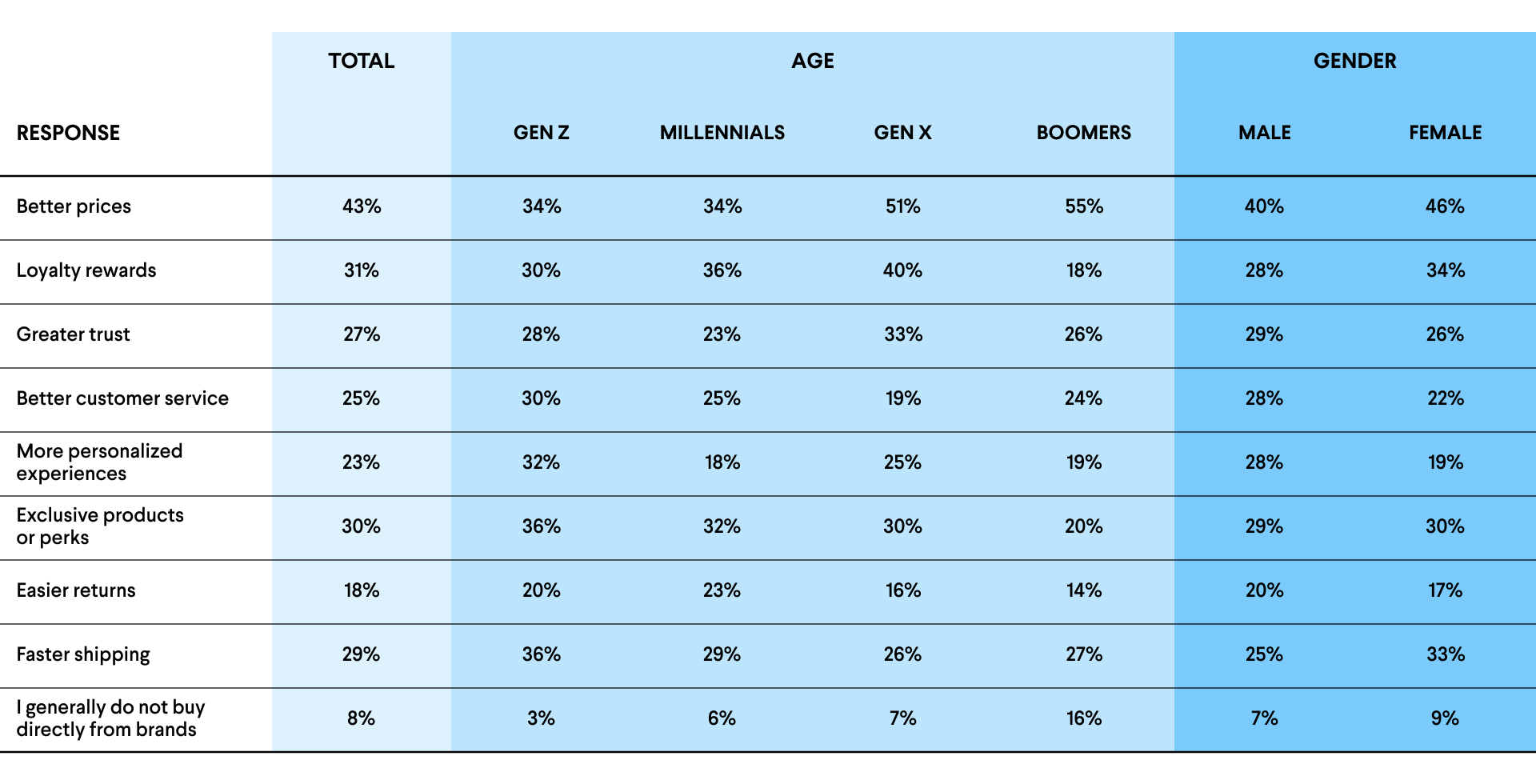
Why do you prefer buying from brands, marketplaces or online retailers directly?

Brands Win on Value and Experience; Marketplaces Win on Ease

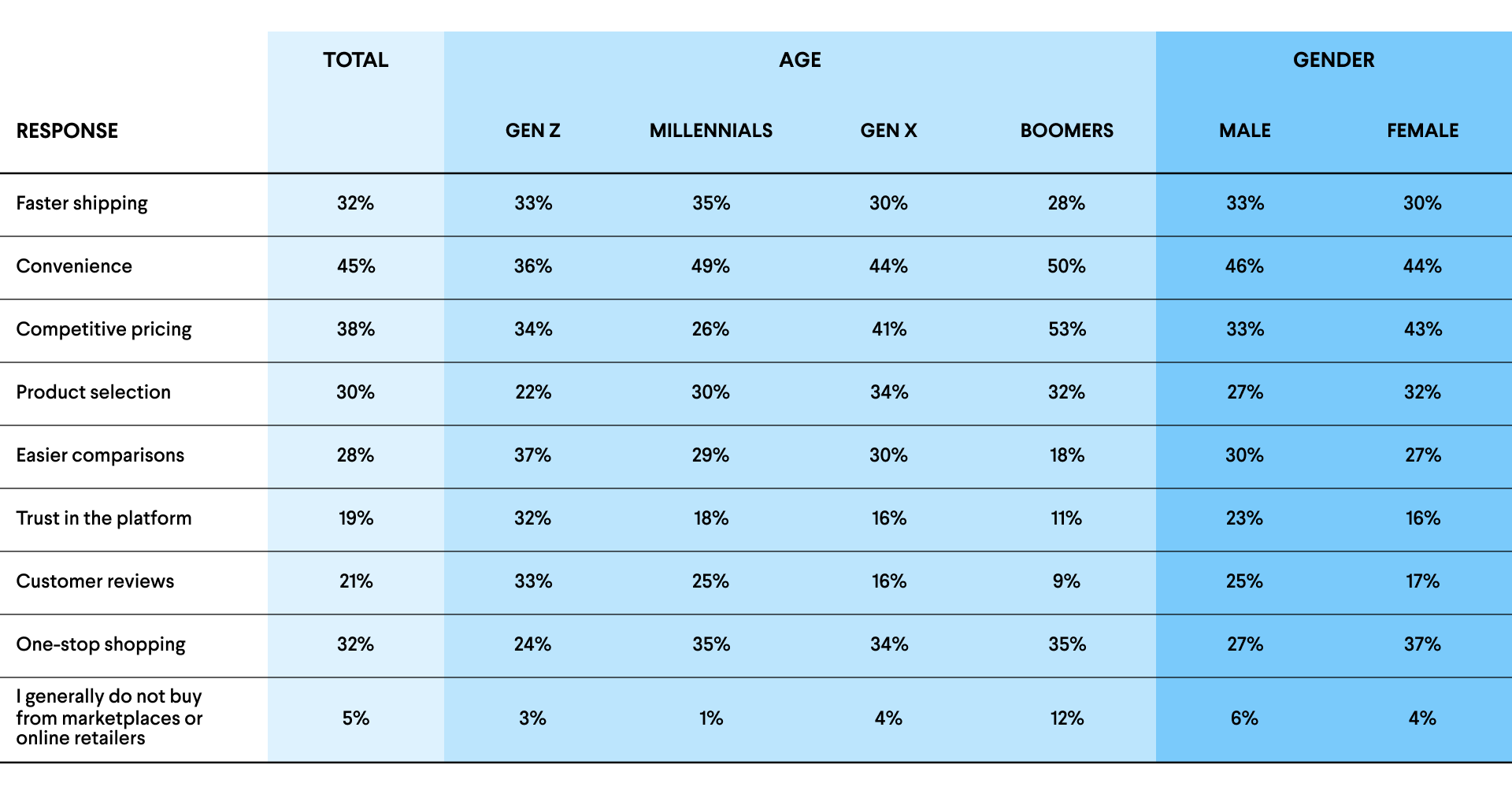
Consumers see distinct advantages in buying directly from brands versus marketplaces and online retailers. Better prices are the leading reason to buy direct (43%), but price is only part of the equation. Loyalty rewards (31%), exclusive products or perks (30%), faster shipping (29%) and trust (27%) all give brands additional ways to compete.

Marketplaces hold a different advantage: convenience leads at 45%, followed by competitive pricing (38%), faster shipping and one-stop shopping (32% each), and product selection (30%). Easier comparisons also matter to 28%, reinforcing marketplaces’ role in reducing friction when shoppers are evaluating multiple options.

Generational differences reveal where direct brands may have greater leverage. Gen Z is particularly receptive to exclusivity and faster shipping (36% each), while 32% value personalized experiences, compared with 23% overall. Millennials show stronger interest in loyalty rewards (36%). Older consumers place greater emphasis on price, with better direct-brand pricing reaching 51% of Gen X and 55% of Boomers. The challenge for brands is therefore not simply matching marketplaces on price, but creating enough differentiated value to make buying direct worthwhile.

Key Findings

DIRECT BRANDS HAVE AN OPPORTUNITY

43%

prefer direct brands for better prices

55%

of Boomers prefer brands

MARKETPLACES OWN CONVENIENCE

45%

cite convenience

38%

cite competitive pricing

GEN Z VALUES MORE THAN PRICE

36%

value exclusive products or perks

32%

value personalized experiences

LOYALTY CAN STRENGTHEN THE DIRECT RELATIONSHIP

31%

cite loyalty rewards

36%

of Millennials
What It Means for Marketers

Give Shoppers a Compelling Reason to Buy Direct

Brands may struggle to replicate the breadth and convenience of marketplaces, but the findings show they have other levers to protect the direct customer relationship. Price, loyalty, exclusivity and personalization can all contribute to a differentiated direct experience.

Recognizing shoppers and understanding their behavior can help brands determine which of those levers is most relevant. Instead of presenting every visitor with the same BFCM proposition, retailers can use identity, browsing behavior, purchase history and intent to personalize journeys and trigger relevant email and text experiences. This can help brands bring shoppers back to their owned properties, strengthen direct relationships and protect share of wallet from outside channels.


Why do you prefer buying from brands, marketplaces or online retailers directly?
BFCM_Question_12

BFCM_Question_13

During Black Friday and Cyber Monday, are you more likely to…

BFCM Opens the Door to New Customer Acquisition, but Familiarity Still Matters

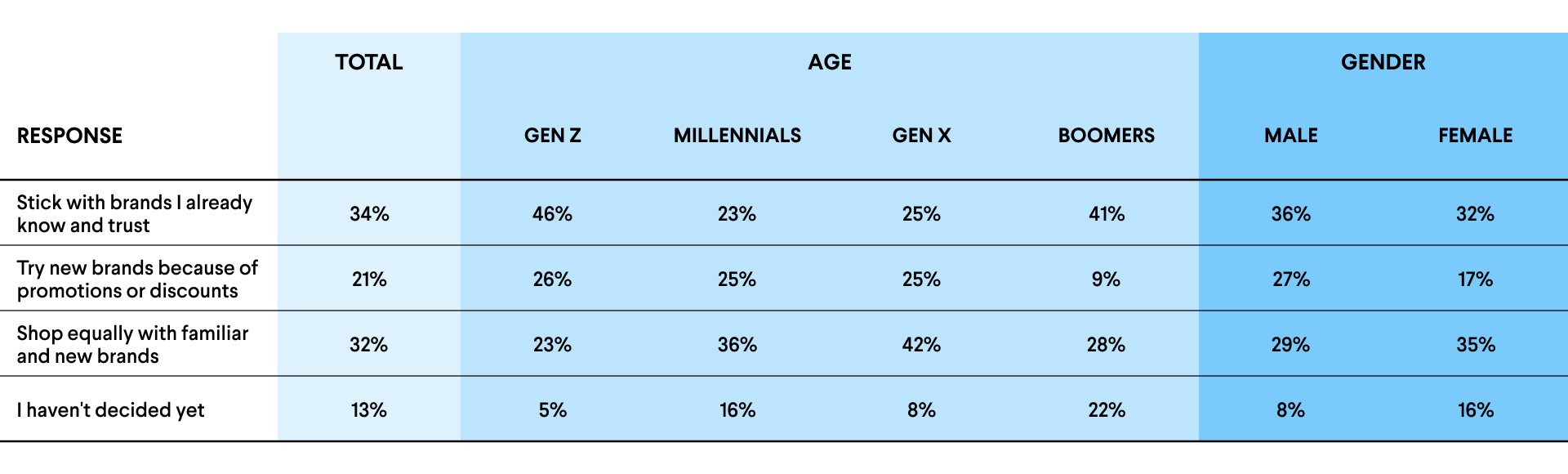
Brand familiarity remains powerful during BFCM, but it does not close consumers off to new options. While 34% plan to stick with brands they already know and trust, more than half are open to shopping beyond familiar brands: 32% expect to shop equally between familiar and new brands, while 21% say promotions or discounts will encourage them to try new ones.

The balance shifts considerably by generation. Gen Z is the most loyalty-oriented, with 46% planning to stick with brands they know, despite 26% being open to new brands because of promotions. Gen X is the most fluid: 42% expect to divide their shopping equally between familiar and new brands, while only 25% plan to remain exclusively with brands they know.

Millennials show similar openness, with 36% planning to shop across familiar and new brands. Boomers lean back toward familiarity (41%), but 22% remain undecided—the highest of any generation. BFCM therefore creates an acquisition opportunity, but retailers must compete against the advantage of established trust.

Key Findings

FAMILIAR BRANDS HAVE AN EDGE

34%

plan to stick with brands they know

21%

will try new brands for promotions

GEN Z LEANS INTO FAMILIARITY

46%

plan to stick with known brands

26%

are promotion-driven brand switchers

GEN X IS THE MOST OPEN TO BOTH

42%

will shop equally across familiar and new brands

25%

plan to stick with known brands

BOOMERS ARE THE MOST UNDECIDED

22%

have not decided where their loyalty will lie

9%

expect promotions to drive brand trial
What It Means for Marketers

Use BFCM to Acquire, and Build Recognition Beyond the First Purchase

BFCM gives retailers an opportunity to win customers from competitors, but discounts alone may not be enough to shift established preferences. Brands need to recognize when new visitors demonstrate meaningful intent and make the experience relevant enough to convert that interest.

Capturing and recognizing these shoppers can also make the first BFCM transaction more valuable over time. Behavioral signals can inform subsequent email and text journeys, helping brands nurture first-time buyers based on what they browse and engage with rather than immediately returning to generic promotions. The goal is to turn peak-season acquisition into an identifiable customer relationship that can support repeat purchase and lifetime value beyond BFCM.


During Black Friday and Cyber Monday, are you more likely to…
BFCM_Question_14

Have You Used AI for Shopping, and Which Tasks Are You Most Comfortable Using It For?

AI Is Fast Becoming a Shopping Copilot, but Consumers Still Want Control

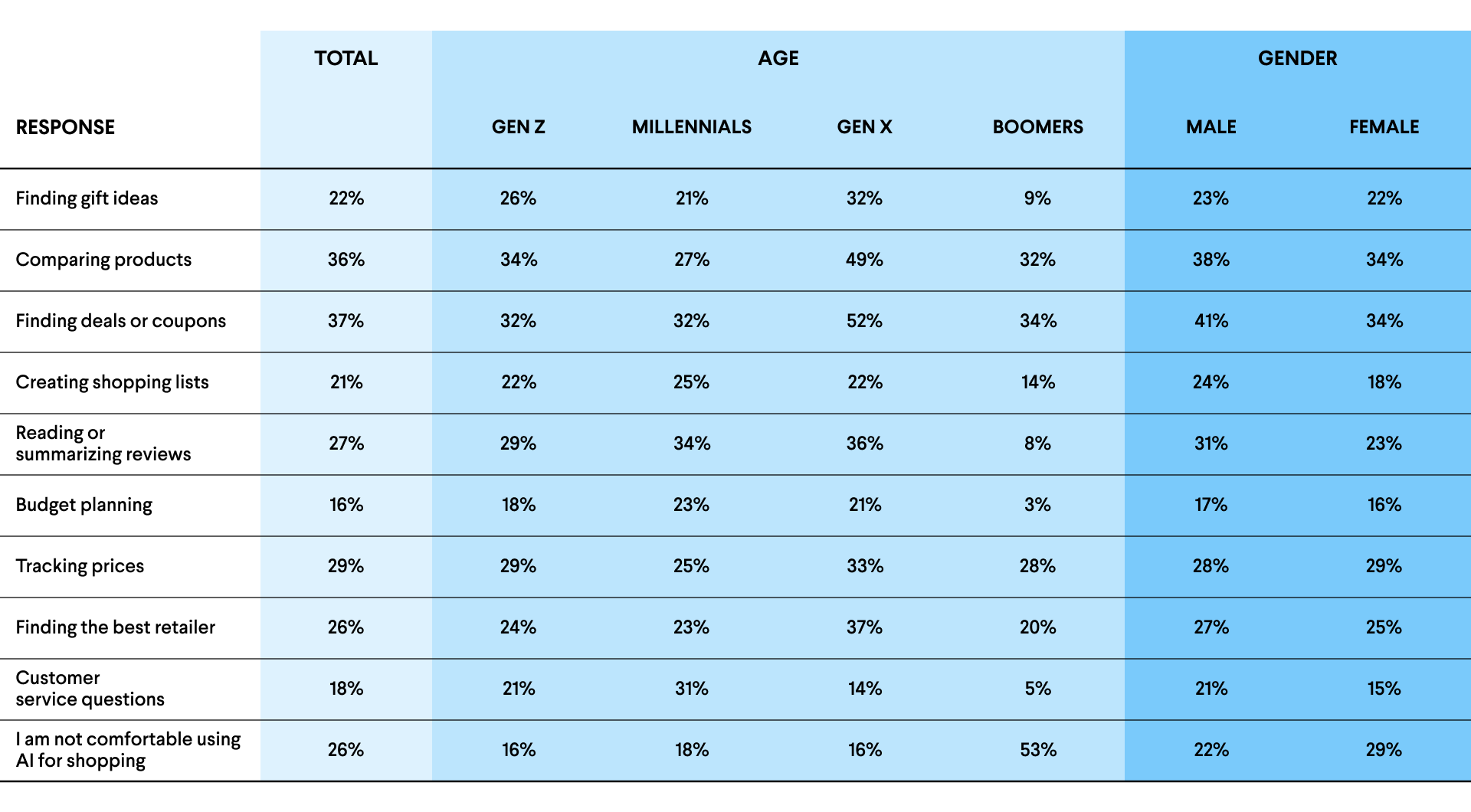
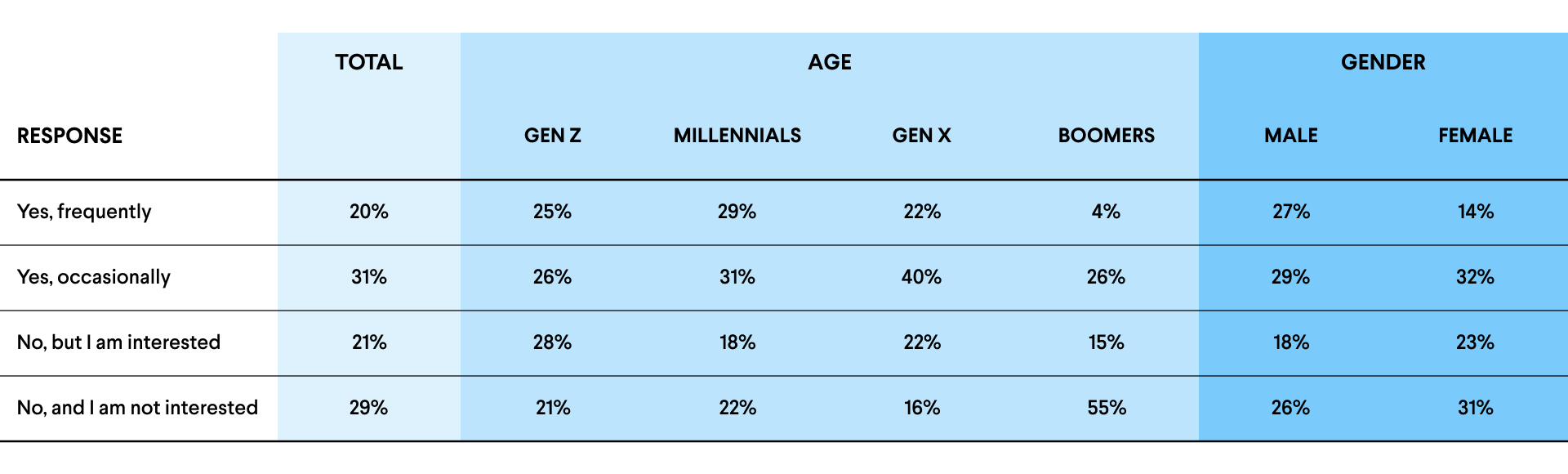
AI-assisted shopping is already established among many consumers: 51% have used AI tools to help them shop, including 20% who use them frequently, with a further 21% interested but not there yet. However, enthusiasm is far from universal: 29% are not interested, rising sharply to 55% of Boomers.

Consumers appear most comfortable using AI as a decision-support tool rather than a replacement for their own judgment. Finding deals or coupons (37%) and comparing products (36%) are the leading use cases, followed by tracking prices (29%), reading or summarizing reviews (27%) and finding the best retailer (26%). This points to AI playing a particularly relevant role during consideration, helping shoppers navigate choice and assess value.

Gen X stands out for this practical, value-oriented use: 52% are comfortable using AI to find deals, 49% to compare products and 37% to identify the best retailer. Millennials lead frequent AI shopping adoption at 29%, with review summaries (34%) and customer service (31%) among their stronger use cases. Boomers remain the clearest holdouts, with 53% uncomfortable using AI for shopping, highlighting a pronounced generational divide in adoption and acceptance.

Key Findings

AI HAS CROSSED INTO THE MAINSTREAM

51%

have used AI for shopping

20%

use it frequently

VALUE IS AI’S STRONGEST USE CASE

37%

are comfortable using AI to find deals

36%

use AI to compare products

GEN X EMBRACES AI FOR DECISION SUPPORT

52%

for finding deals

49%

for comparing products

BOOMERS REMAIN AI HOLDOUTS

59%

have not used AI and are not interested

53%

are uncomfortable using AI for shopping
What It Means for Marketers

Win the Shopper Before AI Makes the Shortlist

As AI becomes another layer between consumers and retailers, brands need to think beyond AI adoption itself. The data suggests shoppers are most receptive to AI when it helps them evaluate value, compare options and narrow choices, not simply replace their decision-making.

That raises the importance of recognizing intent when AI-influenced shoppers reach owned properties. Product comparisons, repeat visits, price sensitivity and browsing behavior can help brands understand what a shopper is considering and respond with relevant email and text experiences. The opportunity is to turn signals generated during an increasingly AI-assisted consideration journey into direct customer relationships and conversion opportunities.


Have You Used AI for Shopping, and Which Tasks Are You Most Comfortable Using It For?
BFCM_Question_15

BFCM_Question_16

Conclusion

Winning BFCM Means Turning Shopper Intent Into Action Before It Moves Elsewhere

The Battle for the BFM Consumer report reveals a shopping period defined by strong spending intent, heightened value consciousness and intense competition for every purchase. Consumers expect to spend, but they are also actively comparing prices, seeking deals and moving between retailers, marketplaces, social platforms and emerging AI tools before deciding where to buy.

Winning that demand will require more than blanket promotions. Discounts remain powerful, but shoppers also respond to urgency, shipping, loyalty benefits and other forms of value. More importantly, consumers are actively signaling what they want: revisiting products, abandoning carts in anticipation of offers, subscribing for discounts and engaging with brand communications.

That puts shopper recognition and behavioral intelligence at the center of the BFCM opportunity. Connecting identity with real-time behavior can help retailers understand who is demonstrating intent, what they are considering and when intervention may matter. A price drop, product-specific message or timely email or text can then respond to demonstrated interest rather than simply adding another promotion to an already crowded season.

The stakes extend beyond a single transaction. Marketplaces and major retailers are positioned to capture a significant share of planned purchases, but BFCM also creates opportunities for consumers to try unfamiliar brands. AI adds another influence layer as shoppers increasingly use it to compare products, prices and retailers.

The retailers that win BFCM 2026 will be those that recognize demand earlier, understand what each shopper values and act on intent with relevance and speed, turning peak-season traffic into purchases, new customers and relationships that continue beyond Cyber Monday.

Frame 1000001887