





Skip to content
2026-LP-BG-Cordial-Research-Report-1920x1080-02

The Customer Marketing Gap

Exclusive research into the divide between what consumers expect and what marketers prioritize

Executive Summary

Closing the Gap Between Consumer Expectations and Marketing Ambition

Customer marketing is operating under a new growth equation. Consumers are increasingly selective about the brands and messages that earn their attention, while marketers are being asked to acquire customers, strengthen retention and improve efficiency. The challenge is not simply to communicate more, but to make every customer interaction work harder.

The Customer Marketing Gap brings together the perspectives of consumers and senior marketers to reveal where expectations and priorities align, and where important disconnects remain.

The clearest gap is around value. Price is the leading consideration for consumers deciding where to buy online, yet marketers significantly underestimate its importance. The same pattern appears in brand communications, where consumers place much greater value on discounts and other tangible benefits than marketers expect. The opportunity is not blanket discounting, but understanding when value matters to an individual customer and responding accordingly.

A second gap surrounds personalization. Marketers place considerable emphasis on personalized recommendations and experiences, while consumers are more focused on outcomes that make shopping easier: saved carts, faster checkout, relevant offers and timely alerts. Personalization works best when customers experience the benefit rather than the technology behind it.

The research also reinforces the importance of direct customer relationships. Email remains consumers' preferred channel for brand communication, while SMS has considerably greater appeal than marketers recognize. Recognizing more customers, understanding their behavior and earning permission to communicate gives brands greater opportunity to turn existing demand into lasting relationships.

Finally, AI ambition is moving faster than consumer confidence. Marketers expect AI-powered personalization to play a major role in customer marketing, but relatively few consumers currently believe AI improves their shopping experience. Transparency, control and tangible customer value will be critical to closing that gap.

Across the research, the message is consistent: consumers want value, convenience, relevance and control; marketers want growth, personalization and efficiency. Closing the gap means translating marketing capability into customer benefit, using better identity, data and decisioning to deliver experiences people actually value.

TL;DR

10 Quick Insights from Our Consumer & Marketer Data

1. Marketers Are Missing the Value Signal

Price is the biggest purchase consideration for consumers (56%), but only 24% of marketers believe it matters most. The gap continues in messaging: 50% of consumers say discounts drive attention, versus 26% of marketers.

2. Personalization Works Best When Consumers Feel the Benefit Marketers place far more emphasis on relevant product recommendations than consumers (61% vs. 32%). Consumers instead prioritize practical experiences such as saved carts and faster checkout (48% each).
3. Don’t Let Customer Intent Disappear With the Session

Saved carts reveal one of the report’s largest experience gaps: 48% of consumers value them, but only 15% of marketers believe they have a major impact on conversion.

4. Email and SMS Still Win the Direct Relationship

Email (82%) and SMS (64%) are consumers’ preferred brand communication channels. Marketers underestimate both, particularly SMS at 47%, while overestimating social media (74% marketer vs. 39% consumer).

5. Identity Has to Be Earned With a Clear Value Exchange

Consumers and marketers agree on the strongest incentive for sharing an email address or mobile number: exclusive discounts (32%). Beyond discounts, preferences vary by generation, from loyalty rewards to convenience and personalization.

6. Behavioral Data Is Critical, but Often Fragmented

Purchase history and website browsing behavior are marketers’ most valued personalization data sources (51% each). Yet limited customer data and data fragmented across systems are also their biggest personalization barriers (19% each).

7. Consumers Want Messages That Do Something

Discounts (72%), price-drop alerts (58%) and order updates (47%) are consumers’ most valued brand messages. Younger consumers show greater interest in recommendations, back-in-stock alerts and new product launches.

8. Trust Is Built Through Control, Not Personalization Alone

Transparency about data use is consumers’ strongest driver of trust in personalized experiences (46%), while just 18% say genuinely relevant recommendations alone would increase trust.

9. AI Ambition Is Running Ahead of Consumer Confidence

While 59% of marketers expect AI-powered personalization to have a major impact over the next three years, only 16% of consumers say AI currently improves their shopping experience and 27% don’t trust it to personalize experiences.

10. Growth Depends on Connecting the Customer Journey

Acquisition leads marketers’ priorities (51%), alongside retention (39%) and efficiency (30%). Marketers also point to more accurate customer data (42%), improved personalization (37%) and identity resolution (27%) as ways to improve performance.

Methodology

In partnership with MX8 Labs and Dynata, Wunderkind and Cordial surveyed 1,000 U.S. consumers and 150 U.S.-based senior marketing professionals to understand where consumer expectations and marketer priorities align, and where meaningful gaps remain.

The research explored shopping behavior, digital experiences, communication preferences, personalization, trust and AI, alongside marketers’ priorities, challenges and approaches to customer growth. Consumer findings were analyzed across Boomers, Gen X, Millennials and Gen Z, with marketer findings examined by seniority and job function.

Data collection was completed in August 2026.

Consumers vs. Marketers

Where Expectations and Priorities Meet

Insights from 1,000 consumers and 150 marketers reveal where consumer expectations align with marketer priorities, and where the gaps are greatest.
Consumer vs. Marketer - What Matters Most to Consumers When Deciding Where to Buy Online?

Price Is the Biggest Blind Spot for Marketers

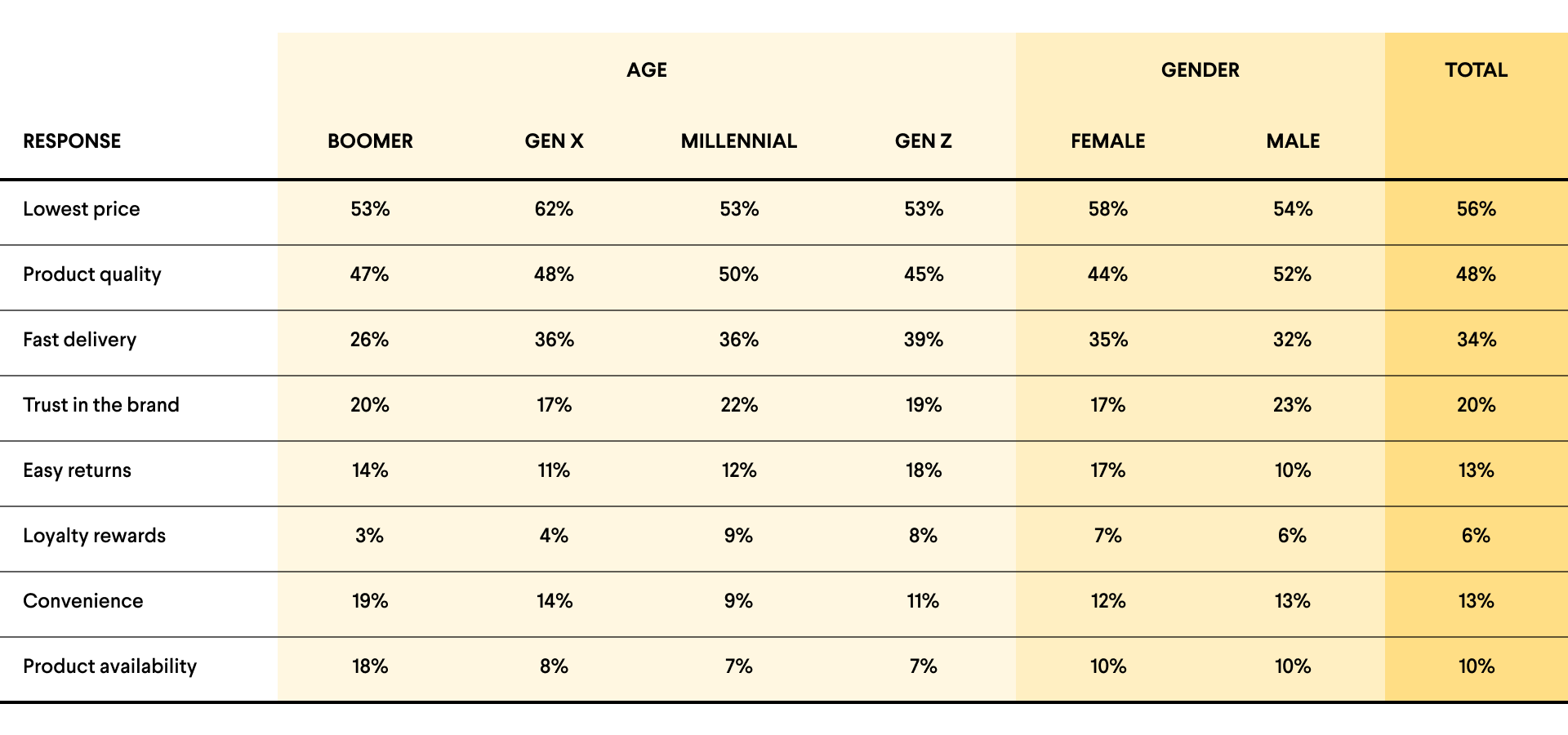
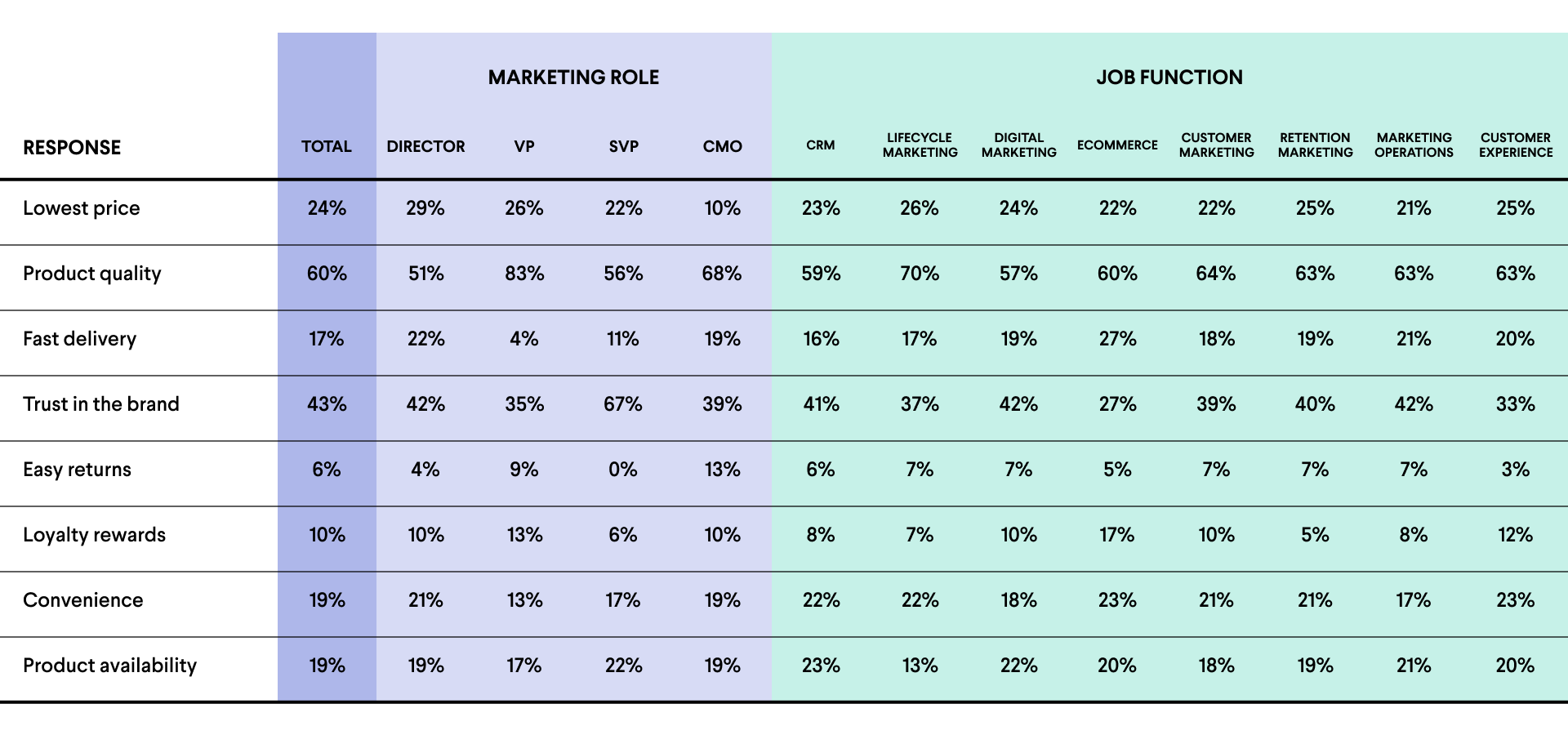
Consumers and marketers agree that product quality matters, but they diverge sharply on what matters beyond it. Price is consumers’ leading consideration at 56%, yet only 24% of marketers believe it is a top factor—a 32-point gap.

Marketers also underestimate the importance of fast delivery (17% vs. 34% of consumers), while placing considerably greater weight on brand trust (43% vs. 20%) and product quality (60% vs. 48%).

The findings suggest marketers may view purchase decisions through a more brand-led lens, while consumers are more pragmatic, prioritizing price, quality and fulfillment. Price sensitivity is also consistent across generations, peaking at 62% among Gen X.

Key Findings

PRICE

32-point gap

56%

Consumers

24%

Marketers

FAST DELIVERY

17-point gap

34%

Consumers

17%

Marketers

BRAND TRUST

23-point gap

20%

Consumers

43%

Marketers

PRODUCT QUALITY

12-point gap

48%

Consumers

60%

Marketers

What It Means for Marketers

Turn consumers’ focus on value into a more targeted customer experience. Use identity and behavioral signals to understand what customers are interested in and when price may be creating friction, then respond with the right incentive rather than relying on broad discounting.

At the same time, make practical purchase factors such as delivery speed and availability clear throughout the journey. This allows brands to deliver the value consumers prioritize while continuing to build quality and trust, and to use promotions more precisely without unnecessarily sacrificing margin.


Consumers: When Deciding Where to Buy Online, What Matters Most? 
cw_ci-ag_question01


Marketers: Which Factors Do You Believe Matter Most When Consumers Decide Where to Buy Online?
cw_mi-role-question01

Consumer vs. Marketer - Which Digital Experiences Make Shopping Easier and Have the Greatest Impact on Conversion?

Marketers Prioritize Personalization. Consumers Prioritize Convenience.

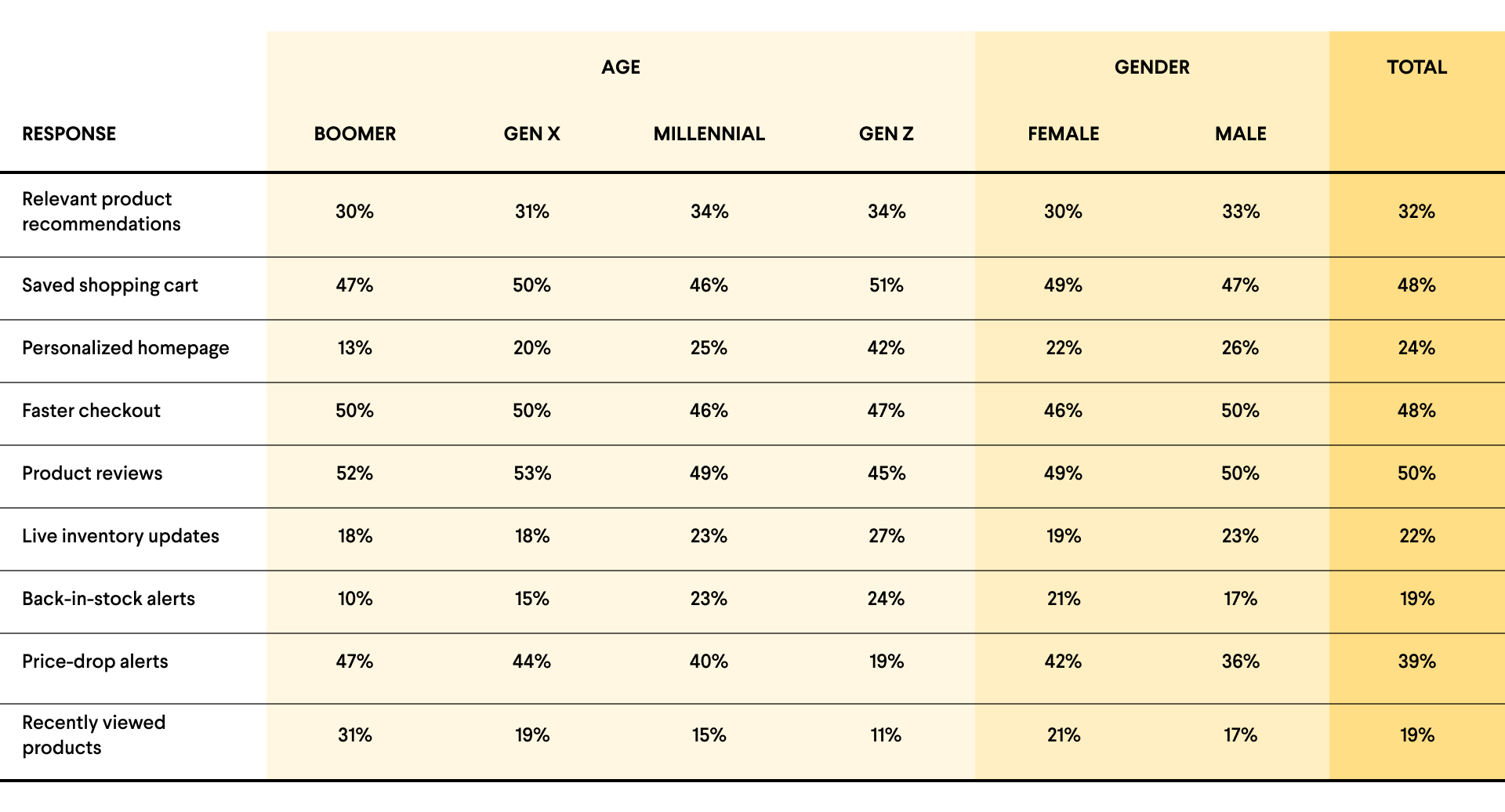
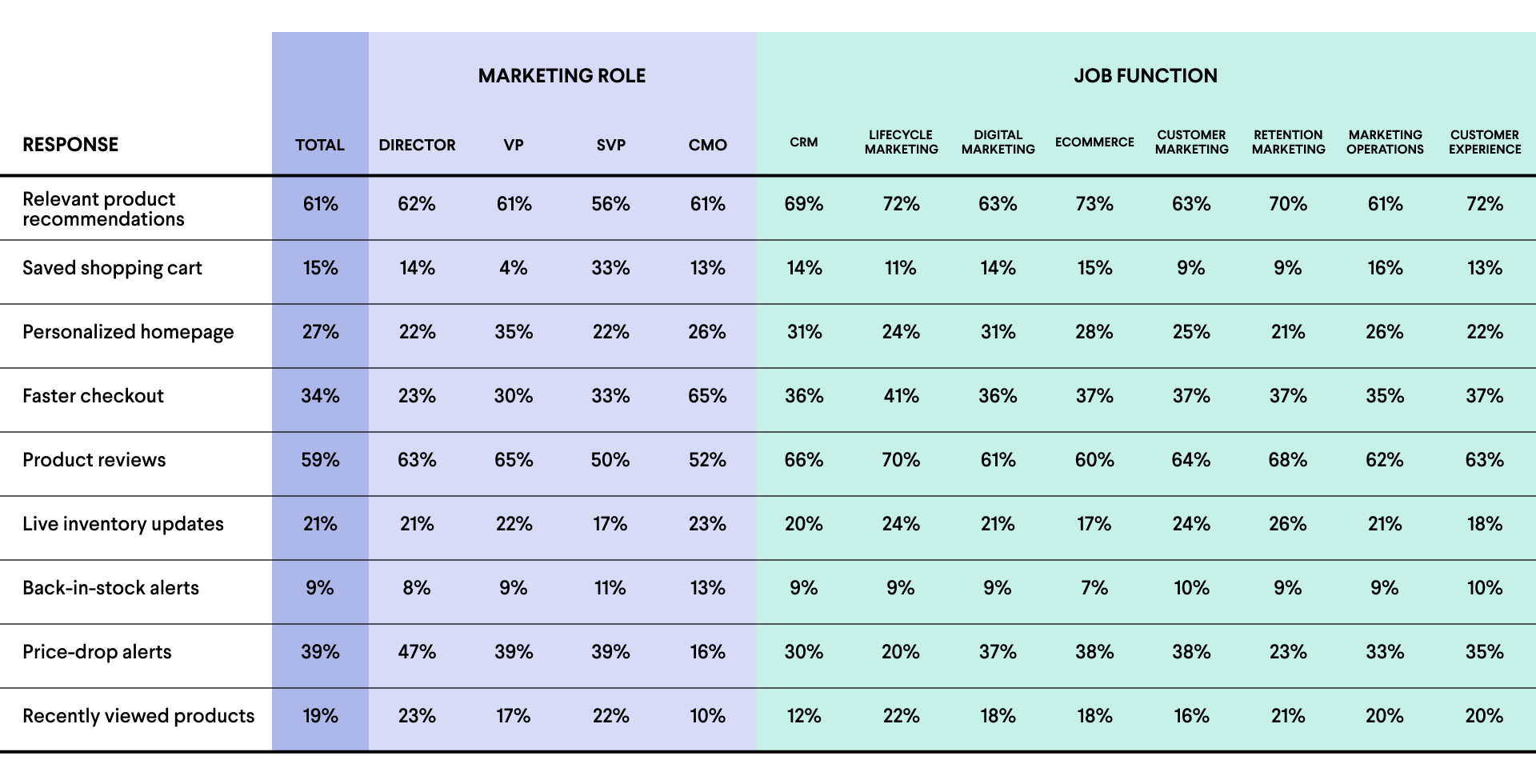
Consumers and marketers agree on the importance of product reviews, but their priorities diverge elsewhere. Nearly half of consumers value saved carts (48%) and faster checkout (48%), while marketers place far greater emphasis on relevant product recommendations (61% vs. 32% of consumers).

The biggest disconnect is the saved cart: just 15% of marketers believe it has a major impact on conversion, compared with 48% of consumers who say it makes shopping easier.

The findings suggest consumers often experience personalization through its utility: remembering their journey, removing friction and helping them complete a purchase. Generational differences reinforce this. 42% of Gen Z value personalized homepages compared with 13% of Boomers, while 47% of Boomers value price-drop alerts compared with 19% of Gen Z.

Key Findings

RELEVANT PRODUCTS

29-point gap

32%

Consumers

61%

Marketers

SAVED CART

33-point gap

48%

Consumers

15%

Marketers

FASTER CHECKOUT

14-point gap

48%

Consumers

34%

Marketers

PRODUCT REVIEWS

9-point gap

50%

Consumers

59%

Marketers

What It Means for Marketers

Personalization is most effective when it makes the customer journey easier. That starts with understanding what a customer is interested in and using identity and behavioral signals to respond with the experience that is most useful in the moment, from relevant recommendations and reviews to faster checkout or timely price and inventory alerts.

Just as importantly, that understanding should carry across visits and channels. Preserving carts and behavioral context, then using email and SMS to help customers resume high-intent journeys, can turn interrupted shopping into conversion opportunities. The goal is a more connected experience that reduces friction, builds confidence and helps customers move naturally toward purchase.


Consumers: Which Digital Experiences Make Shopping Easier for You?
cw_ci-ag_question03


Marketers: Which Digital Experiences Do You Believe Have the Greatest Impact on Increasing Conversions?
cw_mi-role-question02

Consumer vs. Marketer - Which Communication Channels Do Consumers Most Want Brands to Use?

Marketers Overestimate Social and Underestimate Direct Channels

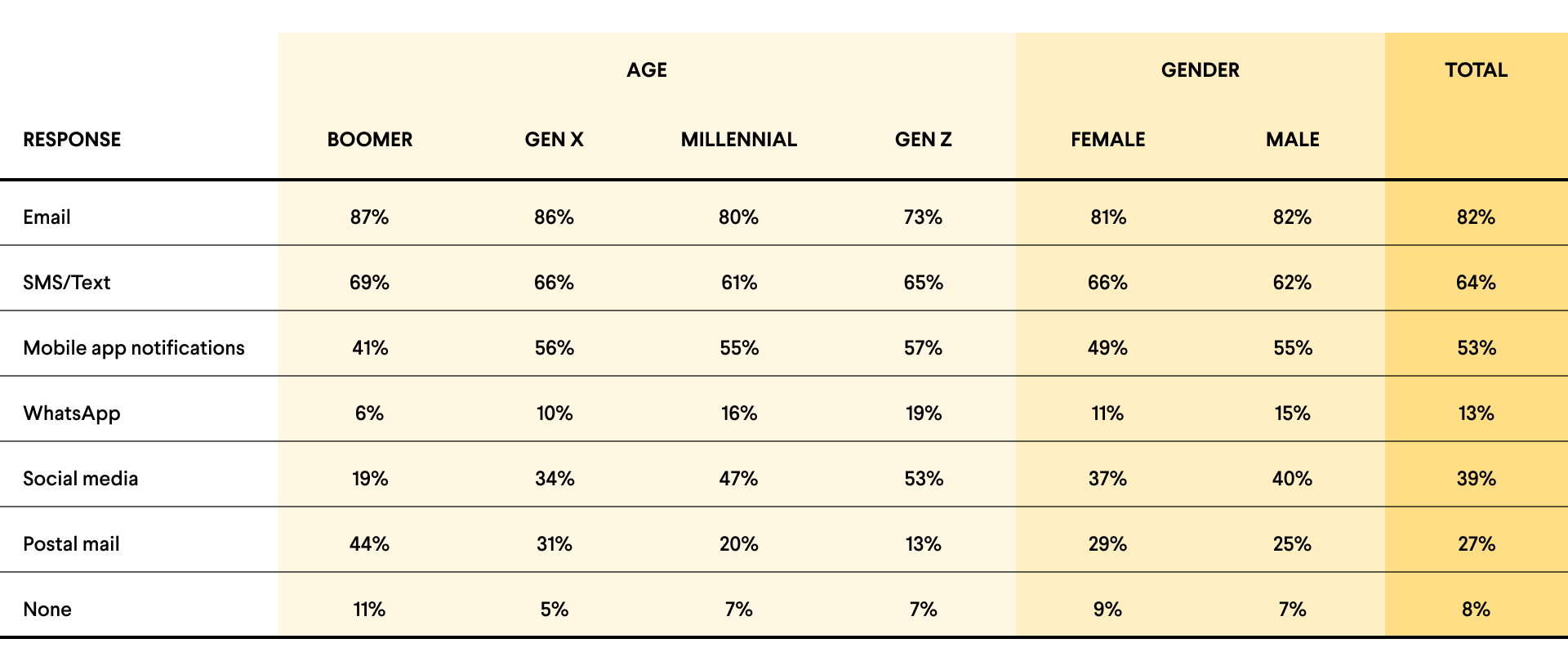
Email remains consumers' clear preferred channel for brand communication at 82%, followed by SMS at 64%. Marketers recognize the importance of email at 73%, but they significantly underestimate SMS, with just 47% believing consumers want brands to use it.

The biggest disconnect is social media. 74% of marketers believe consumers want brands to communicate with them through social channels, compared with just 39% of consumers. Marketers also overestimate mobile app notifications (70% vs. 53%). Age matters, particularly for social media: preference rises from 19% among Boomers to 53% among Gen Z. Yet email remains the leading channel across every generation, suggesting direct, permission-based communication continues to have broad appeal.

Key Findings

SOCIAL MEDIA

35-point gap

39%

Consumers

74%

Marketers

SMS

17-point gap

64%

Consumers

47%

Marketers

APP NOTIFICATIONS

17-point gap

53%

Consumers

70%

Marketers

EMAIL

9-point gap

82%

Consumers

73%

Marketers

What It Means for Marketers

Build channel strategy around customer preference, not marketer assumptions. Email provides a strong foundation for direct customer relationships, while the gap around SMS suggests an opportunity to give text a greater role in timely, high-value moments.

Social and mobile channels still matter, particularly for younger audiences, but should form part of a coordinated mix rather than substitute for channels consumers have actively chosen. Use customer preferences and engagement signals to determine where and when to communicate, creating a connected experience across email, SMS, mobile and social.


Consumers: Which Communication Channels Do You Prefer Brands to Use After You've Chosen to Hear From Them? cw_ci-ag_question04
 

Marketers: Which Communication Channels Do You Believe Consumers Most Want Brands to Use?
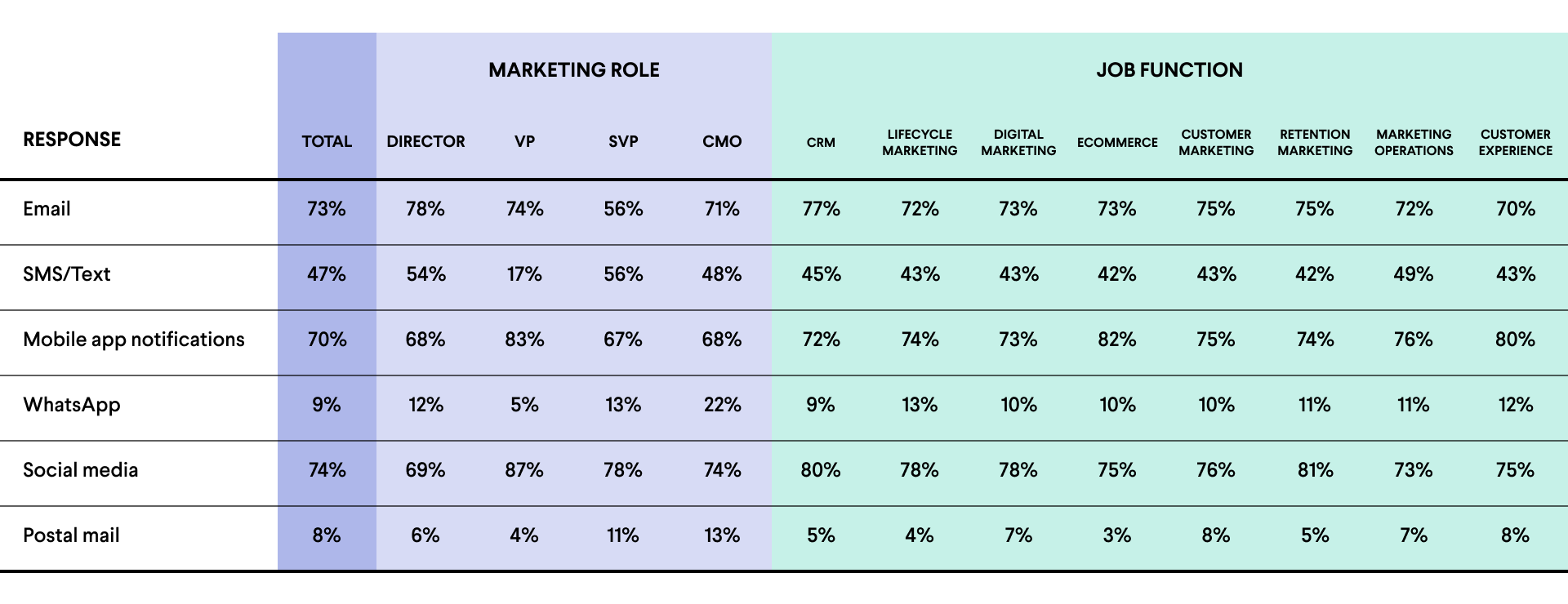
cw_mi-role-question03

Consumer vs. Marketer - What Incentives Encourage Consumers to Share Their Email Address or Mobile Number With a Brand?

Consumers and Marketers Agree: Value Earns the Opt-In

Consumers and marketers agree exactly on the strongest incentive for sharing an email address or mobile number: exclusive discounts, selected by 32% of both groups. Loyalty rewards rank second, although marketers place somewhat greater emphasis on them (29% vs. 22% of consumers).

Personalized recommendations are a weaker incentive than marketers expect, selected by 8% of consumers compared with 13% of marketers. This suggests consumers are more likely to identify themselves in exchange for a clear, tangible benefit than the promise of personalization alone.

The value exchange also varies by age. Gen X is most motivated by exclusive discounts (39%), while Gen Z shows greater interest in benefits such as faster checkout and personalized recommendations (16% each).

Key Findings

EXCLUSIVE DISCOUNTS

Equal

32%

Consumers

32%

Marketers

LOYALTY REWARDS

7-point gap

22%

Consumers

29%

Marketers

EASY ORDER TRACKING

2-point gap

11%

Consumers

13%

Marketers

PERSONALIZED SUGGESTIONS

5-point gap

8%

Consumers

13%

Marketers

What It Means for Marketers

Give consumers a clear reason to identify themselves, then build value from that permission. Discounts remain the strongest incentive, but the right value exchange can vary by customer, from loyalty benefits to greater convenience or personalization. Use customer context and behavior to make the opt-in proposition more relevant, then connect that identity with subsequent browsing and engagement signals to develop a richer understanding of the customer over time.

The goal is not simply to capture an email address or mobile number, but to turn anonymous intent into a relationship that becomes more useful with every interaction.


Consumers: What Would Make You More Willing to Share Your Email Address or Mobile Number With a Brand? 
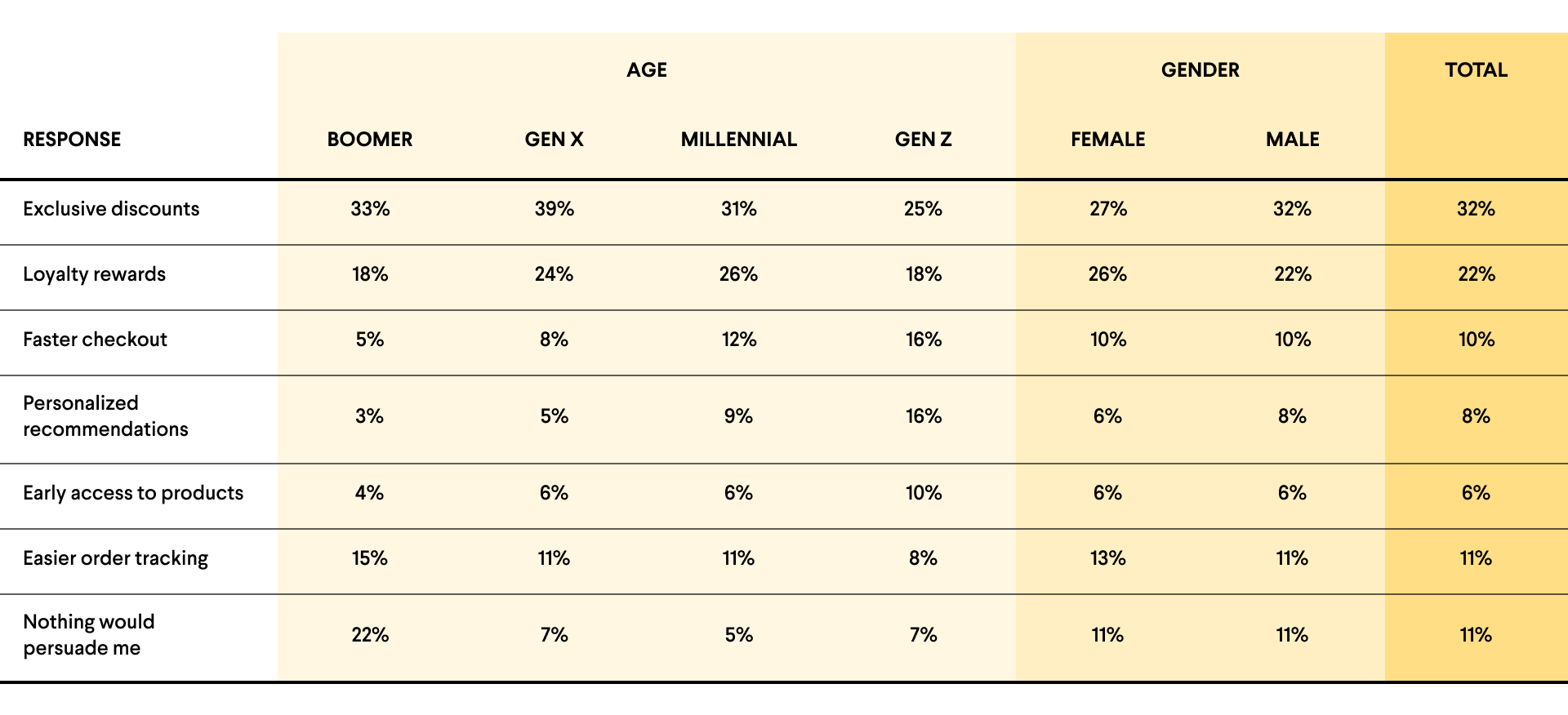
cw_ci-ag_question06


Marketers: What Do You Believe Is the Strongest Incentive for Consumers to Share Their Email Address or Mobile Number? 
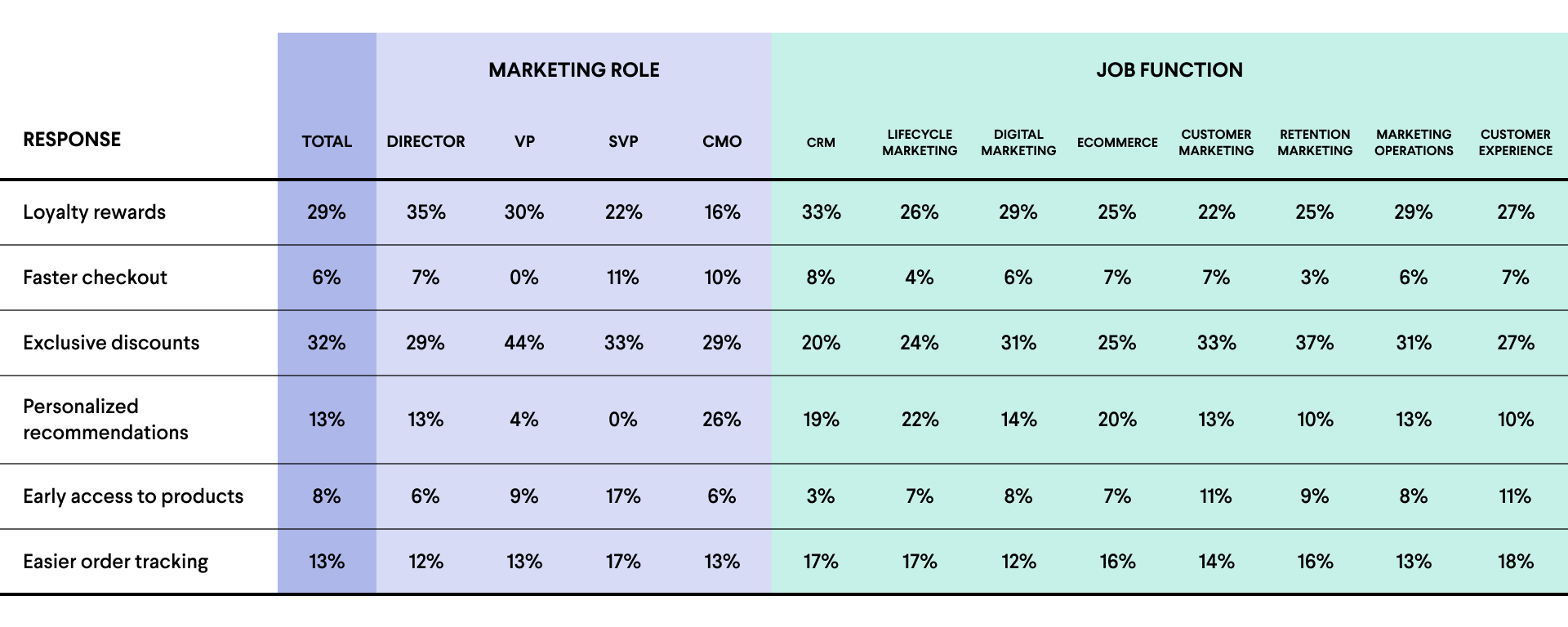
cw_mi-role-question04-1

Consumer vs. Marketer - What Most Determines Whether Consumers Pay Attention to and Engage With Brand Messages?

Marketers Underestimate the Power of the Offer

Discounts are consumers’ strongest reason to pay attention to brand messages, selected by 50%, yet only 26% of marketers see them as a leading engagement driver. Instead, marketers place greater emphasis on product interest (42%), brand trust (40%) and relevance (38%).

Product interest is a point of closer alignment (36% of consumers vs. 42% of marketers), while marketers also place nearly twice as much weight on personalization itself (29% vs. 15%). Marketers underestimate the importance of reaching consumers at the right moment. Just 8% of marketers believe timing has the greatest impact on whether consumers engage with a marketing message, compared with 18% of consumers, and 23% of Gen Z. While marketers place greater emphasis on factors such as product interest, brand trust and personalization, consumers are signaling that when a message arrives can be as important as what it says.

The findings reinforce a pattern seen throughout the research: consumers respond to tangible value and demonstrated interest, while marketers tend to place greater weight on the marketing concepts behind the experience.

Key Findings

DISCOUNT OFFERED

24-point gap

50%

Consumers

26%

Marketers

PERSONALIZATION

14-point gap

15%

Consumers

29%

Marketers

MESSAGE TIMING

10-point gap

18%

Consumers

8%

Marketers

BRAND TRUST

3-point gap

35%

Consumers

38%

Marketers

What It Means for Marketers

Use customer intent to make value more relevant, rather than treating relevance and value as competing strategies. Browsing, product and engagement signals can reveal what customers are interested in and when they may be most receptive, allowing brands to connect the right offer or message to demonstrated intent.

However, consumers are navigating a constant stream of brand communications, so even a relevant message can miss the mark if it arrives when they are not ready to consider or act on it. Rather than relying on higher send volumes to drive incremental revenue, brands have an opportunity to use behavioral and intent signals to identify moments when an individual is more receptive.

Personalization becomes more meaningful when it produces something the customer can recognize, a relevant product, timely offer or useful message, rather than being an objective in itself. Coordinating those signals across triggered email and SMS can also help brands engage customers at moments when their interest is highest.


Consumers: Thinking About All the Messages You Receive From Brands, What Most Determines Whether You Pay Attention
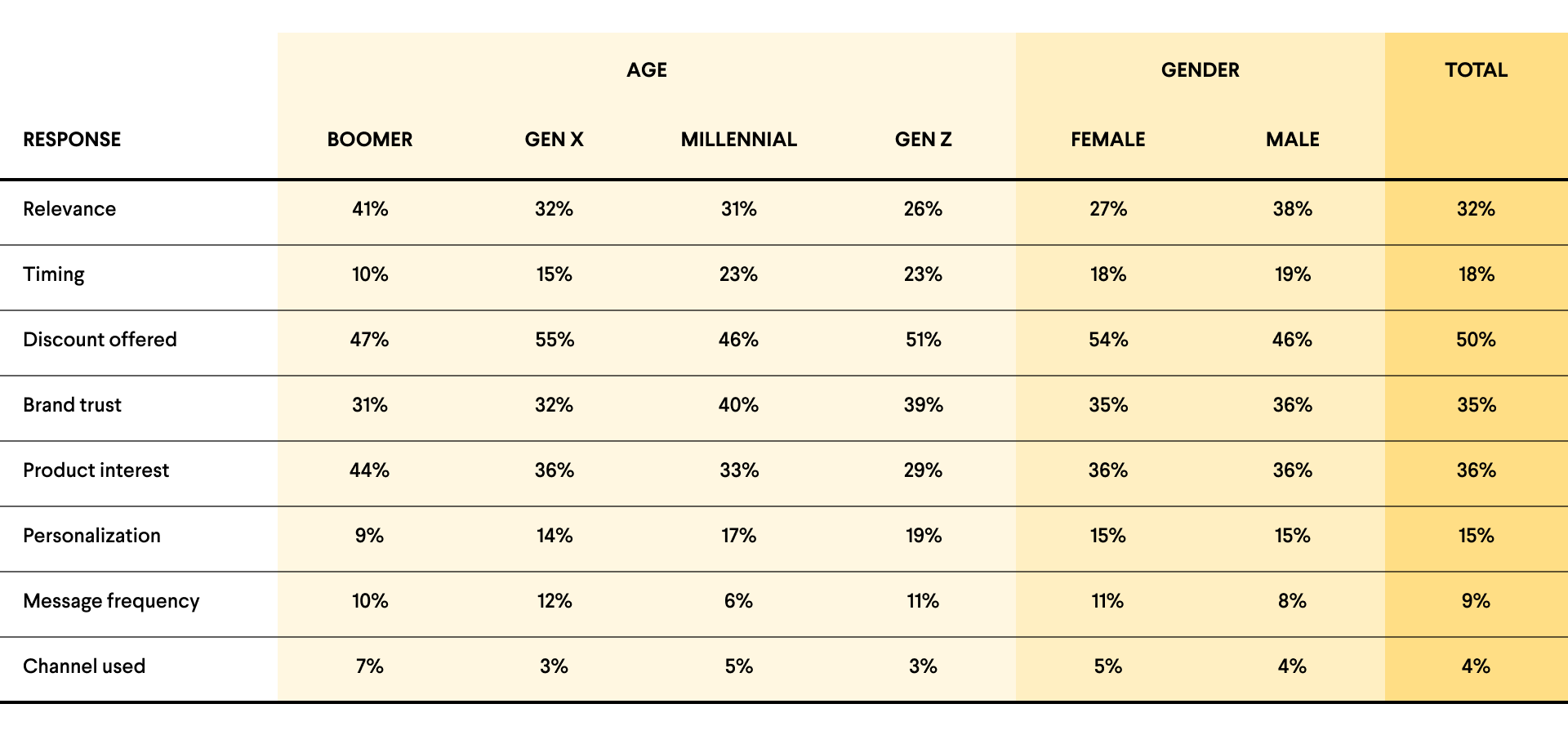
cw_ci-ag_question08

Marketers: What Has the Greatest Impact on Whether Consumers Engage With a Marketing Message?
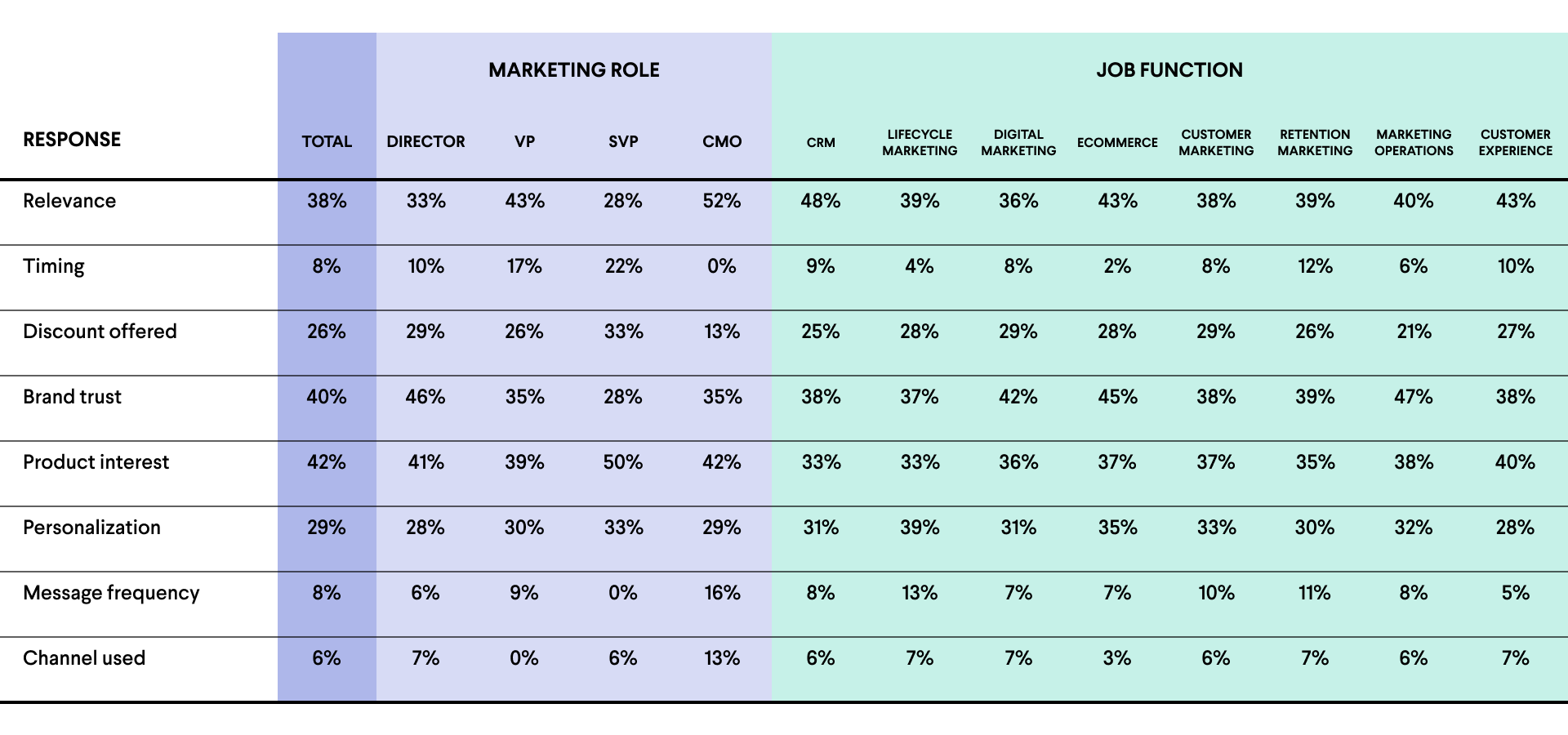
cw_mi-role-question05

Consumer vs. Marketer - How Does Marketer Adoption of AI Compare With Consumer Attitudes Toward AI-Powered Personalization?

Marketers Are Embracing AI Faster Than Consumers Are Embracing the Experience

AI adoption is already widespread among marketers. Customer service and chatbots lead current or planned use cases at 54%, followed by predictive analytics at 49% and product recommendations at 43%. Just 2% of marketers say they are not using or planning to use AI.

Consumers are far less convinced of the benefit. Only 16% say AI improves their shopping experience, while 27% say they don’t trust AI to personalize their experience. Another 26% say AI can be helpful, but only when brands are transparent about how it is being used.

The disconnect suggests that AI adoption is moving faster than perceived customer value. Marketers are investing in AI to predict behavior, automate interactions and personalize experiences, but consumers are judging those capabilities by a simpler standard: does the experience actually become more useful, trustworthy or convenient?

Key Findings

MARKETERS:

CURRENT OR PLANNED USE

54%

Chatbots

49%

Predictive Analytics

43%

Product Recommendations

MARKETERS:

CURRENT OR PLANNED USE

34%

Segmentation/span>

31%

Email Content Generation

24%

Orchaestration

CONSUMERS:

ATTITUDES TOWARD AI

27%

Don’t trust AI personalization

26%

Helpful if brands are transparent

16%

Improves my shopping experience

THE AI EXPECTATION GAP

98%

Marketers using or planning to use AI

16%

Consumers sat AI improves shopping experience

What It Means for Marketers

Close the gap between AI adoption and customer value. The opportunity is not simply to deploy more AI, but to use it in ways consumers can recognize as useful, from better recommendations and timely service to more relevant, convenient experiences. AI can operate behind the scenes to understand intent and improve decision-making, but brands should remain transparent about its use and preserve customer control. Success should ultimately be measured not by how much AI is deployed, but by whether customers experience a meaningful improvement.


Consumers: Brands are increasingly using AI to personalize shopping experiences. Which statement best reflects your opinion?
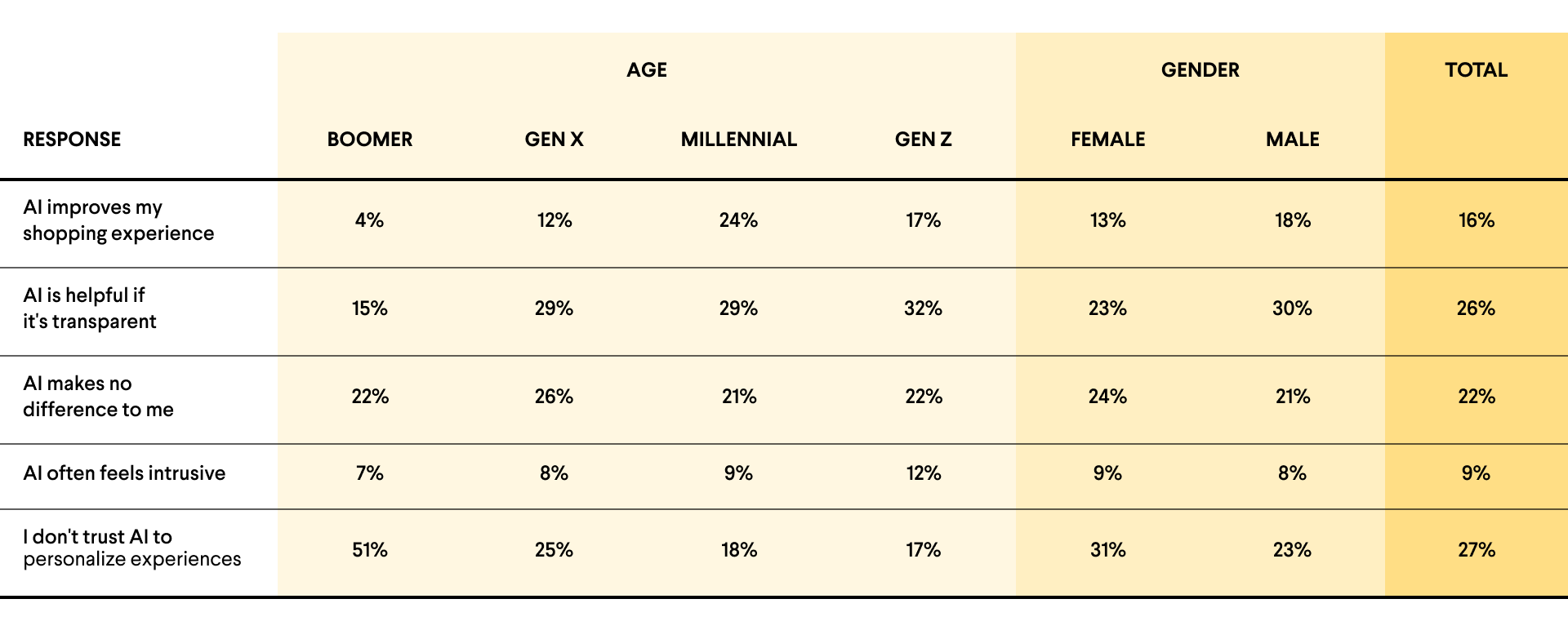
cw_ci-ag_question09


Marketers: Which AI Use Cases Are You Currently Using or Actively Planning to Implement?
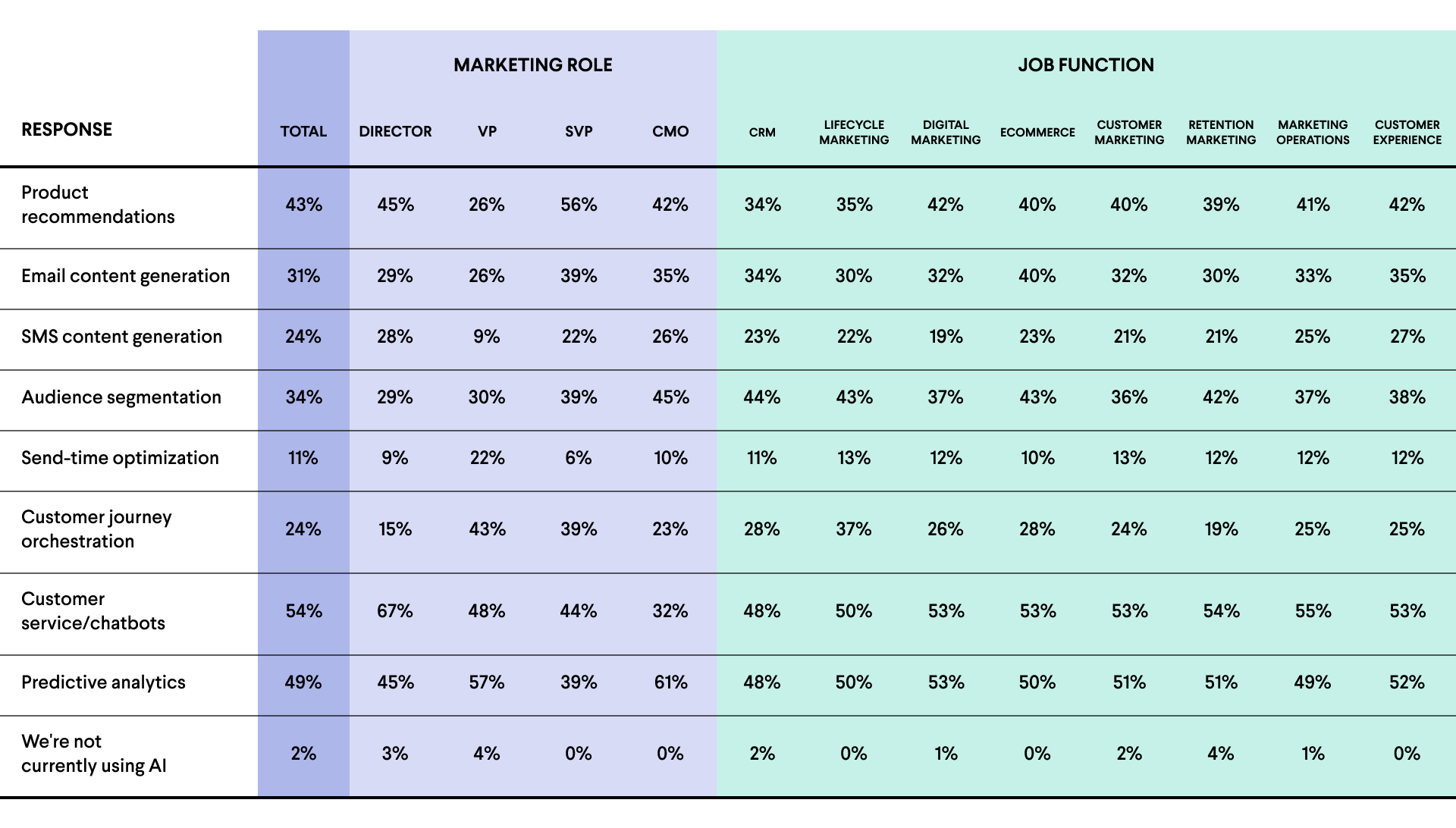
cw_mi-role-question09

Consumer Insights

Inside the Expectations Shaping Consumer Behavior

Insights from 1,000 consumers reveal the behaviors, expectations, and preferences shaping how people discover, engage with, and buy from brands.
What Type of Messages From Brands Are Most Valuable?

Consumers Value Messages That Do Something

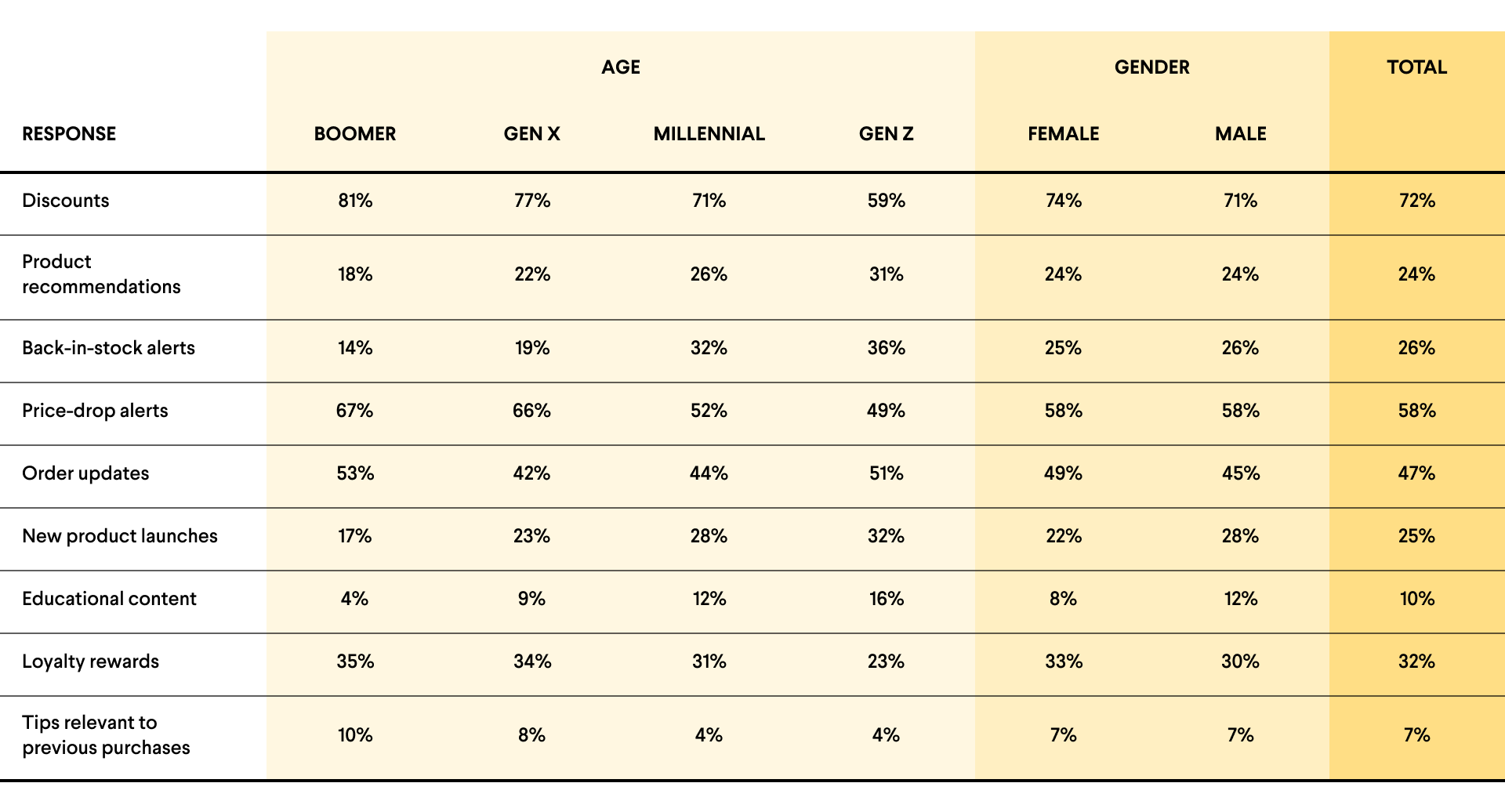
Consumers place the greatest value on messages with a clear, practical benefit. Discounts lead at 72%, followed by price-drop alerts at 58% and order updates at 47%. Loyalty rewards follow at 32%, while product recommendations (24%) and new product launches (25%) have more selective appeal.

Age reveals a broader opportunity beyond promotions. While discounts and price-drop alerts become more important with age, younger consumers are more receptive to discovery and availability messages. Gen Z is more likely than Boomers to value product recommendations (31% vs. 18%), back-in-stock alerts (36% vs. 14%) and new product launches (32% vs. 17%).

The findings suggest that valuable communication is less about staying visible and more about giving customers a useful reason to engage at the right moment.

Key Findings

DISCOUNTS

72% Overall

59%

Gen Z

81%

Boomers

PRICE-DROP ALERTS

58% Overall

49%

Gen Z

67%

Boomers

ORDER UPDATES

47% Overall

42%

Gen X

53%

Boomers

BACK-IN-STOCK

26% Overall

36%

Gen Z

14%

Boomers

What It Means for Marketers

Make customer communication useful by connecting the message to what someone needs in the moment. Discounts and price alerts remain powerful, but value extends beyond promotions to service, availability and discovery. Use browsing behavior, purchase history and product interest to identify those moments and trigger communications that respond to them, from a price drop on a viewed product to an order update or back-in-stock alert.

The right message mix will also vary by audience, so adapting communication to customer behavior, preferences and lifecycle stage can help brands deliver greater relevance without simply sending more messages.


What Type of Messages From Brands Are Most Valuable?
cw_ci-ag_question05

Consumers - Which Would Increase Your Trust in Personalized Experiences?

Trust Starts With Transparency and Control

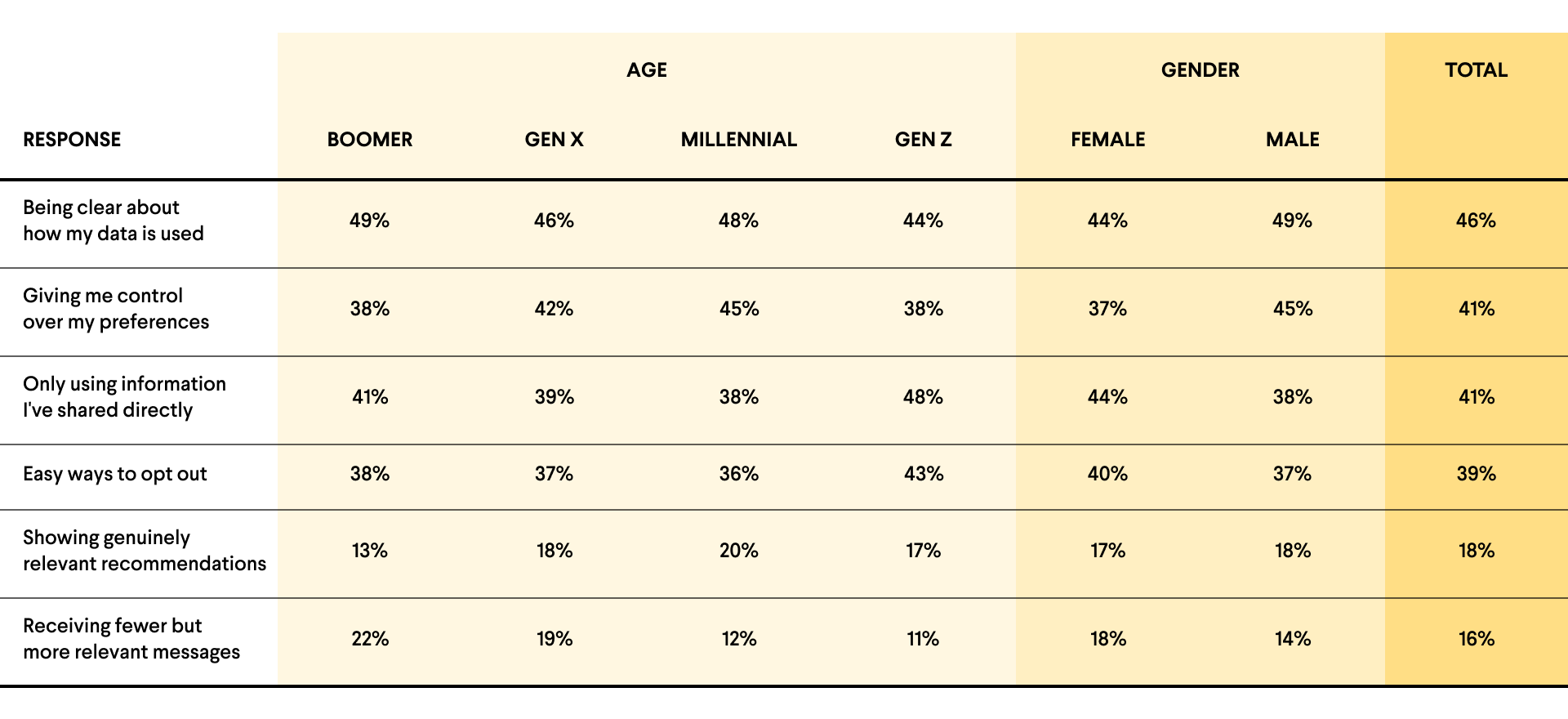
Consumers are more likely to trust personalized experiences when they understand and control how their data is used. Clear explanations of data use lead at 46%, followed by control over preferences and only using information consumers have shared directly, both at 41%. Easy ways to opt out are similarly important at 39%.

By contrast, just 18% say genuinely relevant recommendations would increase their trust. The findings suggest that relevance alone is not enough: consumers want transparency, permission and agency over how personalization works.

These expectations are broadly shared across generations, although Gen Z places particularly strong emphasis on brands only using information they have shared directly (48%).

Key Findings

CLEAR DATA USAGE

46% Overall

49%

Boomers

44%

Gen Z

ONLY RELEVANT MESSAGES

16% Overall

22%

Boomers

11%

Gen Z

PREFERENCE CONTROL

41% Overall

45%

Millennials

38%

Gen Z & Boomers

EASY OPT OUT

39% Overall

43%

Gen Z

36%

Millennials

What It Means for Marketers

Build personalization on transparency and customer control, not relevance alone. Consumers are more likely to trust personalized experiences when they understand how their data is being used and can shape the relationship themselves. Make consent, preference management and opt-outs clear and accessible, and use information customers choose to share as a foundation for more relevant experiences.

Behavioral signals can enrich that understanding, but personalization should operate within the boundaries customers set. The goal is to give consumers confidence that greater relevance does not come at the expense of control.


Which Would Increase Your Trust in Personalized Experiences?
cw_ci-ag_question07

Marketer Insights

Inside the Priorities Shaping Customer Marketing

Insights from 150 marketers reveal how priorities, challenges, and opportunities vary across senior marketing roles and customer-focused functions.
Marketers - Which Marketing Objective Is Your Highest Priority Over the Next 12 Months?

Marketers Are Balancing Acquisition With Retention and Efficiency

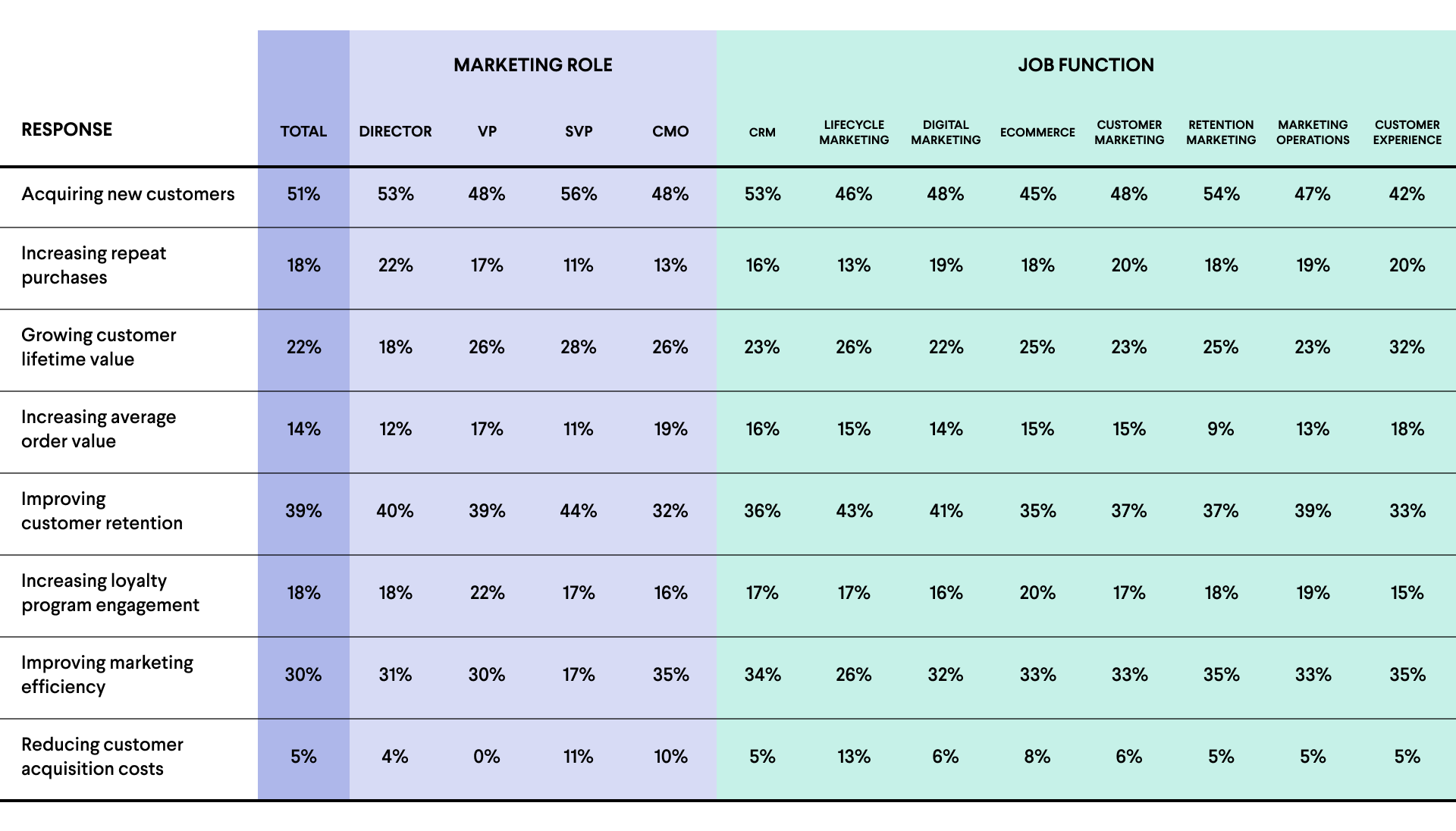
Customer acquisition remains marketers’ leading priority at 51%, but growth is not solely about winning new customers. Retention ranks second at 39%, followed by marketing efficiency at 30% and customer lifetime value at 22%.

Yet more specific measures of deepening existing relationships rank lower, with repeat purchases and loyalty engagement both at 18%. This suggests marketers are balancing an increasingly broad growth mandate, acquiring customers while also getting greater value from the relationships and investment they already have.

Priorities also vary by seniority and function: SVPs place the greatest emphasis on acquisition (56%), while CMOs show stronger focus on marketing efficiency, reflecting the different growth pressures facing strategic and functional leaders.

Key Findings

NET NEW CUSTOMERS

51% Overall
BY ROLE
56%
CMO

BY DEPARTMENT
54%
RETENTION MARKETING

CUSTOMER RETENTION

39% Overall
BY ROLE
44%
SVP

BY DEPARTMENT
43%
LIFECYCLE MARKETING

MARKETING EFFICIENCY

30% Overall
BY ROLE
35%
CMO

BY DEPARTMENT
35%
RETENTION MARKETING

LIFETIME VALUE

22% Overall
BY ROLE
28%
SVP

BY DEPARTMENT
32%
CUSTOMER EXPERIENCE

What It Means for Marketers

Treat acquisition and retention as connected parts of the same growth strategy. With marketers under pressure to win new customers, retain existing ones and improve efficiency, greater value can come from connecting the customer journey rather than optimizing each objective in isolation.

Turning anonymous prospects into known customers and carrying that understanding from first purchase through repeat engagement can help brands get more from demand they have already generated. Linking those efforts to outcomes such as repeat purchase and lifetime value also gives marketers a clearer view of how customer relationships contribute to sustainable growth.


Which Marketing Objective Is Your Highest Priority Over the Next 12 Months?
cw_mi-role-question06

Marketers - Which Customer Data Sources Are Most Valuable for Delivering Personalized Experiences?

Behavioral Data Still Drives Most Personalization

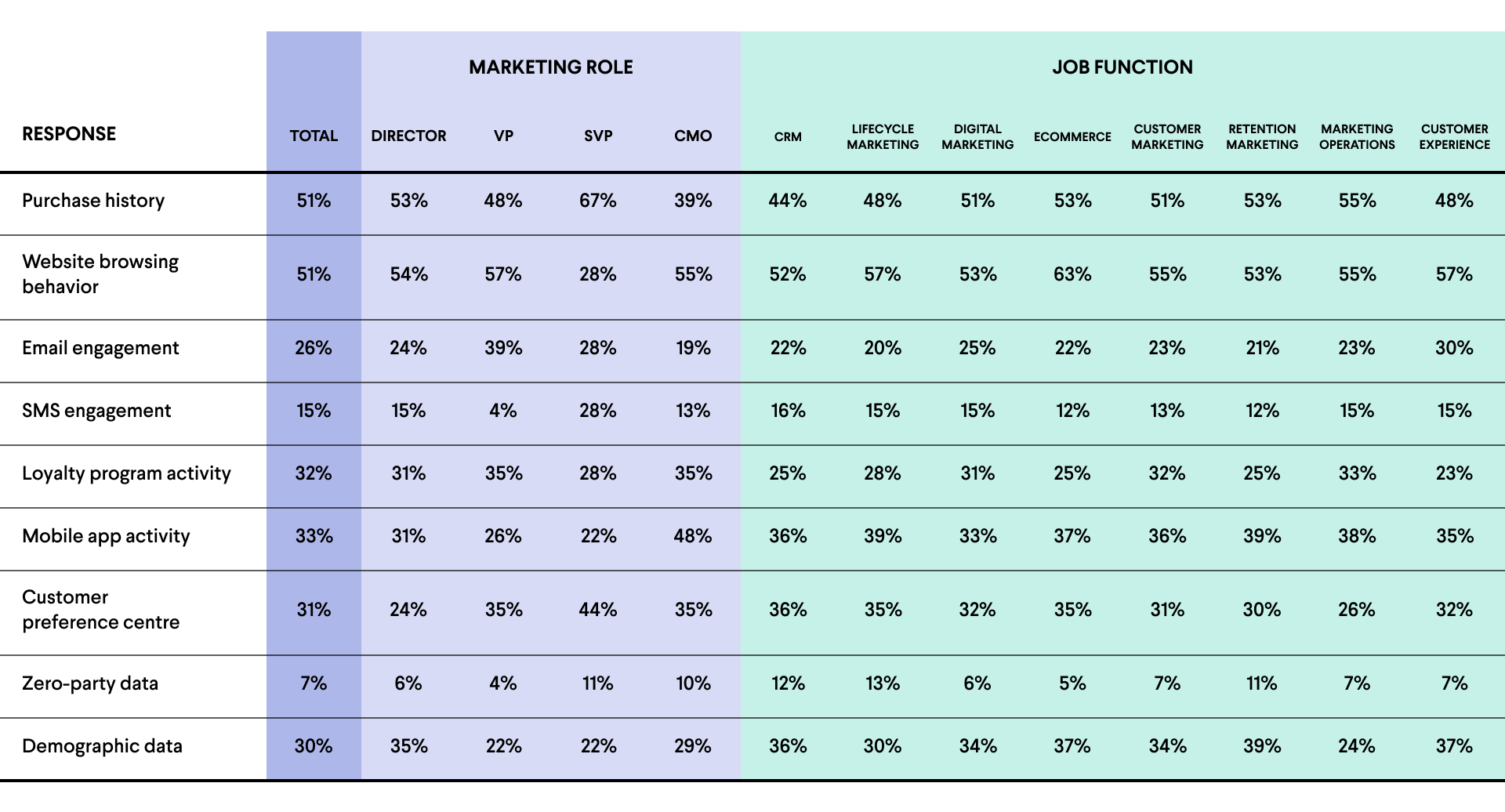
Marketers place the greatest value on signals that reveal what customers have actually done. Purchase history and browsing behavior lead equally at 51%, making them the most used sources of data for personalization.

These signals give marketers a clearer picture of both established preferences and current intent. Purchase history shows what a customer has previously valued, while browsing behavior can reveal what they may be interested in now, creating opportunities to make experiences more relevant throughout the customer journey. Seniority and function shape which behavioral signals marketers value most: SVPs lean heavily toward established purchase history, while CMOs, and especially eCommerce teams, place greater emphasis on browsing behavior as a signal of current customer intent.

The findings reinforce a broader theme of the research: effective personalization depends on understanding the signals that reveal what matters to each customer. Behavioral data can provide valuable indicators of current intent, while other customer data can add important context around preferences and needs. Bringing these signals together can help brands make smarter decisions about what to communicate, when to communicate and how to make each interaction more relevant.

Key Findings

PURCHASE HISTORY

51% Overall
BY ROLE
67%
SVP

BY DEPARTMENT
55%
MARKETING OPERATIONS

BROWSING BEHAVIOR

51% Overall
BY ROLE
57%
VP

BY DEPARTMENT
63%
ECOMMERCE

LOYALTY PROGRAM

32% Overall
BY ROLE
35%
VP / CMO

BY DEPARTMENT
33%
MARKETING OPERATIONS

MOBILE APP ACTIVITY

33% Overall
BY ROLE
48%
CMO

BY DEPARTMENT
39%
LIFECYCLE & RETENTION MARKETING

What It Means for Marketers

Connect past behavior with current intent to create a more useful customer experience. Purchase history can reveal established preferences, while browsing and engagement signals show what a customer may need now.

Bringing those signals together around a persistent customer identity can help brands move beyond static segmentation and respond to changing intent across the journey, from product discovery and recommendations to triggered email and SMS. The value of customer data ultimately comes from how quickly it can be turned into an experience that feels relevant to the customer.


Which Customer Data Sources Are Most Valuable for Delivering Personalized Experiences?
cw_mi-role-question07

Marketers - What Is the Biggest Challenge Preventing Your Organization From Delivering More Personalized Customer Experiences?
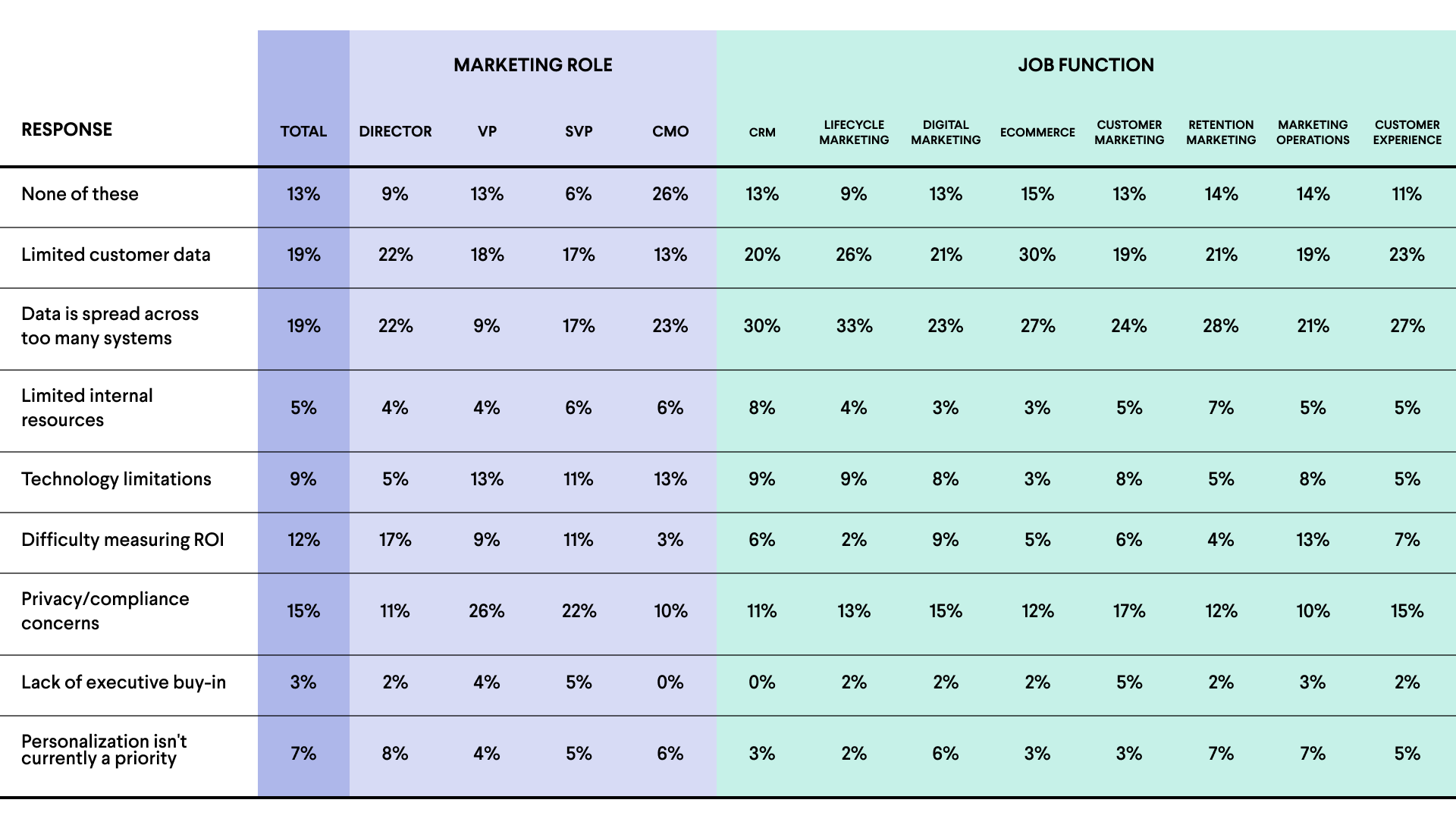
Personalization Has a Data Foundation Problem

No single barrier dominates, but marketers’ biggest personalization challenges center on customer data. Limited customer data and data spread across too many systems jointly lead at 19%, followed by privacy and compliance concerns at 15% and difficulty measuring ROI at 12%.

By contrast, just 5% cite limited internal resources and 3% lack of executive buy-in, suggesting the problem is less about organizational appetite for personalization and more about having the connected data needed to deliver it effectively.

The challenge is particularly pronounced among teams responsible for activating customer data. Fragmented data rises to 33% among Lifecycle Marketing, 30% among CRM and 27% among eCommerce, while 30% of eCommerce marketers also cite limited customer data.

Key Findings

LIMITED CUSTOMER DATA

19% Overall
BY ROLE
22%
DIRECTOR

BY DEPARTMENT
30%
ECOMMERCE

DATA ACROSS TOO MANY SYSTEMS

19% Overall
BY ROLE
23%
CMO

BY DEPARTMENT
33%
LIFECYCLE MARKETING

PRIVACY & COMPLIANCE

15% Overall
BY ROLE
26%
VP

BY DEPARTMENT
17%
CUSTOMER MARKETING

DIFFICULTY PROVING ROI

12% Overall
BY ROLE
17%
DIRECTOR

BY DEPARTMENT
13%
MARKETING OPERATIONS

What It Means for Marketers

The personalization challenge is increasingly about connecting customer understanding to execution. Marketers know behavioral data is valuable, but that value diminishes when identity, browsing, purchase and engagement signals sit across disconnected systems. Bringing those signals together can give lifecycle, CRM and eCommerce teams a more complete view of the customer and make it easier to act on changing intent across channels.

That foundation also needs to incorporate privacy and measurement from the outset, so personalization can scale with customer trust while demonstrating its impact on business outcomes.


What Is the Biggest Challenge Preventing Your Organization From Delivering More Personalized Customer Experiences?

cw_mi-role-question08

Marketers - Which Capability Would Have the Greatest Impact on Improving Your Customer Marketing Performance?

Better Data Is the Foundation for Better Customer Marketing

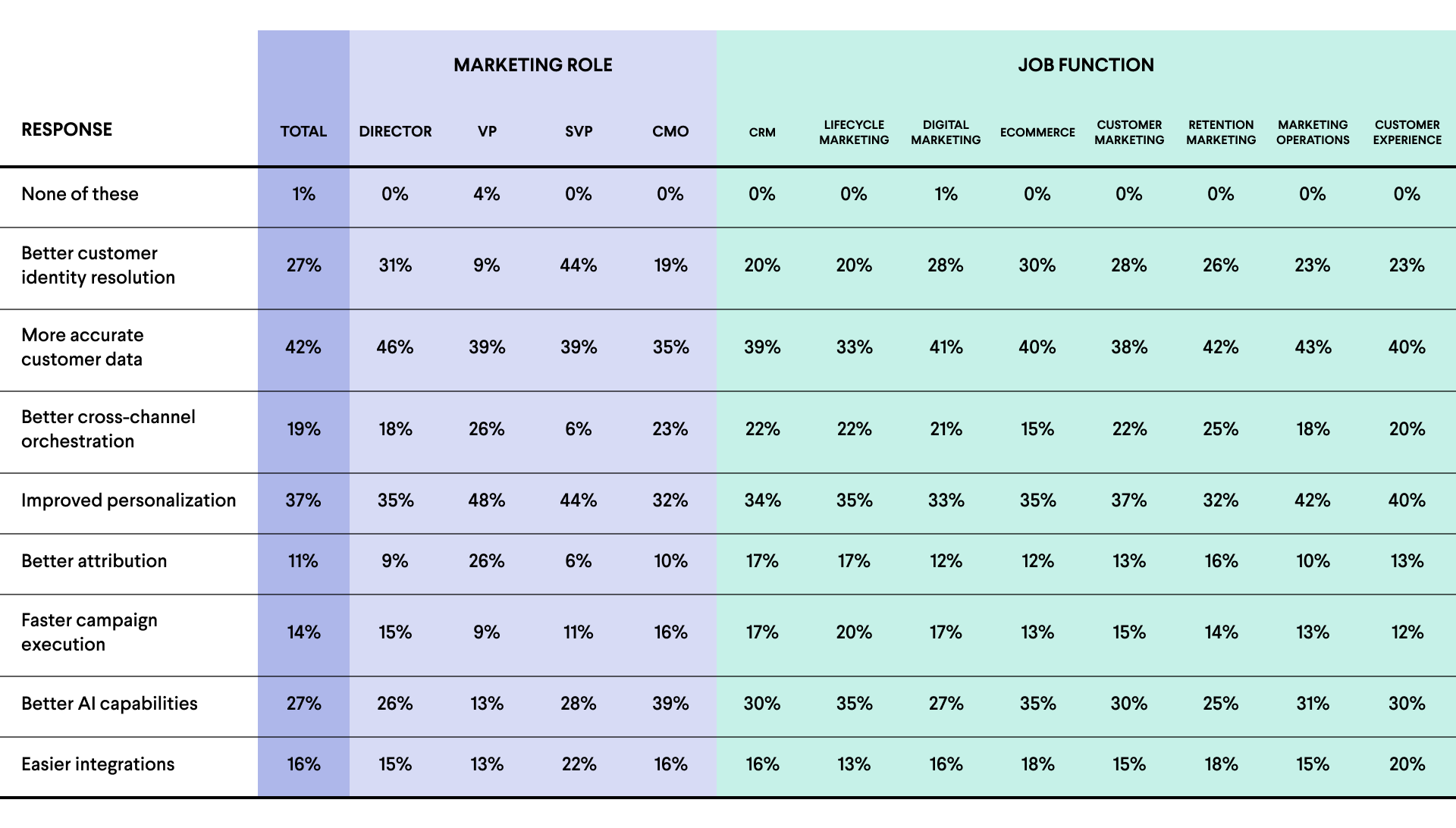
Marketers see more accurate customer data as the capability with the greatest potential impact at 42%, followed by improved personalization at 37%. Better identity resolution and AI capabilities tie at 27%, while cross-channel orchestration reaches 19%.

The hierarchy suggests that marketers see stronger customer understanding as the foundation for better performance. Accurate data and identity help brands understand who customers are and what they want, creating the foundation for more effective personalization and AI.

Priorities vary by leadership and function. Improved personalization rises to 48% among VPs and 44% among SVPs, while AI capabilities reach 39% among CMOs. Marketing Operations places particularly strong emphasis on both accurate customer data (43%) and personalization (42%).

Key Findings

ACCURATE DATA

42% Overall
BY ROLE
46%
DIRECTOR

BY DEPARTMENT
43%
MARKETING OPERATIONS

IMPROVED TAILORING

37% Overall
BY ROLE
48%
VP

BY DEPARTMENT
42%
MARKETING OPERATIONS

IDENTITY RESOLUTION

27% Overall
BY ROLE
44%
SVP

BY DEPARTMENT
30%
ECOMMERCE

BETTER AI CAPABILITIES

27% Overall
BY ROLE
39%
CMO

BY DEPARTMENT
35%
LIFECYCLE MARKETING & ECOMMERCE

What It Means for Marketers

Strengthen the customer data foundation before adding more sophistication. More accurate data and stronger identity resolution can connect customer behavior across interactions and give teams a more reliable understanding of intent.

That foundation can then power better personalization and AI-driven decisioning, helping brands turn customer signals into more relevant experiences rather than amplifying incomplete or disconnected information.


Which Capability Would Have the Greatest Impact on Improving Your Customer Marketing Performance?
cw_mi-role-question11

Marketers - Looking Ahead, What Do You Believe Will Have the Biggest Impact on Customer Marketing Over the Next Three Years?

AI-Powered Personalization Is Expected to Reshape Customer Marketing

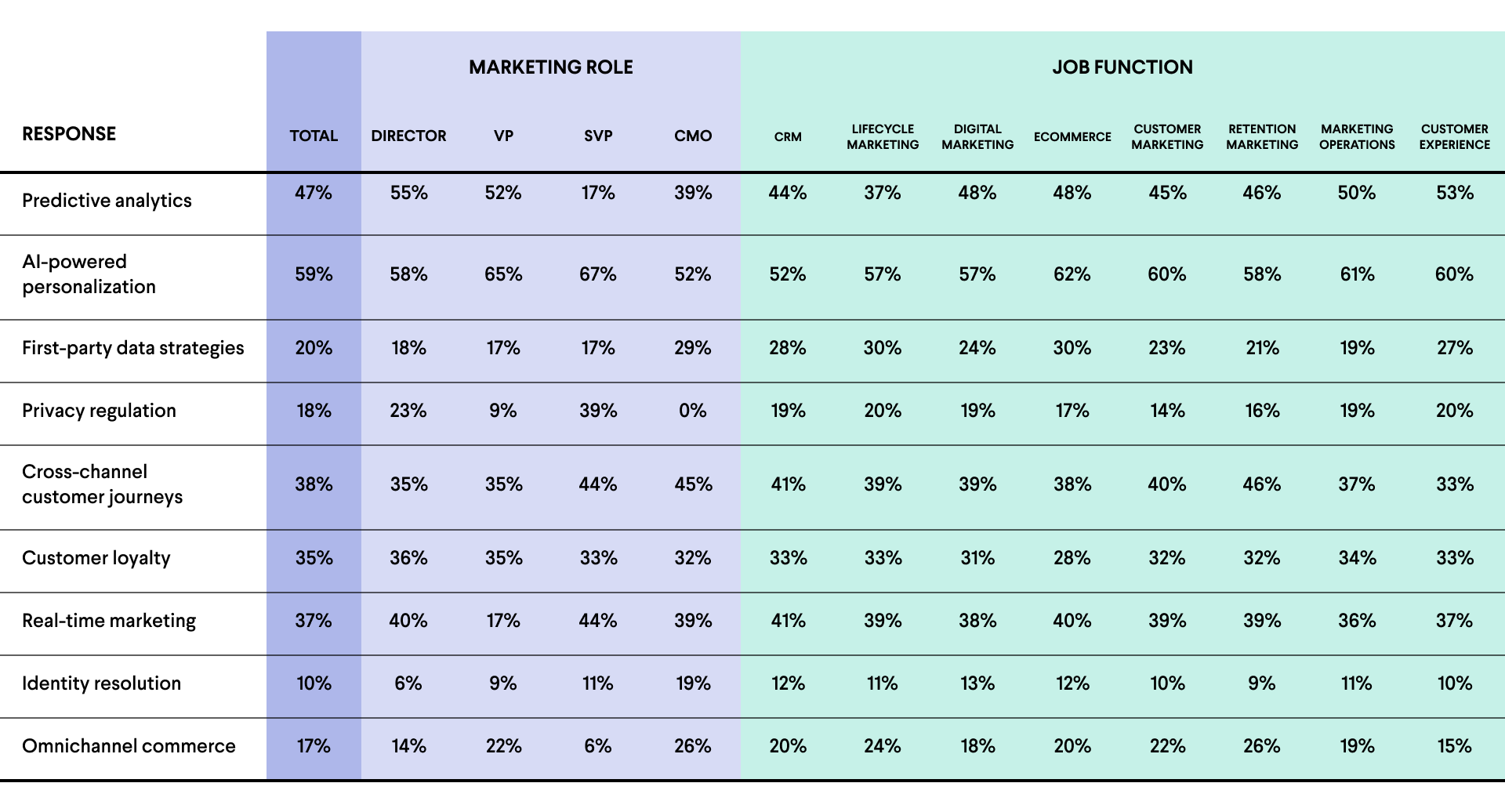
AI-powered personalization leads at 59%, followed by predictive analytics at 47%. Cross-channel customer journeys (38%) and real-time marketing (37%) form a second tier of priorities, suggesting marketers expect the future to be defined by more intelligent, responsive customer experiences.

Confidence in AI-powered personalization is broad across leadership and functions, reaching 67% among SVPs and 65% among VPs, as well as 62% in eCommerce and 61% in Marketing Operations. The findings point toward AI becoming less of a standalone capability and more of an engine for understanding intent and acting on it across the customer journey.

Key Findings

AI-POWERED PRODUCT TAILORING

59% Overall
BY ROLE
67%
SVP

BY DEPARTMENT
62%
ECOMMERCE

PREDICTIVE ANALYTICS

47% Overall
BY ROLE
55%
DIRECTORS

BY DEPARTMENT
53%
CUSTOMER EXPERIENCE

CROSS-CHANNEL JOURNEYS

38% Overall
BY ROLE
45%
CMO

BY DEPARTMENT
46%
RETENTION MARKETING

REAL-TIME MARKETING

37% Overall
BY ROLE
44%
SVP

BY DEPARTMENT
41%
CRM

What It Means for Marketers

Turn AI ambition into experiences customers can actually value. Marketers expect AI, predictive analytics and real-time capabilities to make customer marketing more intelligent and responsive, but the consumer findings show that technology alone will not create better experiences. The opportunity is to use AI behind the scenes to understand intent, make better decisions and coordinate relevant interactions across channels, while maintaining the transparency, permission and control consumers expect.


Looking Ahead, What Do You Believe Will Have the Biggest Impact on Customer Marketing Over the Next Three Years?

cw_mi-role-question12

Conclusion

Closing the Customer Marketing Gap Means Turning Understanding Into Action

The Customer Marketing Gap reveals a fundamental disconnect: marketers and consumers often want compatible outcomes, but define the path to them differently. Marketers are focused on growth, personalization, efficiency, and stronger customer relationships. Consumers are more immediate and pragmatic, rewarding value, convenience, relevance, and control.

Closing that gap does not mean more marketing. It means understanding what customers value and translating that understanding into better decisions. Price matters more than marketers recognize. Email and SMS remain powerful channels for direct relationships. Consumers value experiences that preserve momentum and reduce friction, while personalization succeeds when it produces a tangible benefit rather than simply demonstrating sophistication.

That puts identity, behavioral insight, and connected customer data at the center of the opportunity. Marketers themselves recognize the need: more accurate customer data is the capability most likely to improve performance, while limited and fragmented data are the leading barriers to personalization. Better customer understanding must then translate into coordinated activation across the lifecycle.

AI raises the stakes. Marketers expect AI-powered personalization to reshape customer marketing, but consumers remain cautious. Its value will depend on making experiences demonstrably better while maintaining transparency, permission, and control.

The path forward is to recognize more customers, unify customer data, understand intent as it develops, and turn those signals into timely, useful experiences. The brands that close the gap are not the ones that send more messages; they’re the ones that can actually understand customers, predict intent, and act on what they know.

This is where identity and decisioning have to work together. Recognizing more of the people already on your site turns anonymous demand into addressable relationships. Consolidating your data, understanding those customers, predicting what they are likely to do next, and deciding what to send, when, and on which channel is what turns that recognition into revenue. Wunderkind and Cordial built their integration around that sequence: Wunderkind identifies the customer and the intent signal, Cordial understands the customer and delivers a personalized experience across email, SMS, and mobile.

About Wunderkind

Wunderkind is redefining agentic marketing decisioning, where identity meets AI to drive personalized performance at scale. Its Autonomous Marketing Platform (AMP) uses a proprietary identity graph, built on billions of devices and trillions of digital events each year, to transform anonymous web traffic into known customers. AMP dynamically triggers one-to-one messages across email, text, and ads, optimizing creative, channel, and timing in real time. Wunderkind integrates via SDKs, APIs, and natively with leading ESPs and engagement platforms, fitting into any modern stack without requiring replatforming. Brands like Harley-Davidson and Kendra Scott rely on Wunderkind to unlock reach and revenue, with more than $5 billion in attributable sales annually.

Learn more at www.wunderkind.co.


About Cordial

Cordial is an agentic messaging platform with an embedded CDP, used by Levi's, Tapestry, L.L.Bean, Boot Barn, and other world-class brands to power billions of personalized messages across email, SMS, and mobile. Because customer, product, and behavioral data lives in the same system as the messaging itself, Cordial's AI predicts buyer intent and decides who to message, what to send, when, and on which channel, optimizing for lifetime value rather than volume. Cordial pairs its platform with expert guidance and benchmarks so brands don't just have the tools. They know how to use them.

Learn more at www.cordial.com.


Wunderkind + Cordial

The Wunderkind integration for Cordial combines Wunderkind's identity resolution and behavioral intent signals with Cordial's agentic messaging platform and embedded CDP, so brands can recognize more shoppers, trigger individually relevant experiences, and increase revenue from every message. Available now to mutual customers.

To learn more, visit www.wunderkind.co/partners/cordial or contact your Wunderkind or Cordial representative.

shapeshifter-bg-uplum