




Skip to content
2026-LP-BG-Travel-Report-1920x1080-01

The Future of Travel

Exclusive research into how AI, trust, and changing traveler expectations are reshaping discovery, booking, and customer experience

The Future of Travel
36:47

Introduction

Travel is entering a new era defined by economic uncertainty, rising consumer expectations, and the rapid expansion of AI. Despite persistent inflationary pressures, shifting global travel patterns, and growing adoption of digital technologies, one thing remains remarkably consistent: travelers value trust, convenience, and human reassurance above all else.

The Future of Travel Report reveals a consumer landscape that is becoming increasingly fragmented, but also increasingly connected. Travelers discover inspiration across search engines, social media, creators, AI assistants, and brand-owned channels. They move fluidly between devices and platforms, yet continue to demonstrate a strong preference for booking directly with brands they trust. Experience, simplicity, and transparency increasingly matter more than price alone.

At the same time, AI is reshaping every stage of the travel journey. Consumers are embracing AI for discovery, comparison, and efficiency, but trust has yet to catch up with adoption. Many travelers remain skeptical of AI-generated recommendations, and nearly half report growing fatigue as AI proliferates across digital experiences. The findings suggest that travelers do not necessarily want more AI, they want better AI. Relevance, accuracy, and invisible intelligence matter far more than novelty.

Perhaps most importantly, the research highlights that the future of travel experiences will not be fully automated. Travelers consistently prefer human support during high-stakes moments such as disruptions, cancellations, billing issues, and complex bookings. Younger generations expect self-service and real-time information, while older consumers continue to prioritize direct access to people.

For travel brands, the opportunity is clear. The next generation of growth will come from combining identity, behavioral intelligence, and agentic decisioning to orchestrate adaptive experiences across channels while preserving the empathy and trust that travelers continue to value most.

The winners in 2026 and beyond will be those that make travel feel simpler, more connected, and more human, even as the technology powering those experiences becomes increasingly intelligent.

Methodology

In partnership with MX8 Labs, Wunderkind conducted the Future of Travel Report, surveying U.S. consumers, to better understand how travelers research, plan, and book trips in an increasingly digital and AI-driven landscape.

This research explores how travel consumers discover vacation ideas, where they prefer to book, and which channels are most effective for engaging them throughout the travel journey. It also examines attitudes toward AI, trust in AI-generated recommendations, preferences for automation versus human interaction, and consumers' willingness to share personal data in exchange for more personalized experiences.

The report provides detailed insights by generation, revealing how behaviors and expectations differ across Boomers, Gen X, Millennials, and Gen Z. Each finding is paired with strategic recommendations designed to help marketers, CRM leaders, ecommerce teams, and travel brands strengthen customer relationships, drive direct bookings, and deliver more relevant, connected experiences.

Insights are drawn from a representative sample of 309 U.S. travel consumers, reflecting diversity across gender, ethnicity, age, and household income. Data collection was completed in June 2026.

Chapter 1

Trust in Travel AI Has Yet to Catch Up With Adoption

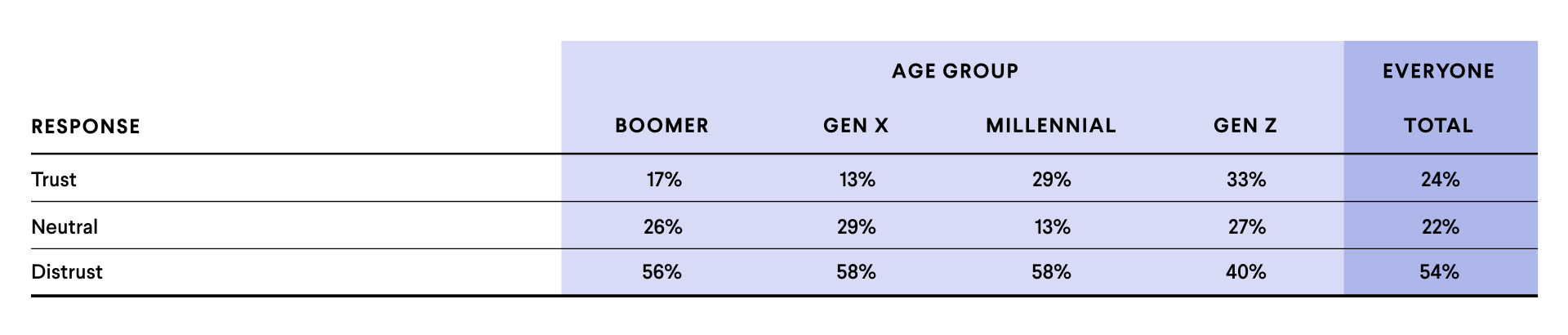
Trust in AI-generated recommendations remains a work in progress. While AI is becoming increasingly visible across search, planning, and customer service, most travelers remain skeptical. More than half (54%) of consumers distrust AI recommendations, with distrust particularly pronounced among Boomers and Gen X. Gen Z stands apart, exhibiting the highest levels of trust and signaling where broader consumer sentiment may eventually head.

The findings suggest that adoption and trust are advancing at different speeds. Travelers are becoming accustomed to AI-enabled experiences, but confidence depends on whether those experiences feel accurate, relevant, and transparent. Younger generations appear more willing to embrace AI, while older travelers continue to place greater value on familiarity and human oversight.

For travel brands, this creates an opportunity to use AI less as a visible feature and more as an intelligence layer that improves experiences behind the scenes. The winners will be those that combine rich customer identity, behavioral data, and adaptive decisioning to deliver recommendations that feel timely and helpful rather than automated for automation's sake.

54 OVERALL TRUST
24 OVERALL TRUST
22% NEUTRAL
2X GEN Z TRUST VS. OLDER

Strategic Recommendations

1. Build trust through relevance, not novelty

Consumers are more likely to trust AI when it consistently delivers value. Rather than introducing standalone AI experiences, brands should leverage behavioral signals and identity to create recommendations that reflect real traveler intent. More relevant experiences strengthen confidence while increasing engagement and customer lifetime value.

2. Use AI to enhance existing channels

AI should improve the channels travelers already trust. Email, SMS, websites, apps, and service interactions become more valuable when AI decisioning determines the right message, timing, and channel for each traveler. This shifts marketing from static campaigns to adaptive customer journeys.

3. Establish a foundation for autonomous marketing

As trust grows, travel brands have an opportunity to move beyond one-size-fits-all campaigns. Identity resolution and agentic decisioning create the infrastructure for continuously learning systems that optimize experiences across the entire customer lifecycle while preserving transparency and customer control.


How much do you trust AI-generated travel recommendations?
2026-Travel-Report-1920x900-Q01


Chapter 2

The AI Sweet Spot in Travel Is Discovery, Not Decisions

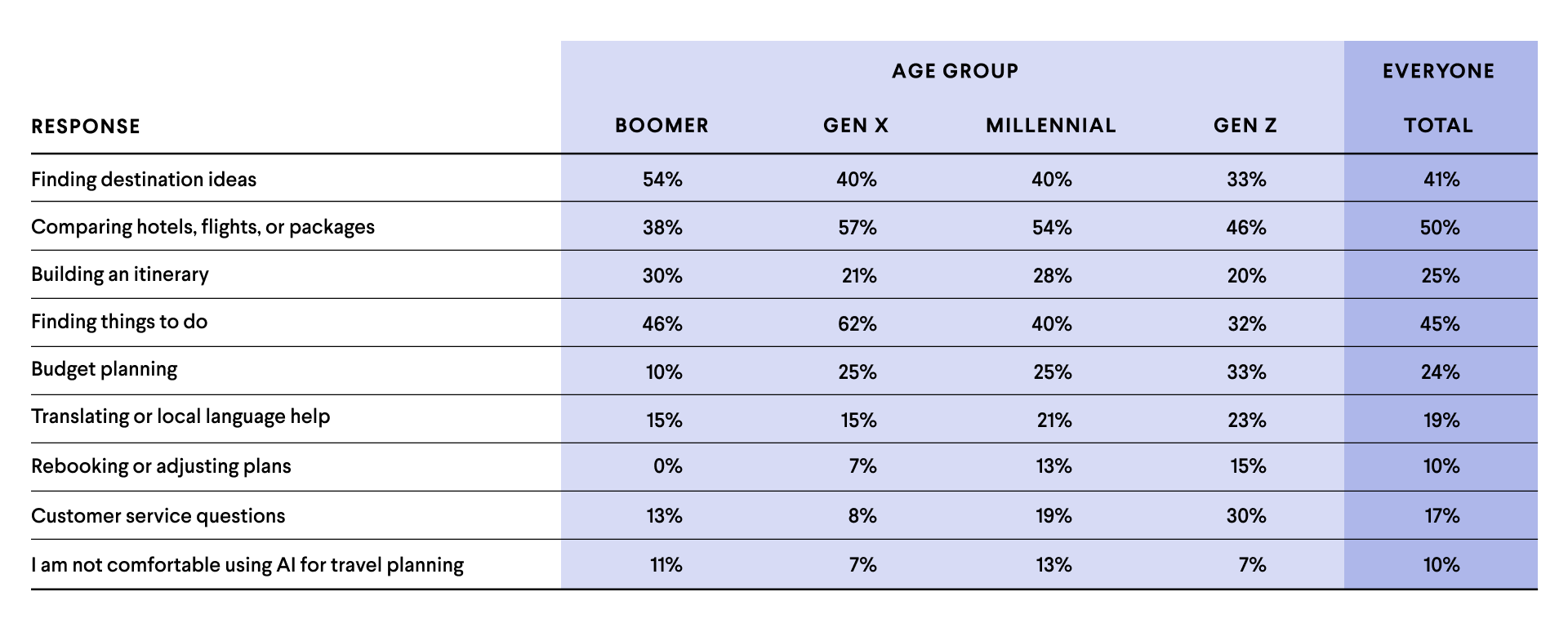
Travelers are not looking to hand over the entire planning process to AI. Instead, they are embracing AI selectively, gravitating toward practical tasks that reduce effort and simplify decision-making. Comparing hotels, flights, and packages is the most widely accepted use case, followed by finding activities and generating destination ideas. Comfort declines considerably when decisions become more consequential, with relatively few travelers willing to rely on AI for rebooking or itinerary changes.

Generational differences reveal how AI adoption is evolving. Gen X travelers are particularly receptive to using AI for activity discovery, while Gen Z demonstrates greater openness to budgeting, customer service, and trip management. These patterns suggest that consumers are not seeking full automation. Rather, they are defining clear boundaries around where AI creates value and where human expertise still matters.

For travel brands, the opportunity lies in deploying AI where it removes friction and enhances discovery. The greatest impact may come not from replacing existing experiences, but from using AI and behavioral intelligence to create more responsive and personalized journeys across channels.


50% FOR PRICE COMPARISON
41% FOR DISCOVERY
17% FOR CUSTOMER SERVICE
10% NOT COMFORTABLE USING AI

Strategic Recommendations

1. Prioritize high-value use cases with clear customer benefits

Consumers are already signaling where they see value. Travel brands should focus AI investments on comparison tools, recommendations, activity discovery, and customer support experiences that simplify planning and accelerate decision-making. These use cases provide faster time-to-value while building confidence in AI-enabled experiences.

2. Combine AI decisioning with human expertise

Travel remains an emotionally significant purchase. Brands should design experiences that blend automation with human support, allowing customers to transition seamlessly between self-service and live assistance when complexity increases. This creates a better customer experience while improving operational efficiency.

3. Move from campaigns to adaptive journeys

Traveler needs vary by generation, context, and stage of the journey. Identity and agentic decisioning enable brands to move beyond static experiences and dynamically personalize content, timing, and channels based on individual behavior. Over time, these adaptive systems create self-improving marketing flywheels that increase conversion, retention, and customer lifetime value.


Which parts of travel planning are you most comfortable using AI for?
2026-Travel-Report-1920x900-Q02

Chapter 3

AI Accuracy Is Becoming the Next Trust Challenge

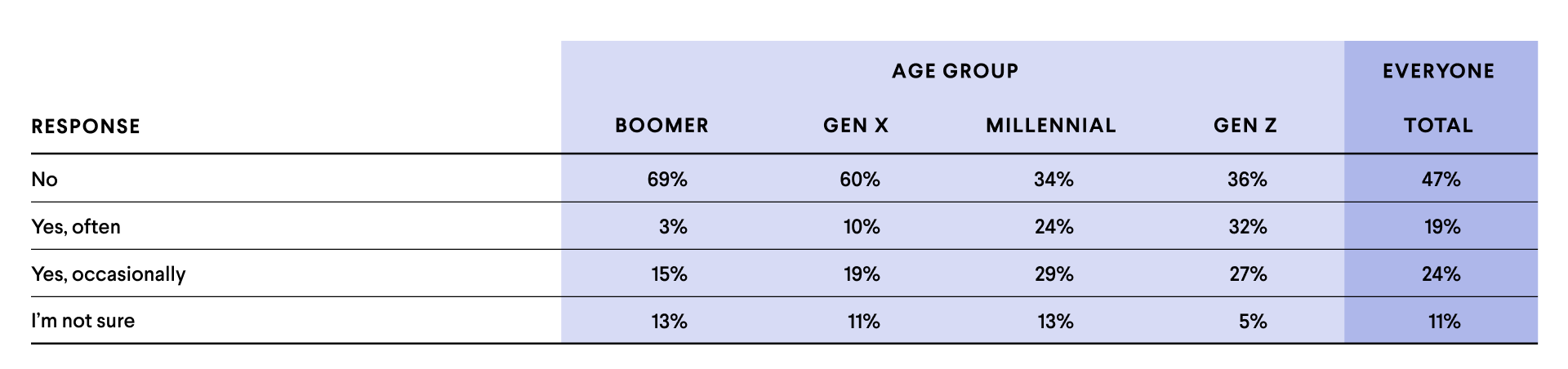
As AI becomes more deeply embedded throughout travel discovery and planning, accuracy is emerging as the next major challenge. While nearly half of travelers say they have never received an inaccurate or irrelevant recommendation, experiences vary considerably by generation. Younger travelers are significantly more likely to report poor recommendations, likely reflecting both higher usage and higher expectations, while older travelers encounter fewer issues, suggesting more limited adoption.

The findings highlight an important distinction: AI adoption alone does not create trust. As consumers interact with AI more frequently, expectations around relevance and precision rise. Gen Z's higher incidence of poor experiences may signal that the next phase of AI maturity will be determined less by access and more by quality.

For travel brands, the opportunity lies in turning behavioral intelligence into marketing intelligence. Rich identity and real-time signals enable brands to move beyond generic recommendations and deliver experiences that adapt to traveler intent. As AI decisioning becomes more sophisticated, relevance, not novelty will increasingly define customer trust and long-term loyalty.

47% NO AI ERRORS
24% SOME AI MISTAKES
19% REGULAR AI MISTAKES
32% OF GEN Z OFTEN EXPERIENCE AI ERRORS

Strategic Recommendations

1. Prioritize intelligence over experimentation

Consumers are willing to embrace AI, but only when it consistently delivers value. Rather than launching isolated AI features, brands should leverage identity, behavioral data, and propensity signals to improve recommendation quality and reduce friction. Better intelligence leads to better experiences and stronger customer relationships.

2. Make recommendations more transparent and contextual

Consumers are more likely to trust AI when they understand why suggestions are being made. Explainable recommendations, dynamic content, and context-driven messaging help transform AI from a black box into a trusted advisor while reducing perceptions of irrelevance.

3. Create self-improving customer experiences

AI should continuously learn from customer behavior across channels. By combining identity with agentic decisioning, brands can move beyond static campaigns and build adaptive systems that become smarter over time, increasing conversion, retention, and customer lifetime value.


Have you ever received travel recommendations from an AI tool that felt inaccurate, outdated, or irrelevant?
2026-Travel-Report-1920x900-Q03


Chapter 4

Travelers Are Embracing AI, But Not Without Limits

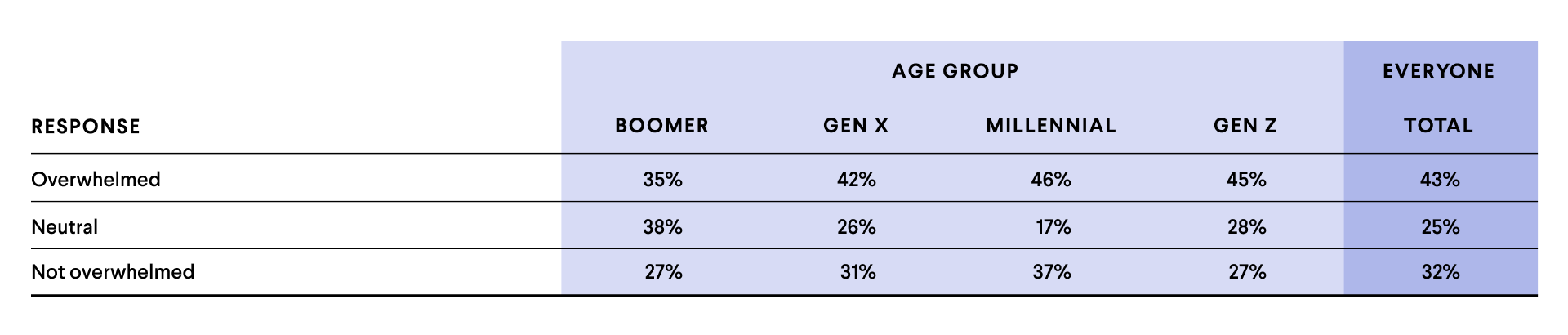
As AI expands across digital experiences, consumers are signaling that enthusiasm has limits. Nearly half of travelers report feeling overwhelmed by the growing presence of AI, making fatigue the dominant sentiment. Yet these findings should not be interpreted as resistance to AI itself. Rather, travelers appear to be rejecting experiences that feel excessive, irrelevant, or unnecessarily complex.

Perhaps the most intriguing dynamic is among Millennials. They are both among the most receptive generations to AI and the most fatigued by its proliferation. Their familiarity with digital experiences appears to have raised expectations around usefulness and relevance. In many ways, Millennials are emerging as both AI power users and its toughest critics.

For travel brands, the message is clear: consumers do not want more AI—they want better AI. The winners will not be the brands that add AI to every interaction, but those that use intelligence selectively to remove friction and create experiences that feel seamless rather than intrusive.


43% OVERWHELMED BY AI
32% NOT OVERWHELMED BY AI
25% NEUTRAL
45% + MILLENNIALS & GEN Z OVERWHELMED

Strategic Recommendations

1. Focus on outcomes, not features

Travelers care less about AI itself and more about the value it creates. Brands should prioritize experiences that simplify planning, reduce effort, and deliver measurable improvements to the customer journey rather than introducing AI for its own sake.

2. Use AI to orchestrate experiences, not overwhelm them

Agentic decisioning can determine when to engage customers—and when not to. Intelligent suppression, channel optimization, and adaptive messaging help brands deliver fewer but more relevant interactions, improving both customer experience and marketing performance.

3. Build invisible intelligence into the customer journey

The most effective AI often operates behind the scenes. Identity, behavioral data, and real-time decisioning can create personalized experiences across email, SMS, onsite, and mobile channels without making AI the focal point. This approach improves operational efficiency while creating the seamless, intuitive experiences travelers increasingly expect.


Are you becoming overwhelmed or fatigued by AI being added to more digital experiences?
2026-Travel-Report-1920x900-Q04

Chapter 5

The Travel Discovery Journey Is Fragmenting

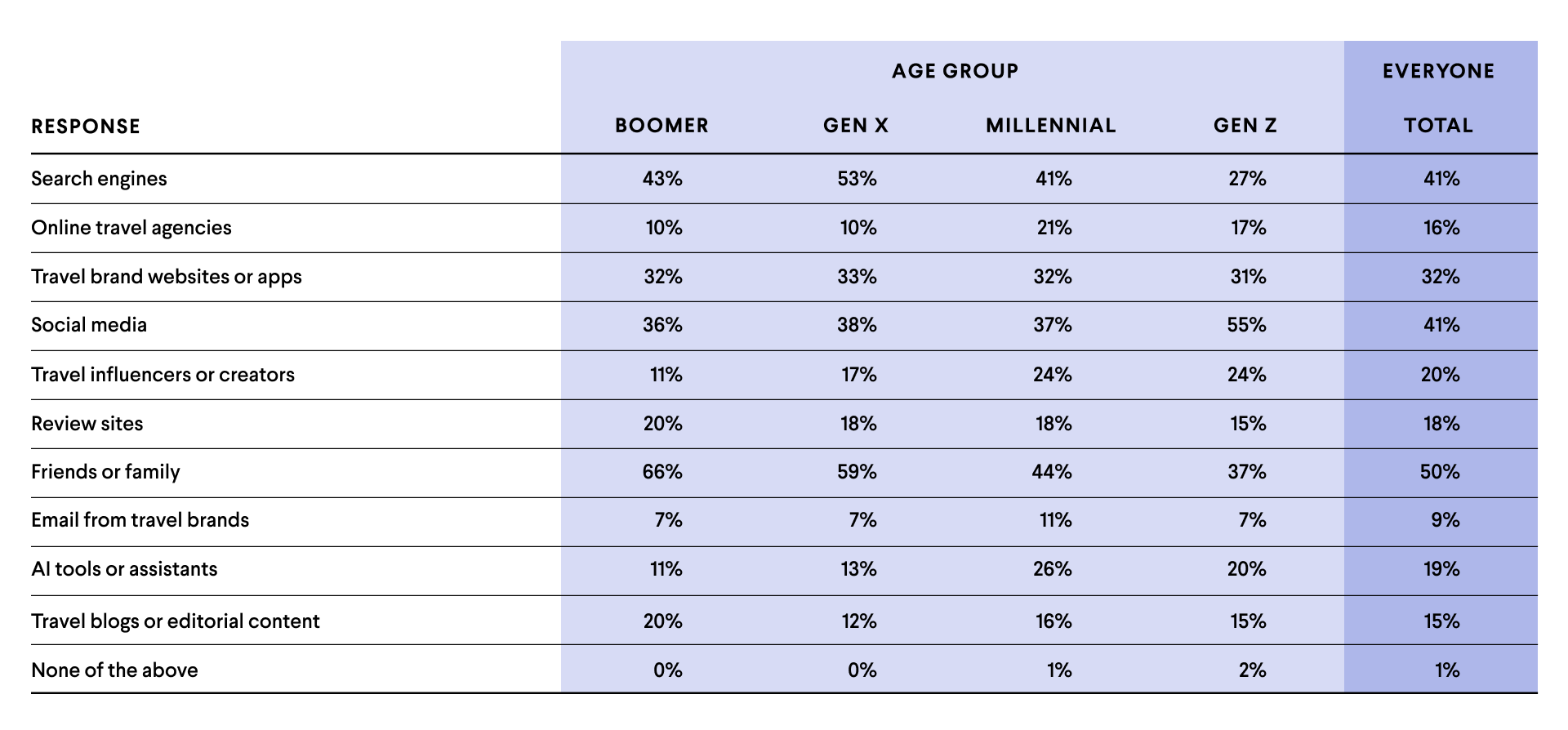
Travel discovery is becoming increasingly fragmented. While friends and family remain the largest source of inspiration overall, travelers now move fluidly between search engines, social platforms, creators, AI assistants, and brand-owned channels. Rather than replacing one another, these channels increasingly work together, creating a more dynamic and nonlinear path to purchase.

One of the most striking findings is the consistency of travel brand websites and apps. Roughly one-third of every generation uses owned digital properties for inspiration, making them one of the few channels that transcend age differences. Meanwhile, AI-powered discovery reveals a different pattern. Millennials have emerged as the bridge generation, embracing search, social media, influencers, and AI tools simultaneously. Gen Z's lower AI usage relative to Millennials likely reflects their stronger reliance on social platforms and creator-driven content, while older travelers continue to lean on search and personal recommendations.

As conversational search and AI assistants gain adoption, discovery will become increasingly distributed. The challenge for travel brands is ensuring that every source of inspiration ultimately leads travelers back into owned experiences where identity, behavioral intelligence, and personalization can drive stronger direct relationships.

32% TRAVEL BRAND WEBSITES
41% USE SEARCH ENGINES
41% USE SOCIAL MEDIA
19% AI TOOLS

Strategic Recommendations

1. Treat discovery as an ecosystem, not a channel

Consumers no longer follow linear journeys. Travel brands should build integrated discovery strategies spanning search, social, creators, AI experiences, and owned properties. The goal is not to optimize individual channels in isolation, but to create connected journeys that move travelers seamlessly from inspiration to booking.

2. Turn owned channels into conversion engines

Brand websites and apps remain remarkably resilient across generations. Identity infrastructure allows brands to recognize visitors across sessions and devices, transforming owned properties from static destinations into dynamic environments that adapt to traveler intent and maximize direct revenue.

3. Prepare for the rise of AI-assisted discovery

As AI becomes another entry point into the travel journey, brands should optimize content, experiences, and data foundations for conversational interfaces. Identity and agentic decisioning can help convert anonymous traffic into known, reachable customers while enabling more personalized experiences across channels.


Where do you typically discover travel ideas today?
2026-Travel-Report-1920x900-Q05

Chapter 6

Email Still Wins Attention, but New Channels Are Reshaping Engagement

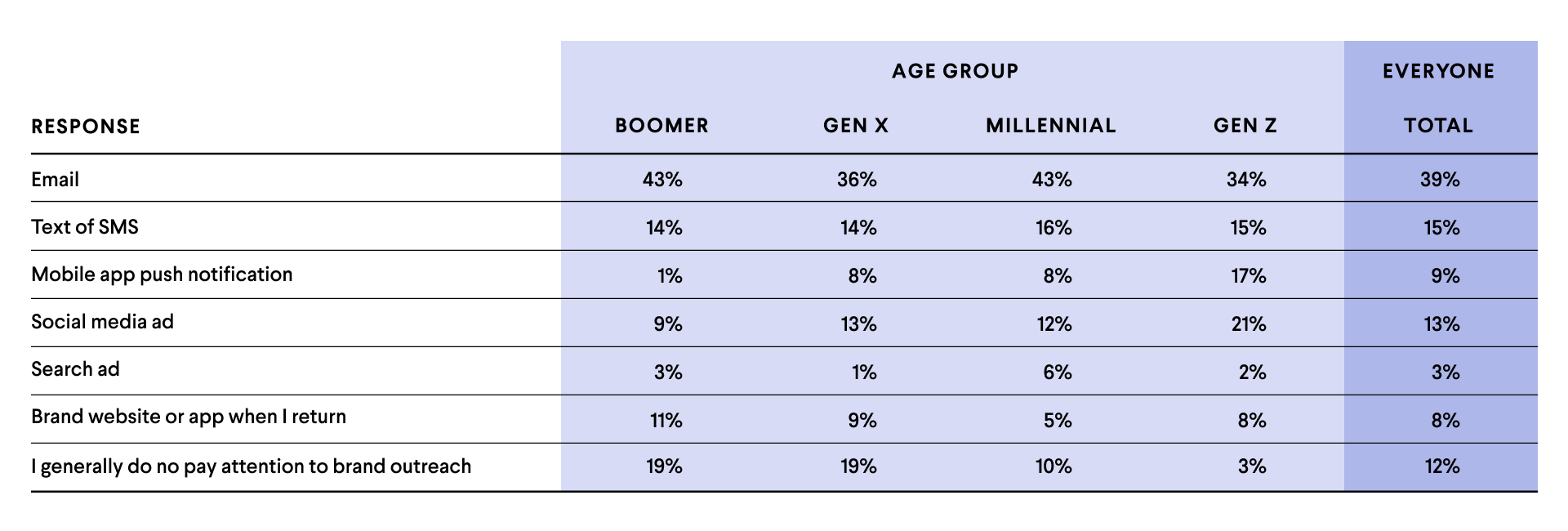
Despite the rise of mobile and social platforms, email remains the most effective channel for capturing travelers' attention. Nearly four in ten travelers say email is most likely to get their attention—more than three times the response for any other channel. Preferences, however, vary by generation. Boomers and Millennials show the strongest affinity for email, while Gen Z is more responsive to push notifications and social media advertising. Older generations are also more likely to tune out brand outreach altogether.

Attention is not confined to outbound channels. Alongside email and SMS, travelers continue to engage when they return to a brand's website or app. These touchpoints should not be viewed independently. Increasingly, they form part of an interconnected ecosystem powered by identity. By recognizing travelers across sessions, devices, and channels, brands can orchestrate email, SMS, onsite experiences, and mobile interactions as a single journey rather than a collection of separate campaigns.

The result is a shift from channel-centric marketing to customer-centric engagement. In this model, channel selection becomes dynamic, enabling brands to meet travelers where they are with the right message, at the right time, on the right device.

39% EMAIL
15% SMS
9% PUSH
8% BRAND WEBSITES WHEN RETURN

Strategic Recommendations

1. Build around email, but think beyond email

Email remains the foundation of CRM and lifecycle marketing, but travelers increasingly expect brands to engage across multiple touchpoints. Travel brands should use email as an anchor while extending experiences across SMS, mobile, onsite, and social channels to create a more connected customer journey.

2. Let identity determine the best channel

Most customer journeys span multiple devices and sessions, yet much of this activity remains anonymous. Identity resolution enables brands to recognize more travelers and use behavioral intelligence to determine not only what message to send, but which channel is most likely to drive engagement and conversion.

3. Replace campaign silos with autonomous orchestration

Consumers do not experience brands channel by channel. Agentic decisioning allows marketers to move beyond static campaign execution and coordinate experiences across email, SMS, websites, apps, and paid media automatically. This creates more relevant customer interactions, improves operational efficiency, and establishes the foundation for continuous performance optimization and customer lifetime value growth.


When a travel or hospitality brand reaches out to you, which channel is most likely to get your attention?
2026-Travel-Report-1920x900-Q06

Chapter 7

Direct Relationships Still Matter in a Multi-Platform World

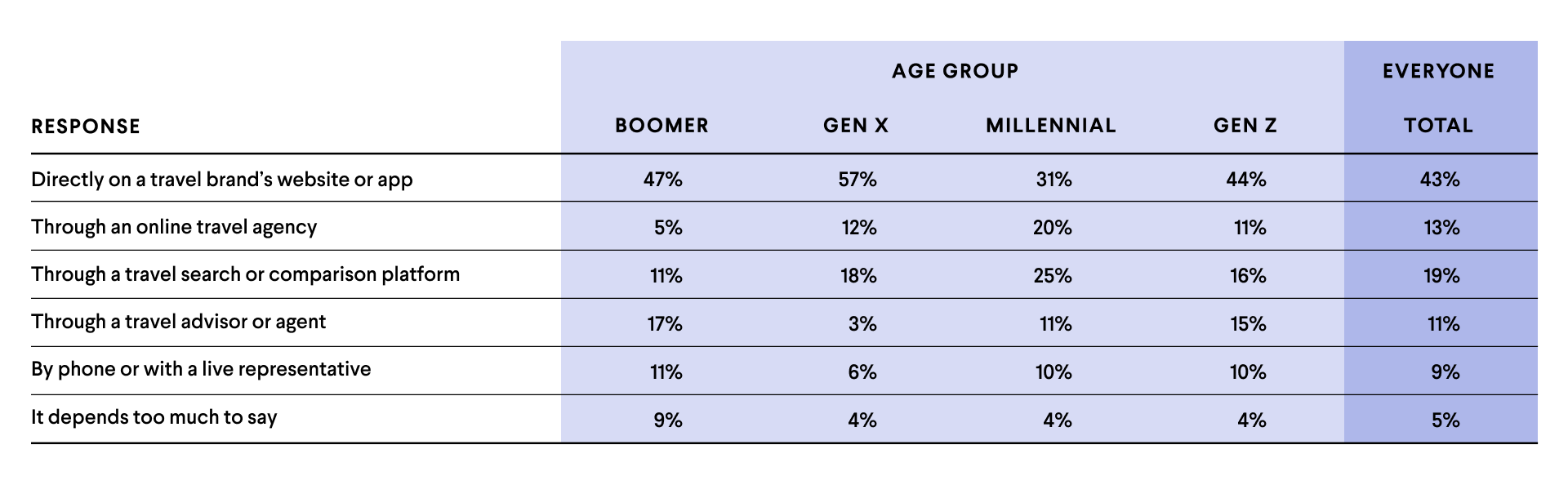
Despite the growth of online travel agencies and metasearch platforms, direct relationships remain remarkably resilient. Nearly half of travelers complete bookings directly through a brand's website or app, making owned channels the preferred point of purchase. However, the journey to that booking is becoming increasingly fragmented.

Millennials exhibit the most diverse behaviors, splitting attention between direct channels, OTAs, and comparison platforms, while Boomers continue to demonstrate the greatest reliance on travel advisors and human expertise. Gen Z combines strong direct-booking tendencies with a willingness to explore alternative channels, suggesting convenience matters more than loyalty to any single platform.

These findings reinforce an important reality: travelers may research across many channels, but they still prefer to transact directly with brands they trust. The challenge is that most of this activity occurs across disconnected sessions, devices, and touchpoints. Without a persistent identity layer, high-intent travelers often disappear into anonymous traffic, only to reappear on OTAs or competitor sites.

The opportunity for travel brands is not simply to drive more traffic, but to recognize more travelers. Identity transforms fragmented journeys into connected relationships, enabling brands to engage consumers across channels and ultimately capture more high-margin direct bookings.

43% BOOK DIRECT
19% SEARCH
13% OTAS
57% OF GEN X BOOK DIRECT

Strategic Recommendations

1. Invest in direct channels as growth engines

Brand websites and apps should be viewed as strategic assets rather than transactional endpoints. By creating frictionless booking experiences and emphasizing the benefits of booking directly, brands can strengthen customer relationships while reducing dependence on third parties.

2. Turn anonymous traffic into reachable customers

Many travelers research across multiple sessions and devices before booking. Identity resolution enables brands to recognize more visitors and activate behavioral signals that support personalized messaging, abandoned-search programs, and conversion journeys that increase direct revenue.

3. Build customer journeys, not channel strategies

Travelers do not think in terms of OTAs, websites, and email programs. They move fluidly between them. Agentic decisioning allows brands to coordinate experiences across channels, optimize timing and messaging, and create adaptive journeys that improve conversion while growing customer lifetime value.


Where do you most often complete a travel booking?
2026-Travel-Report-1920x900-Q07

Chapter 8

Trust and Convenience Drive Direct Relationships

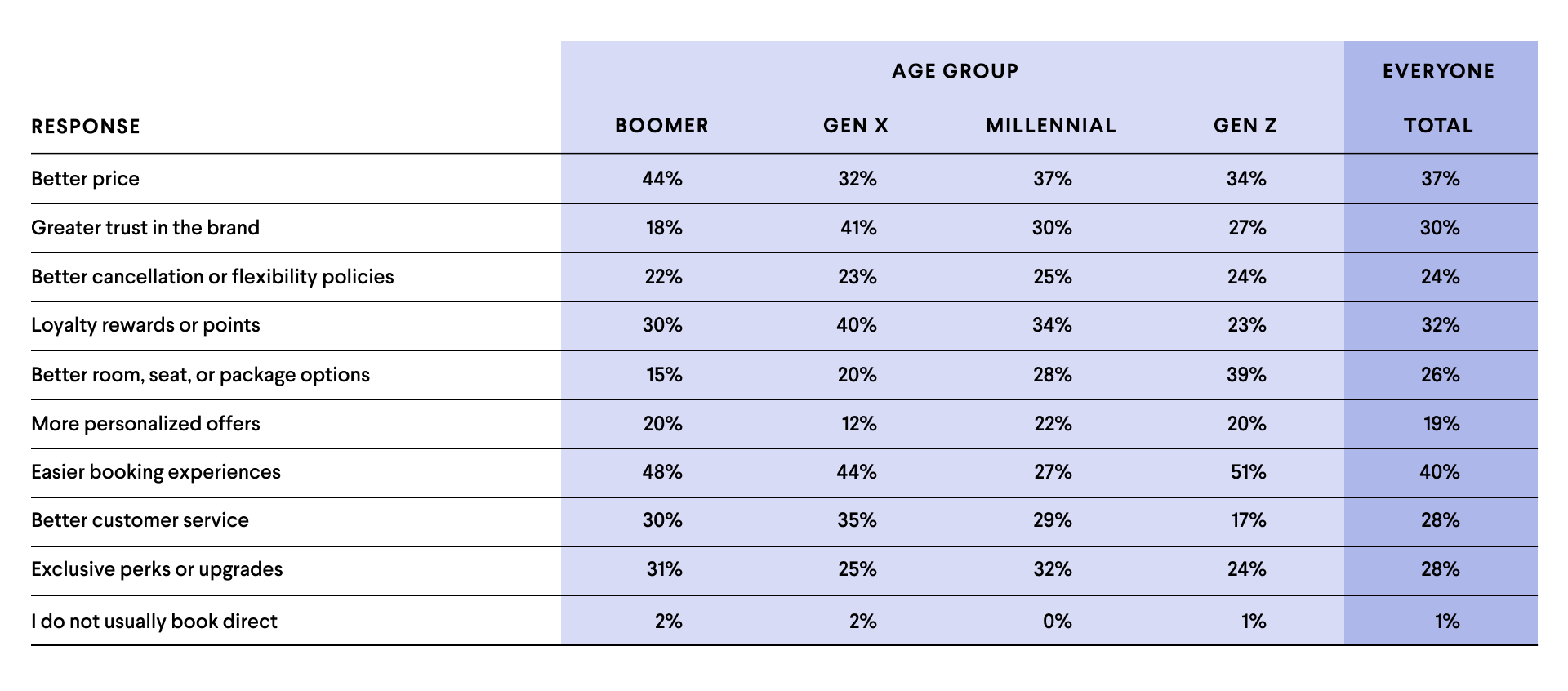
Price has traditionally been viewed as the primary driver of direct bookings, but travelers increasingly value something more fundamental: convenience and trust. Across all generations, ease of booking is the leading factor influencing consumers to book directly, narrowly surpassing price and ranking ahead of loyalty rewards and brand trust. Gen Z places especially high importance on simplicity, while Gen X demonstrates the strongest affinity for trust and loyalty programs. Boomers continue to value customer service and exclusive perks, underscoring the enduring importance of human-centric experiences.

Perhaps the most revealing finding is what consumers do not prioritize. Fewer than one in five travelers cite personalized offers as a reason to book directly. This suggests that consumers value the outcomes of personalization more than personalization itself. Travelers are rewarding brands that make experiences simpler, faster, and more relevant, regardless of whether those experiences are explicitly marketed as personalized.

For travel brands, this represents an opportunity to compete on experience rather than price. Identity and AI decisioning can quietly deliver more relevant offers, upgrades, and recommendations behind the scenes, transforming direct channels into smarter, more intuitive experiences that create long-term loyalty and higher customer lifetime value.

40% EASY BOOKING
37% BETTER PRICES
32% LOYALTY REWARDS
30% TRUST

Strategic Recommendations

1. Differentiate on experience, not discounts

Competing solely on price is a race to the bottom. Brands should focus on reducing friction, simplifying booking flows, and delivering experiences that are easier and more intuitive than those offered by intermediaries.

2. Turn trust and loyalty into retention flywheels

Loyalty programs, customer service, and exclusive benefits are powerful assets, but their value increases when paired with identity and behavioral intelligence. By recognizing customers across interactions, brands can create more relevant experiences that encourage repeat bookings and maximize customer lifetime value.

3. Make personalization invisible but impactful

Consumers do not necessarily want more personalized marketing—they want better experiences. Identity and AI decisioning enable brands to dynamically tailor offers, content, and channel selection without adding complexity for the traveler. Over time, these adaptive experiences create self-improving retention flywheels that strengthen direct relationships and drive profitable growth.


What most influences your decision to book directly with a travel brand instead of a third-party site?
2026-Travel-Report-1920x900-Q08

Chapter 9

Travelers Remain Divided on the Personalization Value Exchange

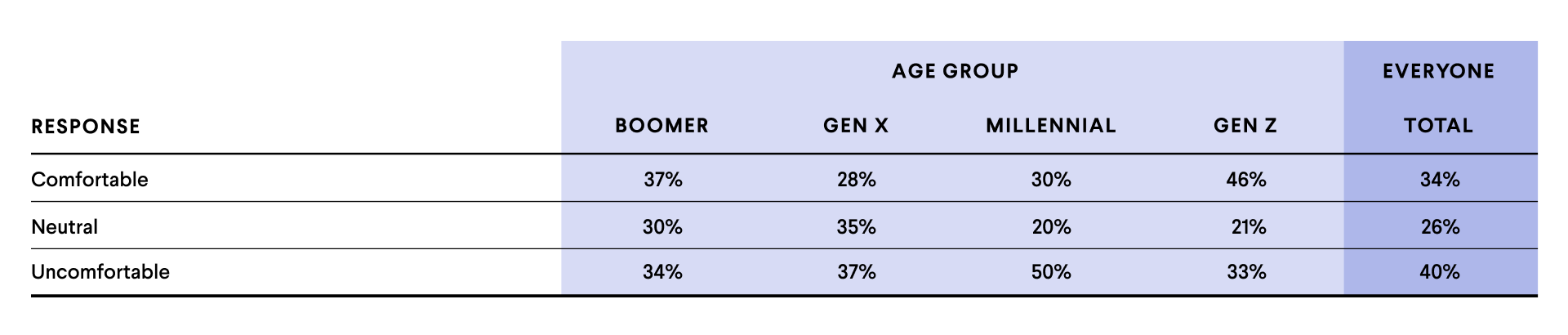
As travel brands pursue increasingly personalized experiences, consumers remain divided on the value exchange required to enable them. Overall, travelers are slightly more uncomfortable sharing personal data than they are comfortable doing so, underscoring the delicate balance between personalization and privacy. Yet attitudes vary considerably across generations. Gen Z is the most receptive to exchanging data for better experiences, while Millennials—despite being among the heaviest users of digital channels and AI-powered tools—are the most reluctant.

This tension reveals an important reality: travelers do not necessarily value personalization as a concept. They value the outcomes it produces. Convenience, relevance, and simplicity matter far more than whether an experience is labeled "personalized." Millennials' skepticism suggests that digital maturity may raise expectations around transparency and trust, rather than automatically increasing willingness to share information.

For travel brands, the challenge is not convincing consumers that personalization matters. It is proving that sharing data results in experiences that are demonstrably better. Identity should not be viewed as a mechanism for collecting more data, but as the infrastructure that enables brands to create more intelligent, connected, and customer-centric experiences.


34% COMFORTABLE WITH THE VALUE EXCHANGE
40% UNCOMFORTABLE SHARING DATA
26% NEUTRAL
46% OF GEN Z COMFORTABLE

Strategic Recommendations

1. Lead with value, not data collection

Consumers are willing to share information when the benefits are obvious. Rather than emphasizing personalization itself, brands should demonstrate how identity enables faster booking experiences, more relevant recommendations, seamless cross-device interactions, and better service. The value exchange should feel tangible, not theoretical.

2. Build identity progressively and transparently

Trust is earned over time. Brands should adopt permission-based approaches that enrich customer profiles gradually through ongoing interactions rather than relying on large upfront requests. Progressive identity creates stronger customer relationships while establishing the foundation for more sophisticated engagement and retention programs.

3. Turn customer intelligence into customer value

First-party data alone does not create competitive advantage. Combined with identity and AI decisioning, it becomes the foundation for adaptive experiences that optimize channel selection, timing, and content. Over time, these self-improving systems increase engagement, retention, and customer lifetime value while respecting customer preferences.


How comfortable are you sharing personal data in exchange for more personalized offers or recommendations from a travel brand?
2026-Travel-Report-1920x900-Q09

Chapter 10

Travelers Still Want Humans for High-Stakes Moments

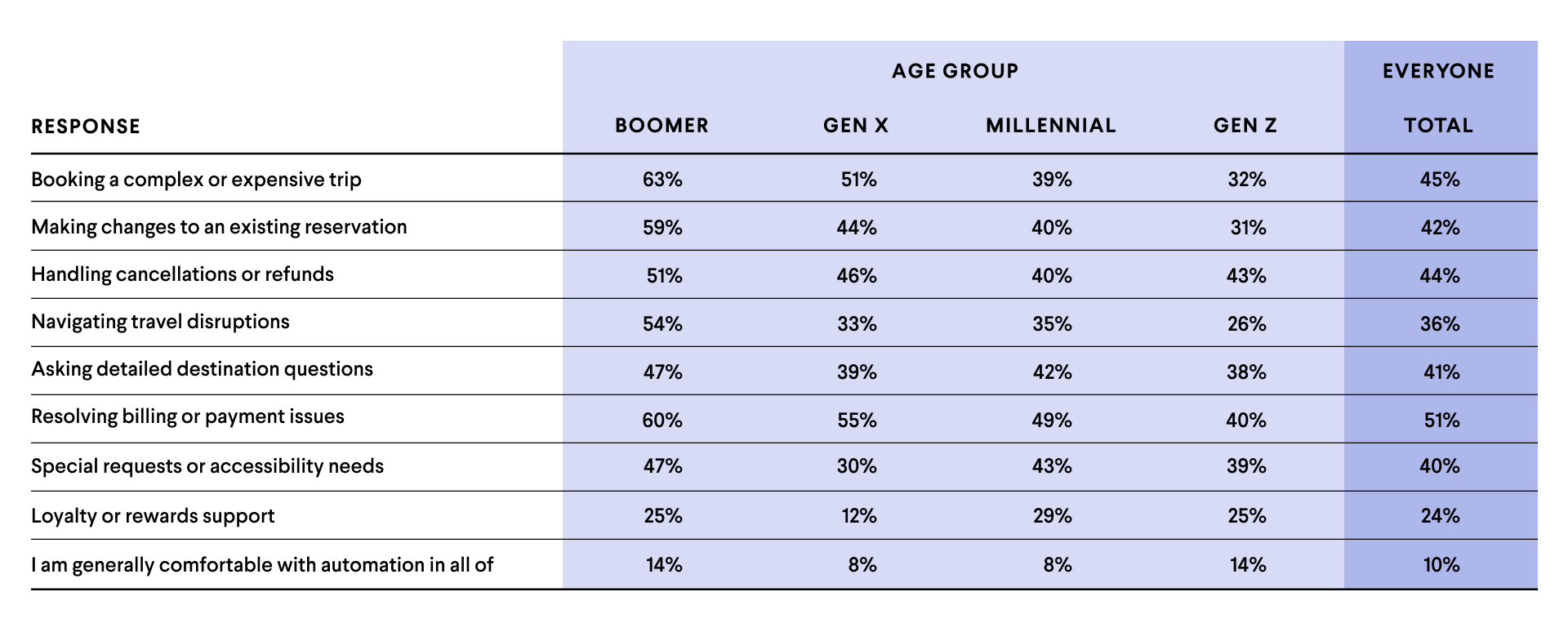
Despite rapid advances in AI and automation, travelers continue to place a premium on human interaction when decisions become complex, expensive, or emotionally charged. Billing issues, cancellations, disruptions, and high-value bookings consistently rank among the moments where consumers most strongly prefer human support. While Gen Z is more comfortable with automation than older generations, even younger travelers continue to value empathy and expertise when uncertainty enters the journey.

These findings suggest that the future of travel experiences is not fully automated. Rather, it will be defined by the combination of intelligent systems and human reassurance. Travelers want efficiency when tasks are straightforward, but they still expect empathy when the stakes are high. The strongest brands will not frame AI and people as competing forces. Instead, they will design experiences where each complements the other.

As AI capabilities mature, automation should increasingly operate as an invisible layer that removes friction, anticipates needs, and accelerates resolution. Human expertise, meanwhile, becomes even more valuable during moments that require trust, judgment, and emotional intelligence.

51% BILLING ISSUES
45% COMPLEX TRIPS
44% CANCELLATIONS
10% AUTOMATION FOR ALL

Strategic Recommendations

1. Automate for efficiency, elevate humans for empathy

Travel brands should focus AI on repetitive and low-friction tasks such as discovery, simple service requests, and routine communications, while preserving human interaction for moments involving disruption, complexity, or emotional stress. This balance improves customer experience while driving operational efficiency.

2. Design seamless transitions between AI and human support

Customers should never feel trapped between channels. Identity and real-time behavioral intelligence allow brands to preserve context as travelers move from self-service experiences to live agents. This creates faster resolutions, more personalized interactions, and stronger customer satisfaction.

3. Create adaptive service ecosystems

The next generation of customer experience will be powered by agentic decisioning that continuously evaluates customer intent, channel preferences, and situational context. By orchestrating interactions across digital and human touchpoints, brands can deliver more responsive experiences, improve retention, and build long-term customer loyalty.


In which travel situations do you still strongly prefer human interaction over automation?
2026-Travel-Report-1920x900-Q10

Chapter 11

Human Support and Real-Time Information Define the Ideal Disruption Experience

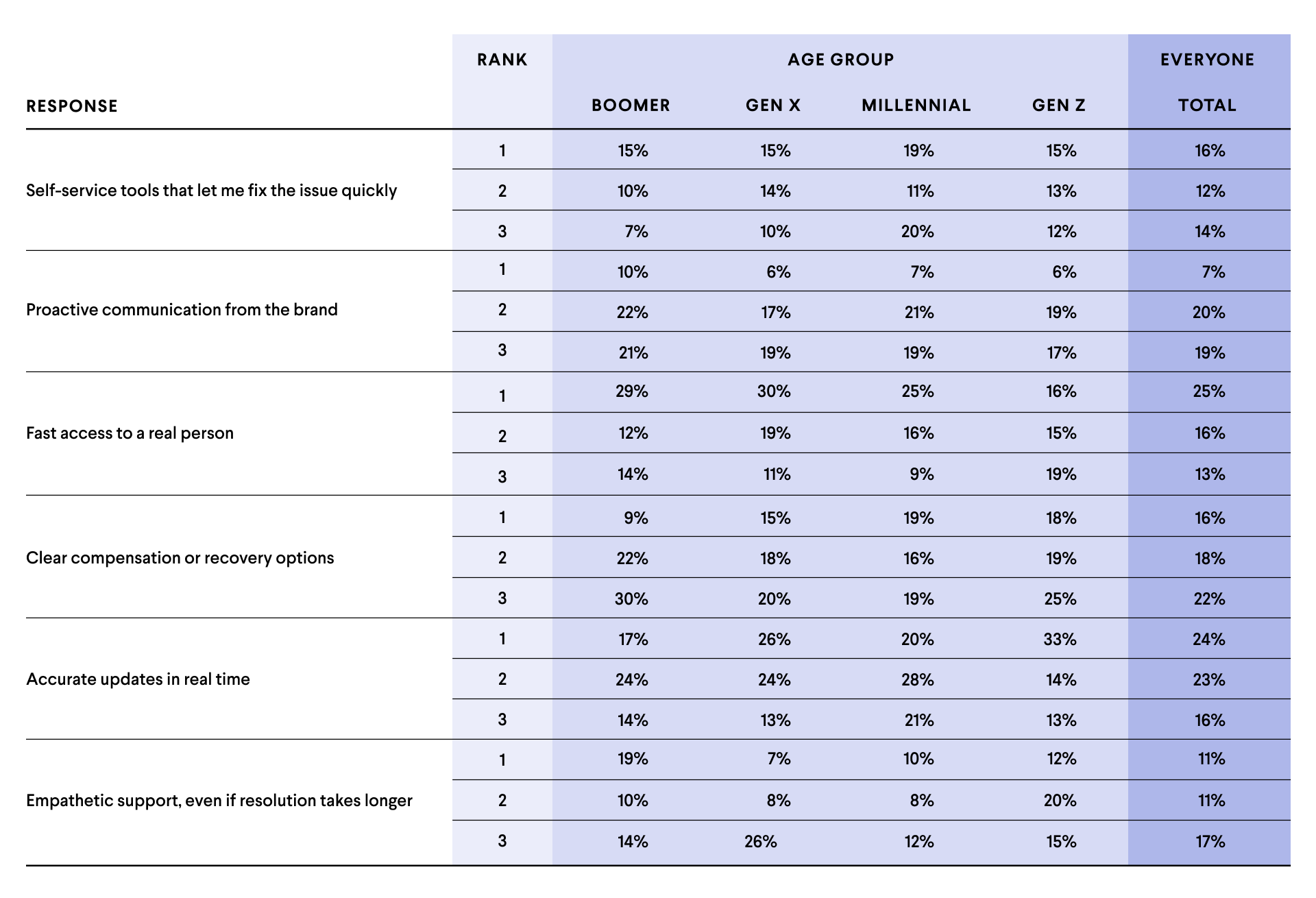
Travel disruptions reveal a clear generational divide in what travelers value most when plans go wrong. Overall, fast access to a real person (25%) emerged as the top priority, particularly among Boomers (29%) and Gen X (30%), underscoring the continued importance of human assistance during stressful and complex situations.

Millennials exhibit more balanced preferences, valuing both human support and digital convenience. They rank accurate updates in real time (20%), fast access to a representative (25%), and self-service tools (19%) highly, suggesting an expectation that brands deliver both efficiency and transparency.

Gen Z stands apart, with accurate updates in real time (33%) representing their highest priority. This generation is less dependent on speaking with an agent and more focused on receiving immediate, trustworthy information and having access to digital tools that help them manage disruptions independently.

Across all age groups, travelers prioritize rapid resolution and clear information over empathy alone. The findings suggest that the strongest disruption experiences will combine intelligent self-service capabilities, real-time communications, and seamless escalation to human support when complexity or emotional stress increases.

Strategic Recommendations

1. Build disruption experiences around speed and transparency

Brands should deliver proactive alerts, dynamic itinerary updates, and clear recovery options across email, SMS, apps, and websites. Providing timely information reduces anxiety, improves satisfaction, and helps preserve trust during high-stress moments.

2. Create seamless transitions between self-service and human support

Customers should never feel trapped between automation and live assistance. Identity and real-time behavioral intelligence allow brands to preserve context as travelers move from chatbots and self-service tools to contact centers and agents. This creates faster resolutions, eliminates repetitive conversations, and enables more personalized support. The result is a customer experience that combines operational efficiency with the reassurance travelers seek when disruptions become more complex.

3. Develop adaptive service ecosystems powered by intent

The future of travel service is not AI versus humans, but intelligent orchestration between the two. Agentic decisioning can continuously evaluate customer intent, disruption severity, loyalty status, and channel preferences to determine the next best action.


During travel disruptions, what matters most to you?
2026-Travel-Report-1920x900-Q11

Conclusion: The Future of Travel Belongs to Intelligent Experiences

The travel industry is entering a period defined not by channels, campaigns, or even AI itself, but by the ability to create experiences that feel effortless, connected, and deeply relevant. As travelers navigate an increasingly fragmented landscape of search engines, social platforms, AI assistants, and brand-owned channels, expectations for convenience, transparency, and trust continue to rise.

The findings in this report reveal a clear pattern. Consumers are embracing AI, but they are not seeking a fully automated future. They want technology that removes friction without removing humanity. They value speed and self-service, but continue to rely on human expertise during moments of complexity, disruption, and emotional stress. Across generations, trust remains the currency that determines where travelers book, which brands they engage with, and how willing they are to share their data.

One defining characteristic of travel consumers is their extended consideration period. Travelers typically browse multiple sites, switch between devices, and compare options for six weeks or more before booking. This protracted booking journey makes re-engagement crucial, delivering the right message, on the right channel, at the right time can mean the difference between securing a booking and losing a potential customer.

Yet, up to 95% of website traffic remains anonymous, making it difficult to deliver personalized offers via email, text, and ads. Additionally, only 3% of visitors complete a booking in a single session. Travel brands that fail to identify and re-engage these potential customers risk missing out on significant revenue opportunities.

Wunderkind's Autonomous Marketing Platform combines its proprietary Identity Graph with agentic decisioning to help travel brands transform fragmented interactions into connected customer relationships. By recognizing more travelers across devices and sessions and activating real-time behavioral signals, brands can deliver hyper-personalized experiences across email, SMS, mobile, onsite, and paid media without relying on static campaigns or manual processes.

The brands that will outperform now and in the future will not simply adopt more AI. They will build intelligent ecosystems that combine identity, automation, and human expertise to create experiences that feel simpler, faster, and more personal. In a world where customer expectations are rising and attention is increasingly scarce, the ability to recognize, understand, and adapt to traveler behavior will become the defining advantage for long-term growth.

Frame 1000001887

Lorem ipsum dolor sit amet nibh massaconsectetur

Lorem ipsum dolor sit amet consectetur. Proin aliquam ut dolor at. Tincidunt mattis mauris ut duis nisi
elit aliquam dis. Tellus gravida id cursus cras vel pulvinar venenatis.