




How publishers can use Wunderkind identity to make Braze a stronger growth, engagement, and monetization engine
In 2026, publisher performance isn’t limited by how strong your journalism is, how compelling your content slate looks, or how many journeys your engagement platform can orchestrate.
It’s limited by who you can actually see.
Most publishers are still operating with only a partial view of their audience. Even with analytics platforms, subscription tools, CRMs, CDPs, and customer engagement platforms like Braze in place, as much as 70–95% of site traffic remains anonymous to the systems that are supposed to personalize experiences, grow registrations and subscriptions, and drive revenue.
That’s not a content problem. It’s an identity problem.
Earlier identity playbooks made the case that recognizing more of your traffic was the unlock for better behavioral messaging and stronger owned-channel performance. In 2026, that idea has grown up. Identity is no longer a supporting character. It is the performance infrastructure underneath audience development, engagement, monetization, and retention.
This ebook is about what that means for modern publishers — and how to turn identity from a background data initiative into a front-line growth lever by pairing Wunderkind and Braze to drive smarter audience journeys, better monetization, and more responsive reader experiences.
The Identity Wake-Up Call for Publishers Using Braze
Publishers didn’t suddenly forget how to build strong audience programs. The environment changed under them. Third-party cookies, once treated as connective tissue across the open web, no longer behave like dependable infrastructure. Browser and OS-level changes have made them fragile at best and irrelevant at worst. At the same time, reader behavior has become more fragmented. A single person might discover a story on social, return from search on another device, sign up for a newsletter days later, and eventually subscribe from an entirely different session. To your systems, that same reader can still look like a trail of disconnected visits. Layer on a much stricter privacy and consent landscape. What used to be shrugged off as “tracking” now comes with real reputational and regulatory risk.

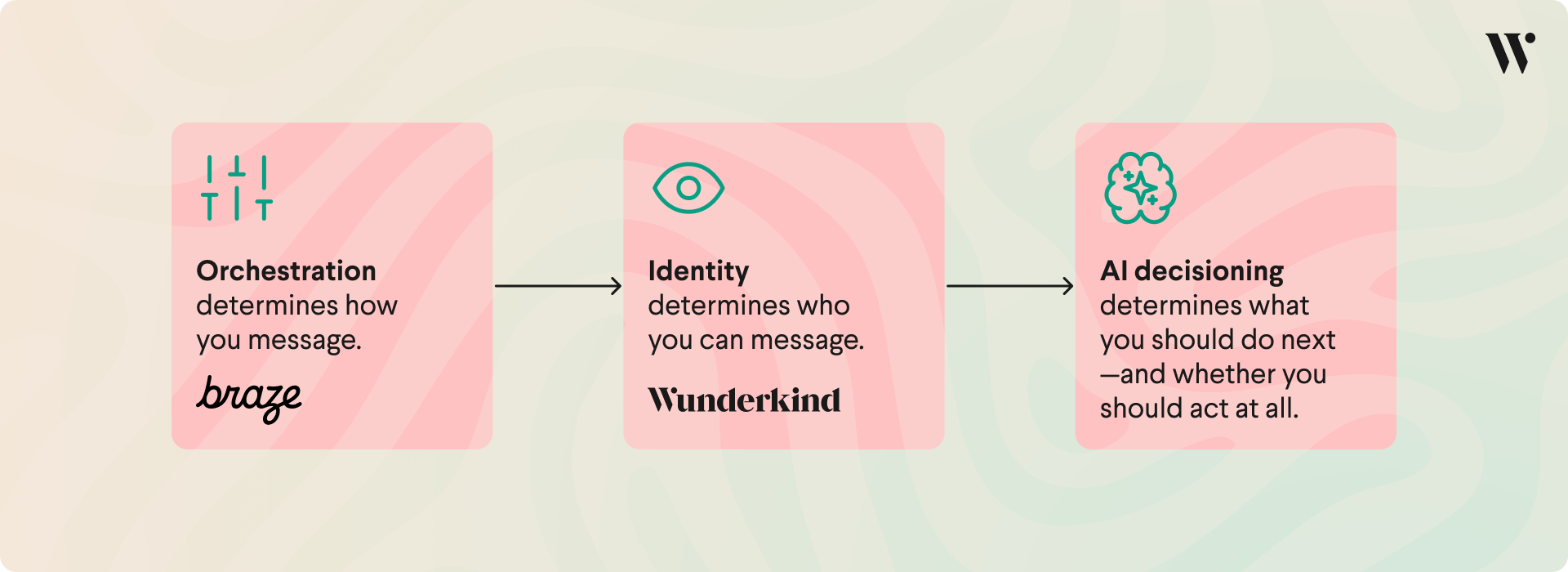
Braze has not become less valuable in this environment — if anything, the opposite is true. Braze remains a powerful customer engagement platform built to ingest customer data in real time, orchestrate cross-channel journeys, and optimize engagement strategies. It is excellent at what it was designed to do: orchestrate campaigns, journeys, and reporting for the audiences it knows. But by design, Braze and other orchestration platforms only act on the data they receive. They were never meant to serve as independent identity networks or reconstruct a reader’s full cross-session, cross-device story on their own. When that identity layer is thin, even your best Braze Canvas journeys are running on only a small slice of your true audience.
For publishers, that means high-intent readers can consume content, hit a paywall, browse multiple sections, engage with newsletters, or show clear subscription propensity — and still never enter the right Braze journey because they were never properly recognized in the first place. Independent research from Forrester captures this tension clearly: marketers overwhelmingly see identity resolution as a driver of growth, efficiency, and customer satisfaction, but fewer than a quarter feel confident their programs have the depth, persistence, and scale required for modern multi-device journeys. Nearly 70% say incomplete identity is what stops them from scaling triggered programs meaningfully.
The conclusion is uncomfortable but helpful: if identity is shallow, your personalization is shallow — no matter how advanced Braze and the rest of your stack look on paper.
From Match Rates to Audience Intelligence Inside Braze
For years, identity conversations revolved around match rates. Could a partner recognize 20% of your traffic? Thirty? Forty? The metric mattered, but the conversation was narrow. In 2026, the lens is wider. The question is no longer just, “How many readers can you identify?” It’s also, “What can your marketing system intelligently do once it recognizes them?”
At Wunderkind, we describe the relationship this way: identity is the eyes; AI decisioning is the brain.
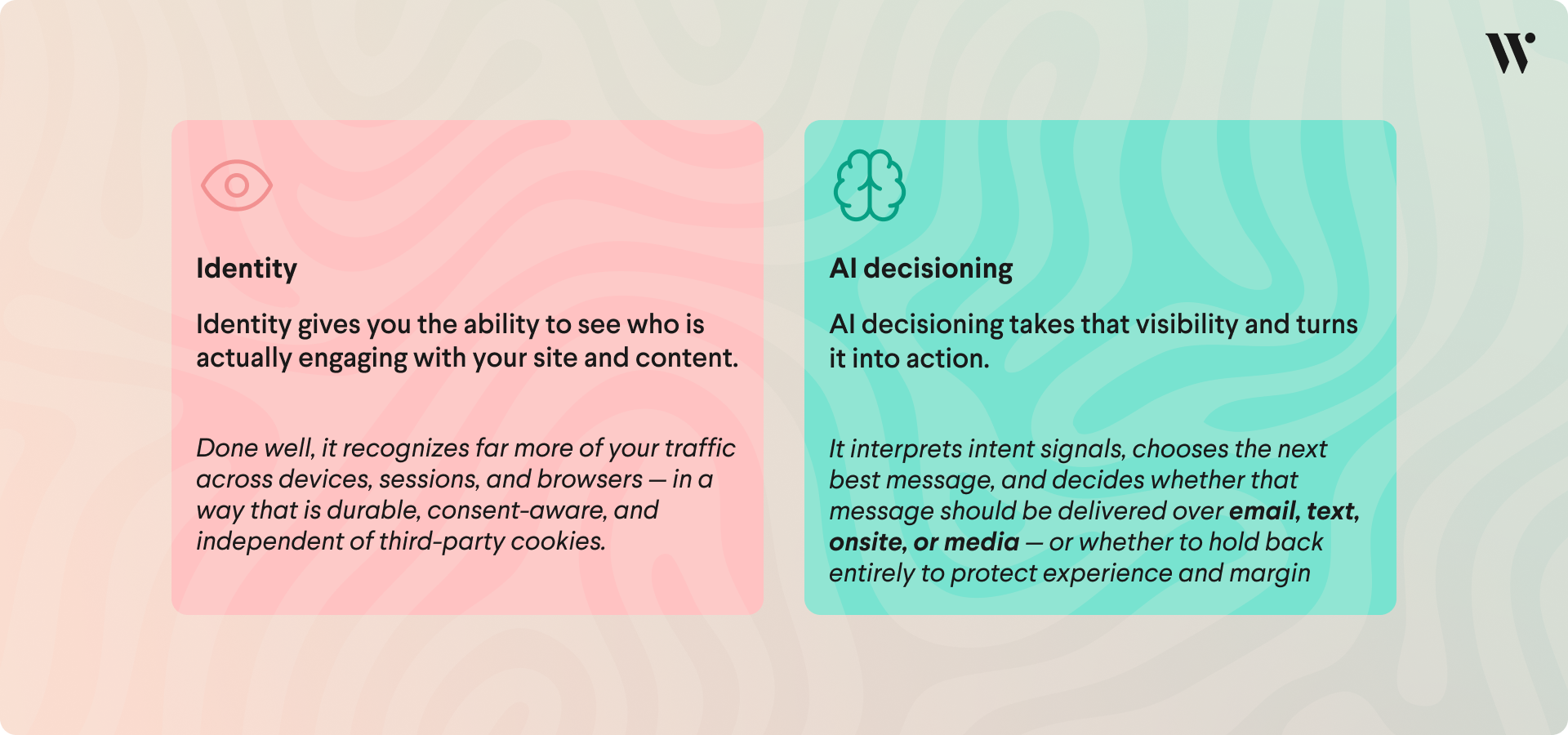
Identity gives you the ability to see who is actually engaging with your site and content. Done well, it recognizes far more of your traffic across devices, sessions, and browsers in a way that is durable, consent-aware, and independent of third-party cookies. AI decisioning then takes that visibility and turns it into action: it interprets intent signals, chooses the next best message, and decides whether that message should be delivered over email, text, onsite, or media — or whether to hold back entirely to protect experience and margin.
For publishers using Braze, that means identity becomes the connective layer between:
- anonymous readership and known Braze profiles
- content consumption and newsletter growth
- registration behavior and subscription conversion
- high-value engagement signals and Braze Canvas entry criteria
- audience understanding and smarter monetization across owned and paid channels
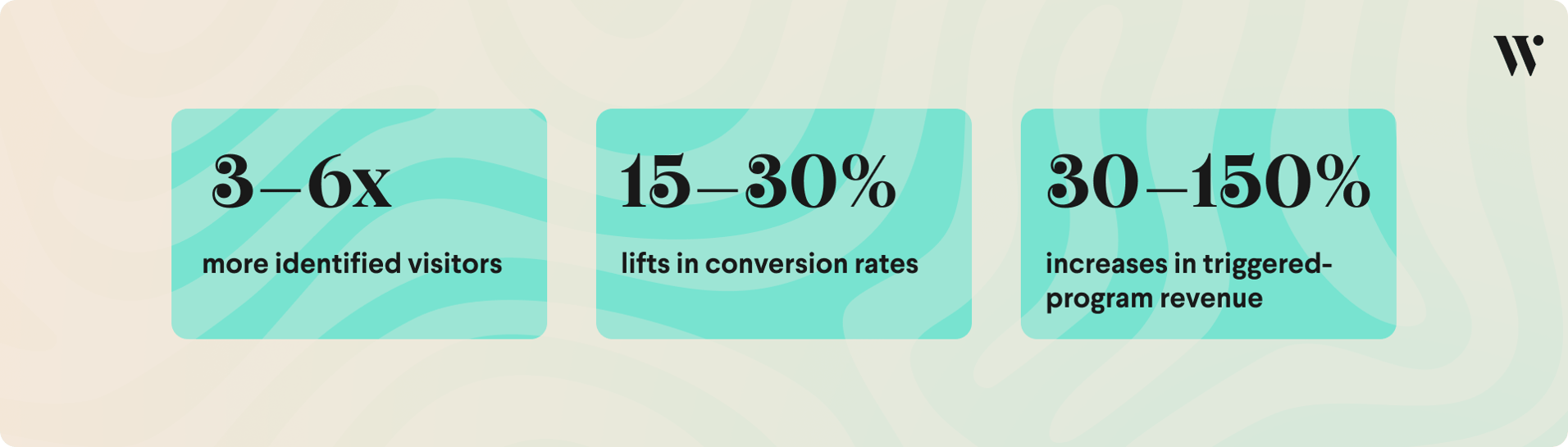
When you pair Braze with a dedicated identity and Signals layer, the calculus changes. Braze stays the system of record for profiles, Canvas logic, content, and send. Wunderkind increases who is eligible, when they qualify, and what context arrives with each trigger. Across brands that have paired their engagement platform with a neutral identity and AI layer, Wunderkind has seen 3–6x more identified visitors, 15–30% lifts in conversion rates, and 30–150% increases in triggered-program revenue — not by inventing new channels, but by enabling existing ones to reach the audience they were built for.
For publishers, the implication is straightforward: the better identity feeds Braze, the more valuable Braze becomes as an engine for reader lifecycle growth.
What Great Identity Looks Like for Braze-Powered Publishers
Strip away vendor language and a strong identity program in 2026 has a few recognizable characteristics.
1. Coverage: Seeing Beyond the Logged-In Few
Instead of recognizing only the small subset of visitors who log in, click from an email, or accept a simple cookie, you can reliably recognize three to six times more visitors than an ESP alone — across devices and sessions.
For publishers, that means more of your anonymous but high-intent audience can become addressable inside Braze: repeat readers, prospective subscribers, loyal but unauthenticated visitors, and readers with clear content affinity who would otherwise remain invisible.
That expanded reach is the raw fuel for every Braze Canvas and campaign that sits on top.
2. Confidence: Making Decisions You Can Automate
Strong identity is persistent and precise enough that you are comfortable automating real business decisions on top of it — without manual approval each time.
For publishers, that can mean triggering:
- registration nudges
- newsletter onboarding
- subscription conversion journeys
- churn-risk messaging
- recirculation prompts
- paid media suppression
- premium-content engagement follow-ups
You’re no longer asking, “Is this really the same reader?” every time you look at cross-device behavior.

3. Context: Understanding Why Someone Is Acting
Recognition does not stop at “this is the same person.” It threads together the depth of browsing sessions, content categories or verticals a reader gravitates toward, recency and frequency of visits, conversion behaviors, and lifecycle stage.
That context is the difference between sending a generic “subscribe now” message and launching a Braze journey that reflects what a reader is actually trying to do.
4. It Is Privacy-First by Design
Modern identity is not an excuse to reconstruct third-party tracking by other means. The most effective approaches use cookie-free, server-side methods wherever possible, prioritize clear and meaningful consent, and align with frameworks like GDPR and CCPA.
Wunderkind’s innovations such as PrivacyID exist specifically to keep match rates high while respecting the direction regulators, platforms, and consumers are moving.
For publishers, that matters doubly. Trust is not just a compliance requirement. It is part of the product.
5. It Is Connected
Identity is not a dark corner of the stack that only analytics or engineering can see. It should operate as a live, neutral layer that feeds Braze, onsite experiences, registration and subscription programs, ad platforms, and analytics views.
That connectivity is what allows identity to function as infrastructure, not another silo.
How Identity Makes Braze More Powerful for Publishers
For advanced publishers, the most compelling thing about identity in 2026 is not a brand-new channel. It’s the way your existing channels behave once they’re no longer operating in the dark.
Email, Push, and Messaging in Braze: From Lists to Reader Systems
Most publishers still think about lifecycle messaging performance as a function of content quality, subject lines, and send cadence. Those things matter. But the bigger constraint is often who is eligible to receive those messages in the first place.
Without an independent identity layer, your engagement platform will typically recognize only a minority of your daily traffic — often somewhere around 30% of visitors. Everyone else can arrive, read, browse, and leave without ever entering a relevant Canvas. When you pair Braze with a dedicated identity and Signals layer, the calculus changes. For publishers, that can mean more intelligent Braze activation around:
- newsletter signup and onboarding
- registration completion
- article and topic follow-up
- subscriber conversion nudges
- churn-risk and retention journeys
- loyalty and recirculation programs
- app or browser messaging tied to real readership behavior
Braze becomes more effective not because the platform itself changed, but because it is finally seeing more of the audience it is meant to orchestrate.
Onsite Experience and Braze: Capture + Journey Entry as One System
Many publishers still treat onsite prompts as disconnected tactics: deploy a newsletter box, present a registration wall, offer a subscription discount, and hope conversion rates improve. In an identity-first world, onsite experience and capture become part of a larger performance system. When more readers are recognized in real time, you can adapt experiences based on whether someone is known or unknown, where they are in their consideration, and how they have interacted with your content before.
Those same identity-enriched profiles then flow into Braze as addressable audiences and event streams — so your onsite experience, your list growth, and your triggered journeys reinforce one another rather than compete. For publishers, this is where the Braze story gets materially stronger. Identity does not just help you “see” more readers. It helps turn more of those readers into usable Braze profiles, better Canvas entrants, richer audience segments, and more timely lifecycle triggers.
Paid Media and Meta: Paying Once for Each Conversion
The identity story in paid media is as much about efficiency as it is about reach. Rising acquisition costs mean publishers can no longer afford to pay for traffic that owned channels could have converted more cheaply and more contextually. When identity connects your owned-channel programs to platforms like Meta and your Braze audiences, several things become possible:
- you can suppress people who are already in high-performing Braze email or message flows before paying to re-acquire them
- you can build lookalike and prospecting audiences from richer, identity-resolved profiles instead of generic pixel events
Early adopters of identity-powered Meta campaigns are already seeing double-digit reductions in cost per purchase once they stop bidding against their own triggered journeys for the same conversions. For publishers, the equivalent opportunity is clearer audience acquisition economics — and better coordination between paid acquisition and Braze-powered owned journeys.
Braze for Publishers: Intelligence Without Replatforming
One of the most important lessons of the last few years is that you do not need to rip out Braze to modernize your audience strategy. You need to complement it. Braze remains excellent at managing flows, campaigns, and reporting once a user is known. What it relies on — by design — is the quality of the data sent into it. It is not meant to operate as a global identity network or an independent real-time decision engine on its own.
When you add an external identity and AI layer alongside Braze, three things change:
- Visibility. Braze can see a much larger share of your audience because more traffic is resolved into profiles Braze can address — often 3–6x more than identity-light setups.
- Signals. Braze receives richer behavioral context in each Canvas entry payload — for publishers, that can include content affinity, registration behavior, subscription propensity, recency, loyalty patterns, and monetization-relevant actions.
- Maturity. You can move up the triggered-messaging maturity curve, where identity and AI together help choose timing, channel, and content — not just fixed rules keyed to narrow events.
You preserve your team’s existing Braze workflows and reporting structures. What changes is what the system can see — and what it can act on.