




Wunderkind Inside Your Braze Journeys
The Identity Wake-Up Call
Marketers didn’t suddenly forget how to build good programs. The environment changed under them. Third-party cookies, once treated as a universal connector, no longer behave like dependable infrastructure. Browser and OS-level changes have made them fragile at best, irrelevant at worst. At the same time, consumers now move fluidly between phones, laptops, tablets, and in-store touchpoints. The same shopper appears as a trail of disconnected “people” scattered across your analytics, Braze workspace, ESP, and ad platforms. Layer on a much stricter privacy and consent landscape. What used to be shrugged off as “tracking” now comes with real reputational and regulatory risk. Brands are forced to choose: keep doing what’s easy and slowly lose signal, or rethink how they recognize and engage customers altogether.
Braze has not become obsolete—in fact, the opposite is true. Braze remains a leading customer engagement platform, built to ingest and process customer data in real time, orchestrate and optimize cross-channel campaigns, and continuously evolve engagement strategies. It is still excellent at what it was designed to do: orchestrate campaigns, journeys, and reporting for people it knows. By design, though, Braze and other orchestration platforms only act on the data they receive. They were never meant to serve as independent identity networks or to reconstruct a shopper’s full cross-session, cross-device story on their own. When that foundational identity layer is thin, even the most elaborate Canvas flows are running on a small slice of your true audience.
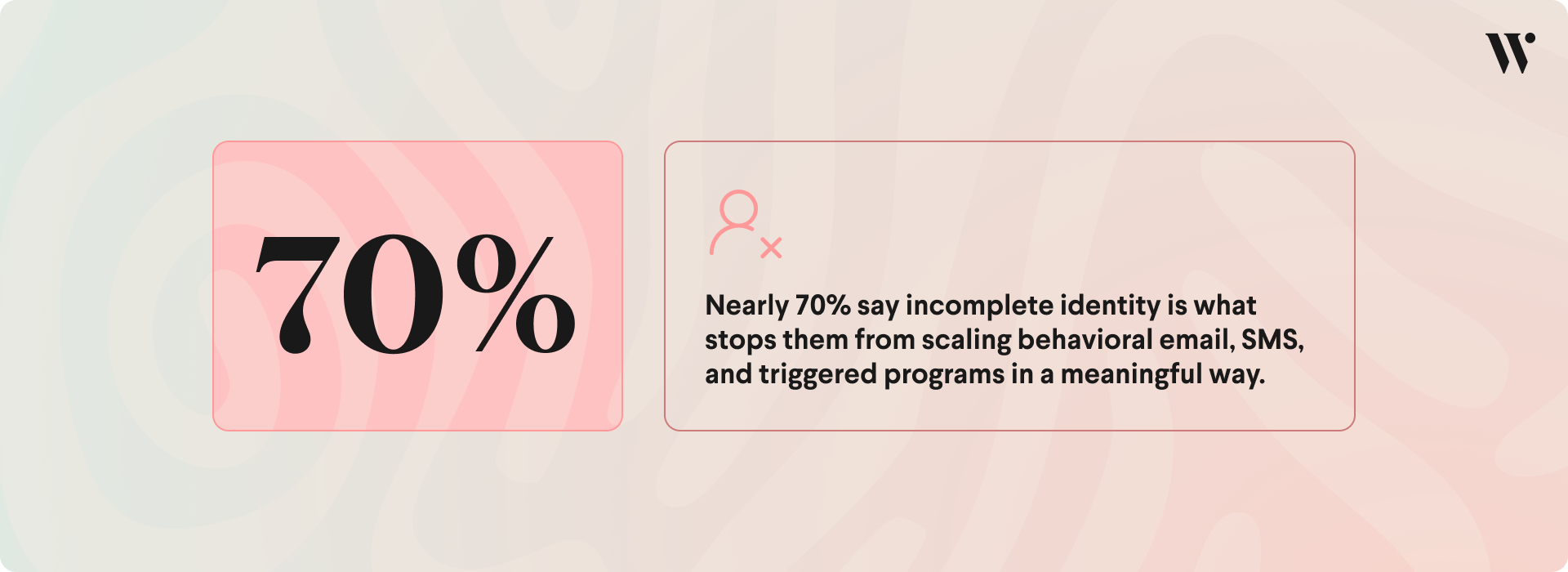
Independent research from Forrester has captured this tension clearly: marketers overwhelmingly see identity resolution as a key driver of growth, efficiency, and customer satisfaction—but fewer than a quarter feel confident their programs have the depth, accuracy, persistence, and scale required for modern, multi-device journeys. Nearly 70% say incomplete identity is what stops them from scaling behavioral email, SMS, and triggered programs in a meaningful way. The uncomfortable but helpful conclusion: if identity is shallow, your personalization is shallow—no matter how advanced Braze and the rest of your stack look on paper.
From Match Rates to Marketing Intelligence
For years, identity conversations revolved around match rates. Could a partner recognize 20% of your traffic? Thirty? Forty? The metric mattered, but the conversation was narrow.
In 2026, the lens is wider. The question is no longer just:
“How many visitors can you identify?”
It’s also:
“What can your marketing system intelligently do once it recognizes them?”
At Wunderkind, we describe the relationship this way: identity is the eyes; AI decisioning is the brain.
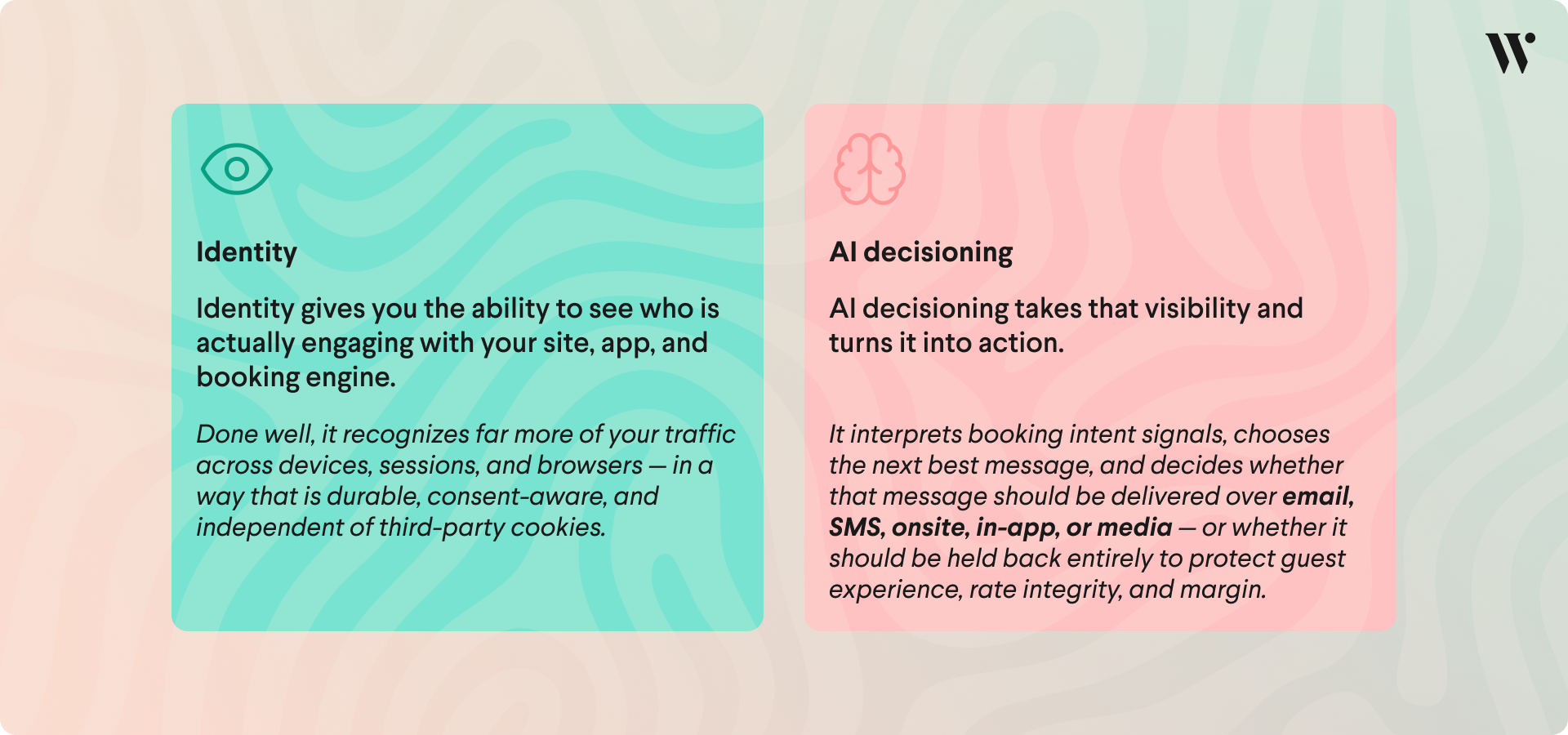
Identity gives you the ability to see who is actually engaging with your site and channels. Done well, it recognizes far more of your traffic across devices, sessions, and browsers—in a way that is durable, consent-aware, and independent of third-party cookies. AI decisioning then takes that visibility and turns it into action: it interprets intent signals, chooses the next best message, and decides whether that message should be delivered over email, text, onsite, or media—or whether to hold back entirely to protect experience and margin.
Wunderkind’s identity network now recognizes over 9 billion consumer devices and 1 billion consumer profiles, built on first-party and observed behavioral data rather than rented third-party lists. That scale isn’t a vanity statistic; it’s what makes it possible to turn anonymous sessions into reachable, permissioned profiles that Braze, your SMS provider, and your ad platforms can act on confidently.
When you put this high-fidelity identity graph beneath an agentic AI decisioning engine and connect it directly into Braze Canvas, you move from static campaigns to something closer to a responsive nervous system. Journeys stop behaving like brittle flows that assume a linear path, and start behaving like dynamic systems that adapt to what individual customers are doing—in the moment, on any device.
What “Great Identity” Looks Like in 2026
Strip away vendor language and a strong identity program in 2026 has a few recognizable characteristics.

Coverage: seeing beyond the logged-in few
Instead of recognizing only the small subset of visitors who log in, click from an email, or accept a basic cookie, you can reliably recognize three to six times more visitors than an ESP or engagement platform alone—across devices and sessions. That expanded reach is the raw fuel for every Braze Canvas and campaign that sits on top.
Confidence: making decisions you can automate
Identity is precise and persistent enough that you are comfortable automating real business decisions on top of it: triggering one-to-one emails, texts, onsite experiences, and media campaigns without manual approval for each case. You’re no longer wondering, “Is this really the same person?” every time you look at a cross-device journey.
Context: understanding why someone is acting
Recognition doesn’t stop at “this is Jane on mobile and desktop.” It threads together the depth of her browsing sessions, the categories she gravitates toward, the carts she builds and abandons, the price changes and inventory movements she has reacted to in the past, and the stage of the lifecycle she’s in right now. That context becomes the difference between sending yet another generic promotion and sending a message that genuinely reflects intent.
Privacy-first by design
Modern identity is not an excuse to reconstruct third-party tracking by other means. The most effective programs use cookie-free, server-side methods wherever possible, prioritize clear and meaningful consent, and align with frameworks like GDPR and CCPA. Wunderkind’s innovations such as PrivacyID exist specifically to keep match rates high while respecting the direction regulators, platforms, and consumers are moving.
Connected to Braze and the rest of your stack
Identity is not a dark corner of your stack that only analytics or data engineering can see. It is a live, neutral layer that feeds Braze, your onsite experiences and capture programs, your ad platforms such as Meta, and your analytics and attribution views. That connectivity is what allows identity to function as infrastructure, not another silo.
How Identity Transforms the Channels You Already Run
For advanced marketers, the most compelling thing about identity in 2026 is not a brand-new channel. It’s the way existing channels behave once they are no longer operating in the dark.
Email and SMS in Braze: from lists to living systems
Most brands still treat email and SMS performance as a function of creative quality and cadence. Those things matter. But for many teams, the bigger constraint is simply who is eligible to receive those messages in the first place.

Without an independent identity layer, your engagement platform will typically recognize only a minority of your daily traffic—often somewhere around 30% of visitors. Everyone else can browse, compare, add to cart, and leave without ever entering any Canvas.
When you pair Braze with a dedicated identity and Signals layer, the calculus changes. Behavioral email stops being a “nice-to-have” retention tactic and becomes one of the most efficient performance channels in your stack, routinely driving a double-digit share of total digital revenue.
In practice, that looks like:
- Cart, product, and category abandonment journeys in Braze Canvas that are fed by Wunderkind Signals instead of (or in addition to) simple view-based triggers.
- Back-in-stock, price-drop, and low-inventory alerts that automatically target the right users because they are anchored to a richer identity graph, not just a last-clicked product.
The same shift plays out in text. When Wunderkind’s identity and Signals flow into Braze, SMS evolves from a blunt, high-pressure broadcast tool into a tightly coordinated urgency layer—reserved for moments that genuinely warrant a tap on the shoulder, like low stock on a highly viewed item or an expiring promotion on a high-value cart.
Across brands that have paired their ESP or engagement platform with a neutral identity and AI layer, we’ve seen three to six times more identified visitors, 15–30% lifts in conversion rates, and 30–150% increases in triggered-program revenue—not by inventing new channels, but by letting existing ones reach the audience they were designed for.
Braze remains the system of record for profiles, Canvas logic, content, and send. Wunderkind quietly increases who is eligible, when they qualify, and what context arrives with each trigger.
Onsite: capture and experience as part of the same system
Identity also changes how you think about your own website.
Many marketers still treat onsite capture as a disconnected tactic: deploy a popup, offer a discount, hope the list grows. In an identity-first world, onsite experience and capture become part of a larger performance system.
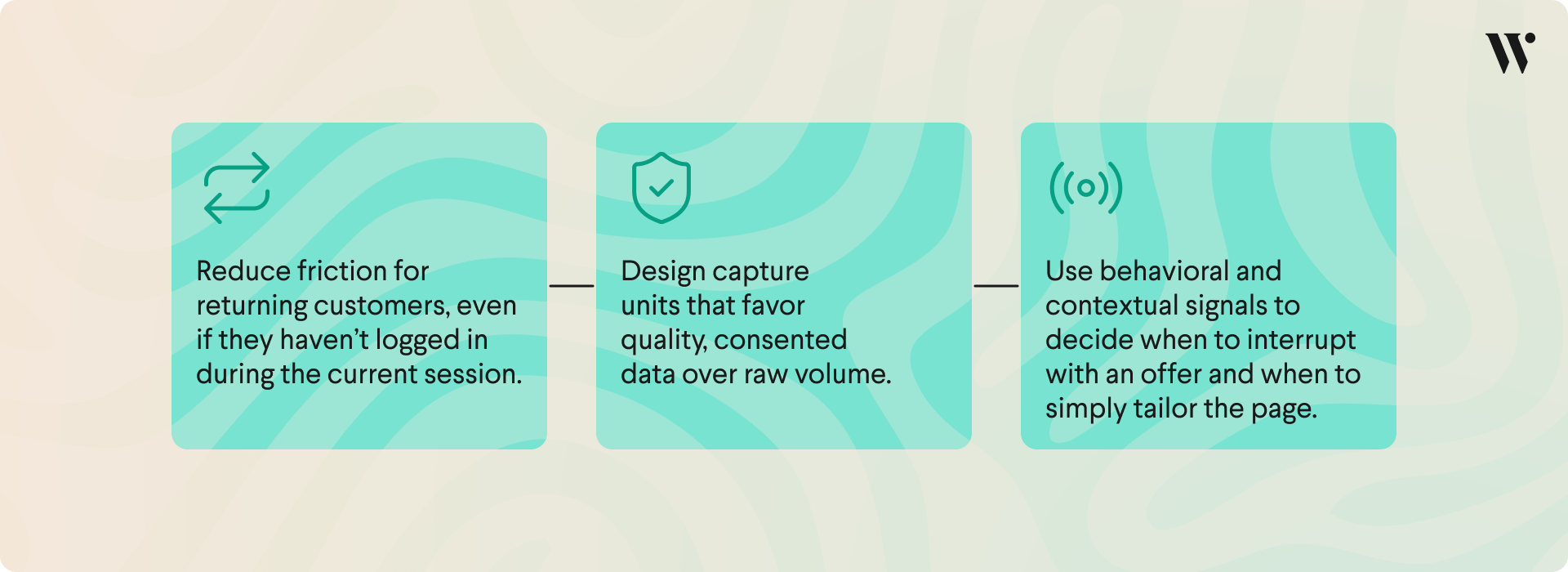
When more visitors are recognized in real time, you can adapt experiences based on whether someone is known or unknown, where they are in their consideration, and how they have interacted with your brand before. Instead of treating every new visitor as a stranger, you can reduce friction for returning customers, design capture units that favor quality, consented data over raw volume, and use behavioral and contextual signals to decide when to interrupt with an offer versus when to simply tailor the page.
Those same identity-enriched profiles then flow into Braze as addressable audiences and event streams—so your onsite experience, your list growth, and your triggered journeys all reinforce one another rather than competing.
Paid media: paying once for each conversion
The identity story in paid media is as much about efficiency as it is about reach. Rising CPMs mean you can no longer afford to pay for impressions that your owned channels could have converted more cheaply and more contextually.
When identity connects your owned-channel programs to platforms like Meta and your Braze audiences, several things become possible:
- You can automatically suppress people who are already in high-performing Braze email or SMS flows, letting those channels convert first before you invest in paid impressions.
- You can build lookalike and prospecting audiences not from generic pixel events, but from rich, identity-resolved profiles that reflect real behavior and value.
Early adopters of identity-powered Meta campaigns are already seeing double-digit reductions in cost per purchase once they stop bidding against their own triggered journeys for the same conversions. Media turns from a blunt instrument into an extension of the same intelligence that powers your Braze Canvases.
Braze (and other orchestration platforms): intelligence without replatforming
One of the most important lessons of the last few years is that you do not need to rip out Braze to modernize your marketing. You need to complement it.
Klaviyo, Salesforce Marketing Cloud, and Braze itself remain excellent at managing flows, campaigns, and reporting once a user is known. What they rely on—by design—is the quality of the data sent into them. They are not meant to operate as global identity networks or independent real-time decision engines.
When you add an external identity and AI layer alongside Braze, three things change:
- Visibility. Braze can see a much larger share of your audience because more traffic is resolved into profiles Braze can address—often 3–6x more than identity-light setups.
- Signals. Braze receives richer behavioral context—cart contents, category interest, price and inventory changes, and lifecycle stage—in each Canvas entry payload.
- Maturity. You can move up the triggered-messaging maturity curve, where identity and AI together choose timing, channel, and content—not just pre-set rules keyed to a narrow set of events.
You preserve your team’s existing Braze workflows and reporting structures. What changes is what the system can see—and what it can act on.
Where Identity Goes Next
Across the 2024 Identity Playbook, the 2026 Tech Stack Guide, and our latest performance marketing research, a clear pattern has emerged: orchestration still matters, but orchestration alone is no longer enough.
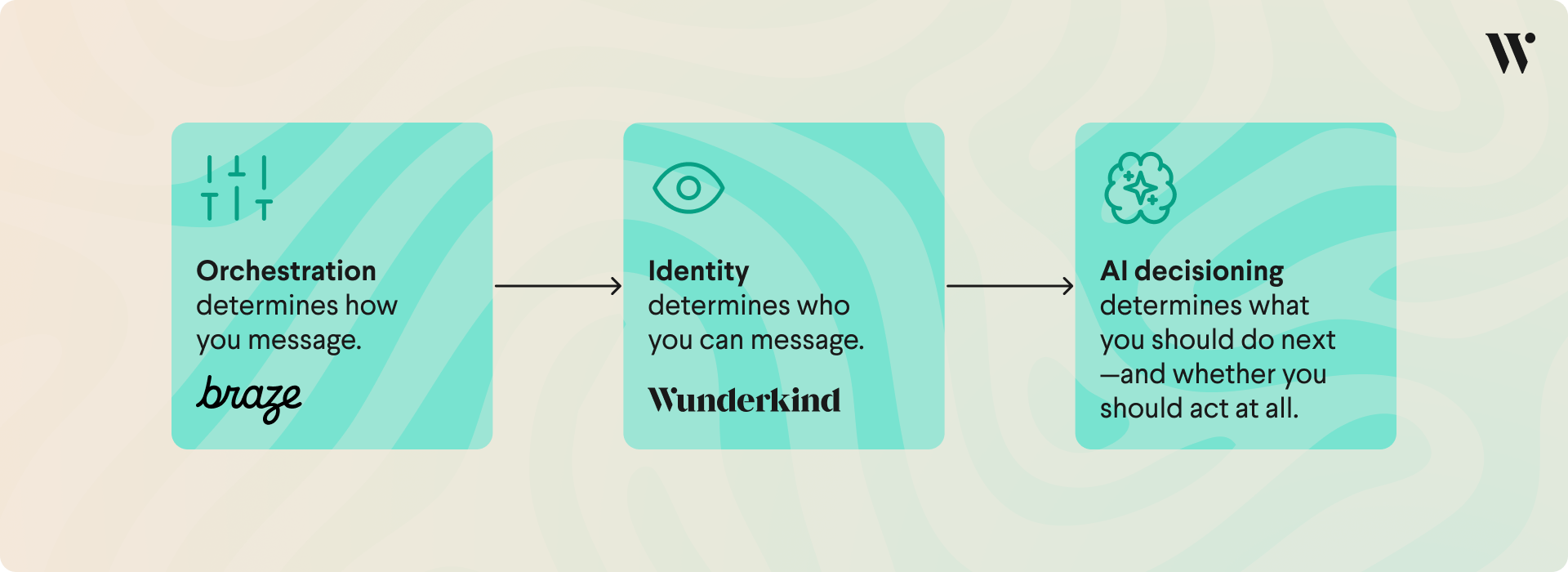
The brands pulling ahead are the ones that treat:
- Orchestration (Braze) as the how: how you sequence, route, and measure messages.
- Identity (Wunderkind) as the who: who you can legitimately recognize and reach.
- AI decisioning as the what and whether: what you should do next—and whether you should act at all.
In that world, channels become interchangeable parts. Email, SMS, onsite, and media are no longer separate teams waging attribution wars. They are simply different surfaces through which the same identity and intelligence can express itself.
For Braze customers, the question in 2026 is not whether identity matters. That debate is over. The real questions are:
- How quickly can you treat identity as the backbone of your Braze strategy?
- How long are you willing to let anonymous, high-intent traffic walk away unseen?
Because the revenue you’re missing is rarely hiding in a new channel. It’s hiding in plain sight, in the visitors your current stack simply does not recognize yet—and in the Braze journeys that are waiting to be fueled by better identity and smarter Signals.